



 Chat with AI
Exam 7: Nontariff Barriers and Arguments for Protection

Exam 1: An Introduction to International Trade36 Questions
Exam 2: Tools of Analysis for International Trade Models48 Questions
Exam 3: The Classical Model of International Trade51 Questions
Exam 4: The Heckscher-Ohlin Model46 Questions
Exam 5: Tests of Trade Models: the Leontief Paradox and Its Aftermath46 Questions
Exam 6: Tariffs46 Questions
Exam 7: Nontariff Barriers and Arguments for Protection48 Questions
Exam 8: Commercial Policy: History and Practice50 Questions
Exam 9: Preferential Trade Agreements48 Questions
Exam 10: International Trade and Economic Growth47 Questions
Exam 11: The Balance of Payments48 Questions
Exam 12: The Foreign Exchange Market50 Questions
Exam 13: International Monetary Systems42 Questions
Exam 14: Exchange Rates in the Short Run46 Questions
Exam 15: Exchange Rates in the Long Run49 Questions
Exam 16: Theories of the Current Account Balance47 Questions
Exam 17: Open Economy Macroeconomics44 Questions
Exam 18: International Banking, debt and Risk44 Questions
Select questions type


If the pollution havens hypothesis is true,we should expect world pollution to decline as a result of international trade and globalization.
(True/False)
4.9/5  (67)
(67) Answer the question(s)below based on the following diagram.
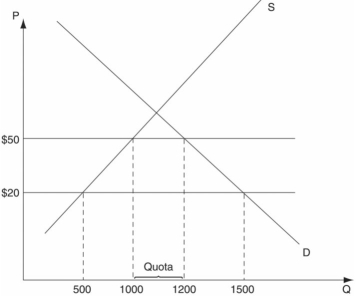 -Refer to the figure above.If this were a voluntary restraint agreement,the welfare costs to the importing country would be
 (Multiple Choice)
4.9/5 (88)
(88) Explain why each of the following is not a valid argument for protection.
(a) patriotism
(b) fair play (e.g.level international playing fields)
(c) preservation of jobs
(Essay)
4.9/5 (82)
(82) Voluntary export restraints and quotas are essentially identical in their welfare effects.
(True/False)
4.8/5 (90)
(90) Why do countries impose protection even if it lowers economic welfare? Explain fully.
(Essay)
4.8/5 (84)
(84) The argument that developing countries with lax environmental standards will attract foreign manufacturers who want to escape stricter standards in their own countries is known as the pollution havens hypothesis.
(True/False)
4.9/5 (67)
(67) The most commonly expressed arguments for protection tend to be largely invalid.
(True/False)
4.8/5 (88)
(88) Which of the following is true (assume the small country case)?
(Multiple Choice)
4.8/5 (93)
(93) Export subsidies lead to lower prices of exportables for both domestic residents and foreigners.
(True/False)
4.8/5 (65)
(65) Quotas that entirely eliminate trade in a certain product or a number of products are known as
(Multiple Choice)
4.7/5 (79)
(79) The argument that developing countries should nurture their domestic industries by protecting them from foreign competition is known as
(Multiple Choice)
4.9/5 (80)
(80) Answer the question(s)below based on the following diagram.
-Refer to the figure above.The quota restricts trade by the same amount as a tariff of
-Refer to the figure above.The quota restricts trade by the same amount as a tariff of (Multiple Choice)
4.8/5 (89)
(89) A less costly alternative to protection of national defense industries would be a production subsidy.
(True/False)
4.7/5 (96)
(96) Answer the question(s)below based on the following diagram.
-Refer to the figure above.If the government was to auction quota licenses competitively,it could earn up to
-Refer to the figure above.If the government was to auction quota licenses competitively,it could earn up to (Multiple Choice)
4.9/5 (67)
(67) ________ are quotas that lead to a complete elimination of trade.
(Multiple Choice)
4.8/5 (56)
(56) In the case of national defense protection,________ is a better policy than protection.
(Multiple Choice)
4.9/5 (84)
(84) ________ countries tend to depend on tariffs for a relatively large part of their government revenue.
(Multiple Choice)
4.8/5 (73)
(73) 
Filters
- Essay(0)
- Multiple Choice(0)
- Short Answer(0)
- True False(0)
- Matching(0)