



 Chat with AI
Exam 16: Fiscal Policy

Exam 1: Getting Started350 Questions
Exam 2: The Usand Global Economies199 Questions
Exam 3: The Economic Problem271 Questions
Exam 4: Demand and Supply317 Questions
Exam 5: Gdp: a Measure of Total Production and Income254 Questions
Exam 6: Jobs and Unemployment343 Questions
Exam 7: The Cpi and the Cost of Living265 Questions
Exam 8: Potential Gdp and the Natural Unemployment Rate207 Questions
Exam 9: Economic Growth267 Questions
Exam 10: Finance, Saving, and Investment269 Questions
Exam 11: The Monetary System361 Questions
Exam 12: Money, Interest, and Inflation261 Questions
Exam 13: Aggregate Supply and Aggregate Demand272 Questions
Exam 14: Aggregate Expenditure Multiplier311 Questions
Exam 15: The Short-Run Policy Tradeoff208 Questions
Exam 16: Fiscal Policy203 Questions
Exam 17: Monetary Policy188 Questions
Exam 18: International Trade Policy218 Questions
Exam 19: International Finance255 Questions
Select questions type


To eliminate an inflationary gap using fiscal policy, the government could
(Multiple Choice)
4.8/5  (79)
(79) 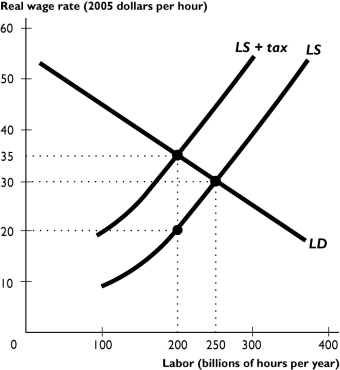 The figure above shows a labor market with an income tax.
-In the figure above, the tax wedge is equal ________ per hour, the after-tax real wage rate is equal to ________, and the before-tax real wage rate is equal to ________.
The figure above shows a labor market with an income tax.
-In the figure above, the tax wedge is equal ________ per hour, the after-tax real wage rate is equal to ________, and the before-tax real wage rate is equal to ________. (Multiple Choice)
4.8/5 (95)
(95) In 2009, Congress passed tax laws to reduce income tax rates for some taxpayers.This action is called
(Multiple Choice)
4.9/5 (82)
(82) When comparing a $100 billion increase in government expenditure to a $100 billion decrease in tax revenue, the effect of the increase in government expenditure on aggregate demand is
(Multiple Choice)
4.7/5 (75)
(75) An income tax cut ________ aggregate demand and ________ aggregate supply.
(Multiple Choice)
4.8/5 (98)
(98) If government expenditures on goods and services increases by $20 billion, then aggregate demand
(Multiple Choice)
4.9/5 (78)
(78) 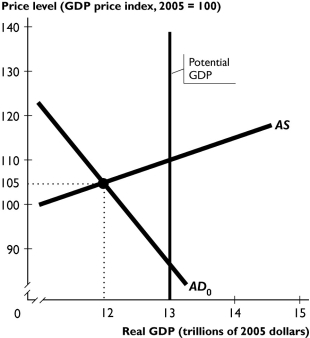 The figure above shows a nation's aggregate demand curve, aggregate supply curve, and potential GDP.
-In the figure above, the ________ gap is one trillion dollars. To close the gap, the government can ________ government expenditure and/or ________ taxes.
The figure above shows a nation's aggregate demand curve, aggregate supply curve, and potential GDP.
-In the figure above, the ________ gap is one trillion dollars. To close the gap, the government can ________ government expenditure and/or ________ taxes. (Multiple Choice)
4.9/5 (73)
(73) 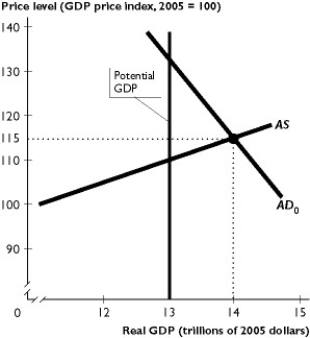 The figure above shows an economy's aggregate demand curve, aggregate supply curve, and potential GDP.
-In the figure above, the ________ gap is one trillion dollars. To close the gap, the government can ________ government expenditure and/or ________ taxes.
The figure above shows an economy's aggregate demand curve, aggregate supply curve, and potential GDP.
-In the figure above, the ________ gap is one trillion dollars. To close the gap, the government can ________ government expenditure and/or ________ taxes. (Multiple Choice)
4.8/5 (81)
(81) What are law-making lags?
What effect do they have on the use of discretionary fiscal policy?
(Essay)
4.9/5 (85)
(85) Mainstream economists believe that Keynesian economist overstate the effect of the multiplier effect.Which of the following statements would a mainstream economists NOT consider to be accurate.
(Multiple Choice)
4.8/5 (81)
(81) In order to reduce inflationary pressure on the economy, what fiscal policy can the government use?
(Multiple Choice)
4.9/5 (74)
(74) During a recession, unemployment compensation payments increase without the need for any government action.This increase is an example of
(Multiple Choice)
4.9/5 (80)
(80) The last U.S.president to be in office when the government had a budget surplus was
(Multiple Choice)
4.9/5 (82)
(82) The balanced budget multiplier is based on the point that the ________ multiplier is larger than the ________ multiplier so that an equal increase in government expenditure and taxes ________ aggregate demand.
(Multiple Choice)
4.7/5 (80)
(80)  The figure above shows an economy aggregate demand curve and aggregate supply curves.
-Suppose the shift from AD₀ to AD₁ and from AS₀ to AS₁ is the result of fiscal policy.Which of the policies below could lead to these shifts?
i. An increase in government expenditure
ii. A tax cut
iii. A decrease in government expenditure
iv. A tax hike
The figure above shows an economy aggregate demand curve and aggregate supply curves.
-Suppose the shift from AD₀ to AD₁ and from AS₀ to AS₁ is the result of fiscal policy.Which of the policies below could lead to these shifts?
i. An increase in government expenditure
ii. A tax cut
iii. A decrease in government expenditure
iv. A tax hike (Multiple Choice)
4.8/5 (72)
(72) Ignoring any supply-side effects, how does the magnitude of the government expenditure multiplier compare to the magnitude of the tax multiplier?
Explain your answer.
(Essay)
4.8/5 (87)
(87) An increase in taxes on labor income shifts the labor supply curve ________ and the ________.
(Multiple Choice)
4.7/5 (73)
(73) Looking at the supply-side effects on aggregate supply shows that a tax hike on labor income
(Multiple Choice)
4.9/5 (92)
(92) 
Filters
- Essay(0)
- Multiple Choice(0)
- Short Answer(0)
- True False(0)
- Matching(0)