



 Chat with AI
Exam 16: Fiscal Policy

Exam 1: Getting Started350 Questions
Exam 2: The Usand Global Economies199 Questions
Exam 3: The Economic Problem271 Questions
Exam 4: Demand and Supply317 Questions
Exam 5: Gdp: a Measure of Total Production and Income254 Questions
Exam 6: Jobs and Unemployment343 Questions
Exam 7: The Cpi and the Cost of Living265 Questions
Exam 8: Potential Gdp and the Natural Unemployment Rate207 Questions
Exam 9: Economic Growth267 Questions
Exam 10: Finance, Saving, and Investment269 Questions
Exam 11: The Monetary System361 Questions
Exam 12: Money, Interest, and Inflation261 Questions
Exam 13: Aggregate Supply and Aggregate Demand272 Questions
Exam 14: Aggregate Expenditure Multiplier311 Questions
Exam 15: The Short-Run Policy Tradeoff208 Questions
Exam 16: Fiscal Policy203 Questions
Exam 17: Monetary Policy188 Questions
Exam 18: International Trade Policy218 Questions
Exam 19: International Finance255 Questions
Select questions type


If the government raises taxes on labor income and interest income, explain how potential GDP and economic growth are affected.
(Essay)
4.8/5  (87)
(87) A country reports that its government outlays total $0.8 trillion and its tax revenues total $0.6 trillion.Does the country have a budget surplus or deficit and what is the surplus or deficit?
(Essay)
4.8/5 (75)
(75) The law-making time lag is best described as the time that it takes
(Multiple Choice)
4.8/5 (69)
(69) Ignoring any supply-side effects, if government expenditure on goods and services decrease by $10 billion and taxes decrease by $10 billion, then real GDP ________ and the price level ________.
(Multiple Choice)
4.8/5 (85)
(85) Why is increased spending on NASA considered a discretionary fiscal policy rather than an automatic fiscal policy?
(Essay)
4.8/5 (91)
(91) Do automatic fiscal stabilizers eliminate business cycles?
(Multiple Choice)
4.9/5 (73)
(73)  -Does the figure above illustrate a recessionary or an inflationary gap?
What do potential GDP and real GDP equal?
What is an appropriate fiscal policy to restore real GDP to potential real GDP?
-Does the figure above illustrate a recessionary or an inflationary gap?
What do potential GDP and real GDP equal?
What is an appropriate fiscal policy to restore real GDP to potential real GDP? (Essay)
4.8/5 (81)
(81) Define the balanced budget multiplier and explain how it works.In your answer, ignore any supply-side effects.
(Essay)
4.8/5 (82)
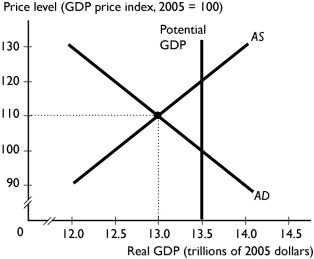
(82)  The figure above shows an economy's aggregate demand curve, aggregate supply curve, and potential GDP.
-In the figure above, the ________ gap is equal to ________.
The figure above shows an economy's aggregate demand curve, aggregate supply curve, and potential GDP.
-In the figure above, the ________ gap is equal to ________. (Multiple Choice)
4.8/5 (69)
(69) Which of the following is an example of a fiscal stimulus?
(Multiple Choice)
4.7/5 (89)
(89) If the economy is in equilibrium with real GDP less than potential GDP, there is ________ gap and a fiscal policy that ________ is appropriate.
(Multiple Choice)
4.8/5 (70)
(70) If the economy is at an above full-employment equilibrium, ________ gap exists and discretionary fiscal policy that ________ will return real GDP to potential GDP.
(Multiple Choice)
4.8/5 (83)
(83) Ignoring any supply-side effects, to close a recessionary gap of $100 billion with a government expenditure multiplier of 5, the government could
(Multiple Choice)
4.8/5 (78)
(78) In order for the United States to use discretionary fiscal policy to deal with a recessionary gap,
(Multiple Choice)
4.8/5 (72)
(72) What are automatic stabilizers?
How do they help stabilize real GDP?
(Essay)
4.9/5 (77)
(77) An economic expansion leads to ________ needs-tested spending and ________ induced taxes.
(Multiple Choice)
4.8/5 (79)
(79) Since 2000, the U.S.government has generally had a government budget ________ and so the national debt has ________.
(Multiple Choice)
4.8/5 (79)
(79) Ignoring any supply-side effects, to close an inflationary gap of $100 billion with a government expenditure multiplier of 5, the government could
(Multiple Choice)
4.9/5 (85)
(85) 
Filters
- Essay(0)
- Multiple Choice(0)
- Short Answer(0)
- True False(0)
- Matching(0)