



 Chat with AI
Exam 12: Money, Interest, and Inflation

Exam 1: Getting Started350 Questions
Exam 2: The Usand Global Economies199 Questions
Exam 3: The Economic Problem271 Questions
Exam 4: Demand and Supply317 Questions
Exam 5: Gdp: a Measure of Total Production and Income254 Questions
Exam 6: Jobs and Unemployment343 Questions
Exam 7: The Cpi and the Cost of Living265 Questions
Exam 8: Potential Gdp and the Natural Unemployment Rate207 Questions
Exam 9: Economic Growth267 Questions
Exam 10: Finance, Saving, and Investment269 Questions
Exam 11: The Monetary System361 Questions
Exam 12: Money, Interest, and Inflation261 Questions
Exam 13: Aggregate Supply and Aggregate Demand272 Questions
Exam 14: Aggregate Expenditure Multiplier311 Questions
Exam 15: The Short-Run Policy Tradeoff208 Questions
Exam 16: Fiscal Policy203 Questions
Exam 17: Monetary Policy188 Questions
Exam 18: International Trade Policy218 Questions
Exam 19: International Finance255 Questions
Select questions type


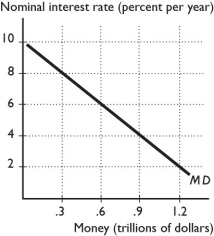 -The above diagram has a demand for money curve.Suppose the Fed initially sets the quantity of money equal to $0.6 trillion.Draw the supply of money curve in the figure.What is the equilibrium interest rate?
Now suppose the Fed increases the quantity of money to $0.9 trillion.Draw the new supply curve.What is the new equilibrium interest rate?
-The above diagram has a demand for money curve.Suppose the Fed initially sets the quantity of money equal to $0.6 trillion.Draw the supply of money curve in the figure.What is the equilibrium interest rate?
Now suppose the Fed increases the quantity of money to $0.9 trillion.Draw the new supply curve.What is the new equilibrium interest rate? (Essay)
4.8/5  (91)
(91) In the long run, if the quantity of money supplied ________ the quantity demanded, the value of money ________.
(Multiple Choice)
4.9/5 (79)
(79) When real GDP increases, the demand for money ________ and the demand for money curve ________.
(Multiple Choice)
4.8/5 (86)
(86) In 2009, the interest rate fell below 1 percent in the United States.As a result, there was a
(Multiple Choice)
4.8/5 (80)
(80) Nominal interest rate (percent per year) Quantity of (trillions of demanded Quantity of money supplied (trillions of dollars) 5 2.9 2.5 6 2.8 2.5 7 2.7 2.5 8 2.6 2.5 9 2.5 2.5 10 2.4 2.5
-The above table has the demand and supply schedules for money.What is the equilibrium nominal interest rate?
(Multiple Choice)
4.9/5 (86)
(86) If the real interest rate is 8 percent and the inflation rate is 2.5 percent, then the nominal interest rate is
(Multiple Choice)
4.9/5 (93)
(93) The proposition that in the long run when real GDP equals potential GDP, an increase in the quantity of money leads to an equal percentage increase in the price level is the called the quantity theory of
(Multiple Choice)
4.9/5 (77)
(77) 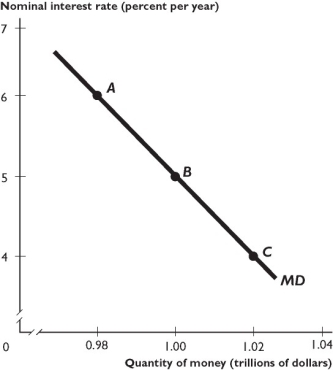 The demand for money curve is in the figure above.
-A movement from point B to point C could be the result of
The demand for money curve is in the figure above.
-A movement from point B to point C could be the result of (Multiple Choice)
4.9/5 (76)
(76) Suppose velocity does not change.Then, in the long run, a growth rate of the quantity of money that exceeds growth in real GDP has what effect?
(Essay)
4.9/5 (74)
(74) A government policymaker suggests "Double the money supply and U.S.citizens' real incomes will double." In the long run, is this policy advice correct?
(Essay)
4.8/5 (74)
(74) George purchased a $10,000 bond that pays a nominal interest rate of 8 percent per year.George's marginal income tax rate is 28 percent.Over the last year, inflation was 3 percent.Find George's before-tax real interest rate and his after-tax real interest rate.
(Essay)
4.9/5 (85)
(85) The demand for money depends on i. real GDP.
Ii) financial technology.
Iii) the price level.
(Multiple Choice)
4.8/5 (90)
(90) If the quantity of money demanded is greater than the quantity supplied, then in the short run the
(Multiple Choice)
4.8/5 (89)
(89) Nominal GDP is $9.6 million dollars, real GDP is $9 million, and velocity is 1.2.The quantity of money is ________ million.
(Multiple Choice)
4.8/5 (78)
(78) 
Filters
- Essay(0)
- Multiple Choice(0)
- Short Answer(0)
- True False(0)
- Matching(0)