



 Chat with AI
Exam 12: Money, Interest, and Inflation

Exam 1: Getting Started350 Questions
Exam 2: The Usand Global Economies199 Questions
Exam 3: The Economic Problem271 Questions
Exam 4: Demand and Supply317 Questions
Exam 5: Gdp: a Measure of Total Production and Income254 Questions
Exam 6: Jobs and Unemployment343 Questions
Exam 7: The Cpi and the Cost of Living265 Questions
Exam 8: Potential Gdp and the Natural Unemployment Rate207 Questions
Exam 9: Economic Growth267 Questions
Exam 10: Finance, Saving, and Investment269 Questions
Exam 11: The Monetary System361 Questions
Exam 12: Money, Interest, and Inflation261 Questions
Exam 13: Aggregate Supply and Aggregate Demand272 Questions
Exam 14: Aggregate Expenditure Multiplier311 Questions
Exam 15: The Short-Run Policy Tradeoff208 Questions
Exam 16: Fiscal Policy203 Questions
Exam 17: Monetary Policy188 Questions
Exam 18: International Trade Policy218 Questions
Exam 19: International Finance255 Questions
Select questions type


Suppose that real GDP grows by 3 percent a year, the quantity of money grows 6 percent a year, and velocity grows by 1 percent.In the long run, the inflation rate equals
(Multiple Choice)
4.9/5  (73)
(73) The speed with which a dollar circulates as people use it to buy a good or service is called
(Multiple Choice)
4.9/5 (84)
(84) The costs of inflation ________ when inflation is more rapid and ________ when inflation is more unpredictable.
(Multiple Choice)
4.7/5 (90)
(90) Suppose nominal GDP is $2,000 a year and the quantity of money is $400.Then the velocity of circulation equals
(Multiple Choice)
4.7/5 (78)
(78) If real GDP grows by 3 percent, the velocity of circulation grows by 4 percent, and the quantity of money grows by 3 percent, then in the long run the inflation rate is
(Multiple Choice)
4.9/5 (93)
(93) When real GDP increases, the demand for money ________ and, as a result, the equilibrium nominal interest rate ________.
(Multiple Choice)
4.8/5 (84)
(84) Suppose the quantity of money and real GDP do not change.If velocity increases, then the
(Multiple Choice)
4.9/5 (85)
(85) 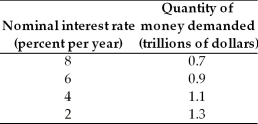 -The above table has the demand for money schedule.
a. If the Fed supplies $1.1 trillion dollars, what is the equilibrium nominal interest rate?
b. Discuss how equilibrium is restored if the interest rate is greater than the equilibrium rate found in part (a).
-The above table has the demand for money schedule.
a. If the Fed supplies $1.1 trillion dollars, what is the equilibrium nominal interest rate?
b. Discuss how equilibrium is restored if the interest rate is greater than the equilibrium rate found in part (a). (Essay)
4.9/5 (90)
(90) Mary has $1,000 and is considering purchasing a $1,000 bond that pays 7 percent interest per year.Mary decides not to buy the bond and holds the $1,000 as cash.If the inflation rate is 4 percent, the opportunity cost of holding the $1,000 as money is
(Multiple Choice)
4.8/5 (81)
(81) If the nominal interest rate is above its equilibrium value, then
(Multiple Choice)
4.9/5 (72)
(72) The ________ the nominal interest rate, the ________ is the quantity of money demanded.
(Multiple Choice)
4.8/5 (65)
(65) If the inflation rate is 3 percent and the real interest rate is 3 percent, then what is the nominal interest rate?
(Essay)
4.8/5 (92)
(92) Inflation is a tax because as the government ________ the quantity of money, the price level ________, and the purchasing power of households' money ________.
(Multiple Choice)
4.8/5 (76)
(76) 
Filters
- Essay(0)
- Multiple Choice(0)
- Short Answer(0)
- True False(0)
- Matching(0)