



 Chat with AI
Exam 16: International Portfolio Theory and Diversification

Exam 1: Globalization and the Multinational Enterprise31 Questions
Exam 2: Financial Goals and Corporate Governance51 Questions
Exam 3: The International Monetary System60 Questions
Exam 4: The Balance of Payments63 Questions
Exam 5: The Foreign Exchange Market60 Questions
Exam 6: International Parity Conditions67 Questions
Exam 7: Foreign Exchange Rate Determination and Forecasting51 Questions
Exam 8: Foreign Currency Derivatives57 Questions
Exam 9: Transaction Exposure56 Questions
Exam 10: Operating Exposure62 Questions
Exam 11: Translation Exposure59 Questions
Exam 12: Global Cost and Availability of Capital62 Questions
Exam 13: Sourcing Equity Capital Globally66 Questions
Exam 14: Financial Structure and International Debt58 Questions
Exam 15: Interest Rate and Currency Swaps63 Questions
Exam 16: International Portfolio Theory and Diversification58 Questions
Exam 17: Foreign Direct Investment Theory and Strategy47 Questions
Exam 18: Political Risk Assessment and Management56 Questions
Exam 19: Multinational Capital Budgeting60 Questions
Exam 20: International Trade Finance55 Questions
Exam 21: Multinational Tax Management52 Questions
Exam 22: Working Capital Management59 Questions
Select questions type


Which of the following is a potential obstacle to international diversification of portfolios?
(Multiple Choice)
4.9/5  (73)
(73) The portfolio with the least risk among all those possible in the domestic portfolio opportunity set is called the minimum risk domestic portfolio.
(True/False)
4.8/5 (84)
(84) Portfolio diversification is beneficial to the investor because it
(Multiple Choice)
4.8/5 (83)
(83) The construction of an internationally diversified portfolio combines
(Multiple Choice)
4.8/5 (75)
(75) Instruction 16.1:
Use the information to answer following question(s).
In September 2002 a U.S. investor chooses to invest $500,000 in German equity securities at a then current spot rate of $1.30/euro. At the end of one year the spot rate is $1.35/euro.
-Refer to Instruction 16.1. How many euros will the U.S. investor acquire with his initial $500,000 investment?
(Multiple Choice)
4.9/5 (71)
(71) Meryl Janicky, a mutual fund manager, is evaluating the recent performance of the shares of Thames Boats International, a publicly traded company in Great Britain. Ms Janicky's firm has $200,000 invested in Thames Boats and she has gathered the information presented in the following table. What was the return on the security in dollars?

(Multiple Choice)
4.9/5 (84)
(84) The correlation of returns of the U.S. equity market index with the indexes of equity markets in seventeen other countries over the period 1977-1996 is between
(Multiple Choice)
4.8/5 (88)
(88) TABLE 16.1
Use the information to answer following question(s).
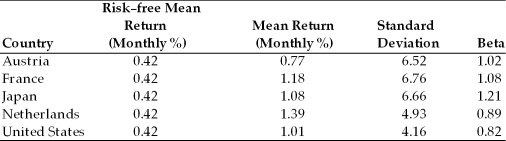 -Refer to Table 16.1. What is the value of the Sharpe Measure for France?
 (Multiple Choice)
4.9/5 (80)
(80) Draw the curve representing the Optimal Domestic Efficient Frontier. Be sure to draw and label the following: The vertical axis and the horizontal axis, the risk-free security, the minimum risk portfolio, the domestic portfolio opportunity set, the optimal domestic portfolio, and the capital market line. Choose a point along the domestic portfolio opportunity set between the optimal domestic portfolio and the minimum risk domestic portfolio and explain why that point is not the optimal risky domestic portfolio for investors to hold.
(Essay)
4.8/5 (81)
(81) The Treynor Measure of portfolio performance calculates the average return of the portfolio above that of the
(Multiple Choice)
4.9/5 (75)
(75) A well-diversified portfolio is only about ________ as risky as the typical individual stock.
(Multiple Choice)
4.8/5 (66)
(66) Instruction 16.1:
Use the information to answer following question(s).
In September 2002 a U.S. investor chooses to invest $500,000 in German equity securities at a then current spot rate of $1.30/euro. At the end of one year the spot rate is $1.35/euro.
-Refer to Instruction 16.1. At an average price of euro 60/share, how many shares of stock will the investor be able to purchase?
(Multiple Choice)
4.9/5 (85)
(85) The Sharpe measure uses ________ as the measure of risk and the Treynor measure uses ________ as the measure of risk.
(Multiple Choice)
5.0/5 (95)
(95) Portfolio theory assumes that investors are risk-averse. This means that investors
(Multiple Choice)
4.7/5 (73)
(73) The Sharpe and Treynor Measures tend to be consistent in their ranking of portfolios when the portfolios
(Multiple Choice)
4.9/5 (94)
(94) Instruction 16.2:
Use the information to answer the following question(s).
A U.S. investor is considering a portfolio consisting of 60% invested in the U.S. equity index fund and 40% invested in the British equity index fund. The expected returns for the funds are 10% for the U.S. and 8% for the British, standard deviations of 20% for the U.S. and 18% for the British, and a correlation coefficient of 0.15 between the U.S. and British equity funds.
-Refer to Instruction 16.2. What is the expected return of the proposed portfolio?
(Multiple Choice)
4.8/5 (70)
(70) 
Filters
- Essay(0)
- Multiple Choice(0)
- Short Answer(0)
- True False(0)
- Matching(0)