



 Chat with AI
Exam 25: Metabolism, Nutrition, and Energetics

Exam 1: An Introduction to Anatomy and Physiology95 Questions
Exam 2: The Chemical Level of Organization183 Questions
Exam 3: The Cellular Level of Organization190 Questions
Exam 4: The Tissue Level of Organization139 Questions
Exam 5: The Integumentary System118 Questions
Exam 6: Bones and Bone Structure165 Questions
Exam 7: The Axial Skeleton146 Questions
Exam 8: The Appendicular Skeleton119 Questions
Exam 9: Joints134 Questions
Exam 10: Muscle Tissue137 Questions
Exam 11: The Muscular System152 Questions
Exam 12: Nervous Tissue158 Questions
Exam 13: The Spinal Cord, Spinal Nerves, and Spinal Reflexes115 Questions
Exam 14: The Brain and Cranial Nerves187 Questions
Exam 15: Sensory Pathways and the Somatic Nervous System125 Questions
Exam 16: The Autonomic Nervous System and Higher-Order Functions129 Questions
Exam 17: The Special Senses170 Questions
Exam 18: The Endocrine System188 Questions
Exam 19: Blood162 Questions
Exam 20: The Heart178 Questions
Exam 21: Blood Vessels and Circulation225 Questions
Exam 22: The Lymphatic System and Immunity167 Questions
Exam 23: The Respiratory System200 Questions
Exam 24: The Digestive System213 Questions
Exam 25: Metabolism, Nutrition, and Energetics140 Questions
Exam 26: The Urinary System137 Questions
Exam 27: Fluid, Electrolyte, and Acid-Base Balance66 Questions
Exam 28: The Reproductive System203 Questions
Exam 29: Development and Inheritance146 Questions
Select questions type


In order to determine the LDL level in a patient's blood, it is necessary to measure
(Multiple Choice)
4.8/5  (90)
(90) Removal of the amino group from amino acids in the first step of their catabolism requires a coenzyme derived from vitamin
(Multiple Choice)
4.9/5 (74)
(74) An element that is a component of hemoglobin, myoglobin, and cytochromes is
(Multiple Choice)
4.9/5 (74)
(74) In-Text Figure Based Questions
-The energy produced from aerobic metabolism comes from what two sources? (Figure 25-5)
(Multiple Choice)
4.7/5 (89)
(89) What happens during protein catabolism? How is this related to nitrogen balance?
(Essay)
5.0/5 (77)
(77) Figure 25-1 The Citric Acid Cycle
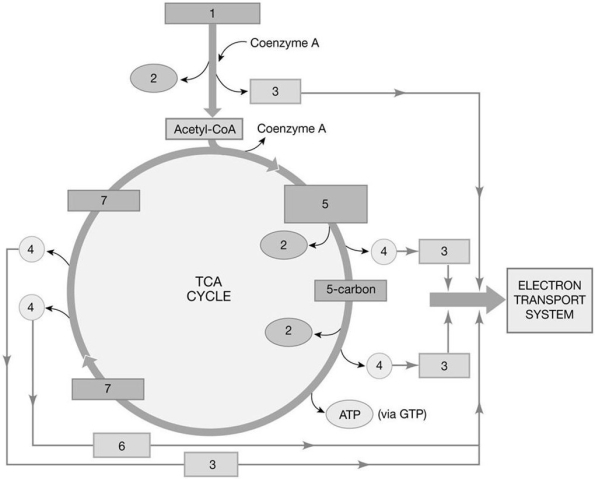 Use Figure 25-1 to answer the following questions:
-What is the substance labeled "4"?
Use Figure 25-1 to answer the following questions:
-What is the substance labeled "4"? (Multiple Choice)
4.9/5 (75)
(75) Lipoproteins that are formed within the intestinal epithelium to transfer dietary fats into circulationarecalled
(Multiple Choice)
4.9/5 (73)
(73) In glycolysis, each molecule of glucose that is catabolized gives a net yield of how many molecules of ATP?
(Multiple Choice)
4.8/5 (72)
(72) Eating disorders are common among girls and young women. They result from a psychological problem thatcauses inadequate or excessive food consumption. Two major eating disorders are anorexia nervosa and
(Multiple Choice)
4.8/5 (78)
(78) The term ________ refers to an unhealthy state resulting from inadequate intake of one or more nutrients that becomes life-threatening as the deficiencies accumulate.
(Multiple Choice)
4.9/5 (69)
(69) Fatty acids and many amino acids cannot be used for ________ because their catabolic pathways produce acetyl-CoA.
(Multiple Choice)
4.8/5 (98)
(98) A high uric acid level (above 7.4 mg/dl) can lead to the painful condition known as
(Multiple Choice)
4.8/5 (80)
(80) All of the following occur when the temperature of the preoptic area of the hypothalamus drops below its thermostat setting except
(Multiple Choice)
4.7/5 (88)
(88) How many net ATP molecules are produced by the complete metabolism (all pathways) of one glucose molecule?
(Multiple Choice)
4.9/5 (86)
(86) The complete catabolism of fatty acids is through the process called
(Multiple Choice)
4.8/5 (71)
(71) The removal of amino group from a protein to prepare it to enter the citric acid cycle is termed
(Multiple Choice)
4.9/5 (78)
(78) 
Filters
- Essay(0)
- Multiple Choice(0)
- Short Answer(0)
- True False(0)
- Matching(0)