



 Chat with AI
Exam 25: Monetary Policy Theory

Exam 1: Why Study Money, banking, and Financial Markets111 Questions
Exam 2: An Overview of the Financial System110 Questions
Exam 3: What Is Money110 Questions
Exam 4: Understanding Interest Rates110 Questions
Exam 5: The Behaviour of Interest Rates111 Questions
Exam 6: The Risk and Term Structure of Interest Rates110 Questions
Exam 7: The Stock Market, the Theory of Rational Expectations, and the Efficient Market Hypothesis110 Questions
Exam 8: An Economic Analysis of Financial Structure110 Questions
Exam 9: Financial Crises110 Questions
Exam 10: Economic Analysis of Financial Regulation110 Questions
Exam 11: Banking Industry: Structure and Competition112 Questions
Exam 12: Nonbank Finance110 Questions
Exam 13: Banking and the Management of Financial Institutions135 Questions
Exam 14: Risk Management With Financial Derivatives110 Questions
Exam 15: Central Banks and the Bank of Canada110 Questions
Exam 16: The Money Supply Process166 Questions
Exam 17: Tools of Monetary Policy109 Questions
Exam 18: The Conduct of Monetary Policy: Strategy and Tactics106 Questions
Exam 19: The Foreign Exchange Market129 Questions
Exam 20: The International Financial System143 Questions
Exam 21: Quantity Theory, inflation, and the Demand for Money111 Questions
Exam 22: The Is Curve139 Questions
Exam 23: The Monetary Policy and Aggregate Demand Curves110 Questions
Exam 24: Aggregate Demand and Supply Analysis120 Questions
Exam 25: Monetary Policy Theory147 Questions
Exam 26: The Role of Expectations in Monetary Policy110 Questions
Exam 27: Transmission Mechanisms of Monetary Policy108 Questions
Exam 28: The ISLM Model107 Questions
Select questions type


Early Keynesians felt that ________ policy was ________,so they stressed the importance of ________ policy.
(Multiple Choice)
4.9/5  (74)
(74) The monetarist reduced-form evidence does not specify the working of the economy and thus is considered to be a ________.
(Multiple Choice)
4.9/5 (82)
(82) To say that inflation is a monetary phenomenon seems to beg the question: ________.
(Multiple Choice)
4.9/5 (84)
(84) Which of the following is not an advantage of a correctly specified structural model?
(Multiple Choice)
4.8/5 (72)
(72) The time it takes to pass legislation to implement a particular policy is called ________.
(Multiple Choice)
4.9/5 (77)
(77) Monetarists assert that monetary policy may affect aggregate demand through ________.
(Multiple Choice)
4.8/5 (76)
(76) In the new classical model,an expansionary monetary policy will lead to a decline in aggregate output if ________.
(Multiple Choice)
4.7/5 (76)
(76) In a study published in 1963,Milton Friedman and Anna Schwartz found that in every business cycle they studied over nearly a hundred-year period,________.
(Multiple Choice)
4.9/5 (83)
(83) The notion that anticipated monetary policy has no effect on the real aggregate output is commonly called the ________.
(Multiple Choice)
4.8/5 (79)
(79) What do you know about the reduced-form evidence in describing the transmission mechanism of monetary policy? Provide a brief description.
(Essay)
4.9/5 (79)
(79) Figure 27-3  -In the new classical model in Figure 27-3,the initial impact of an unanticipated monetary contraction ________.
 (Multiple Choice)
5.0/5 (85)
(85) A disadvantage of ________ evidence is that it cannot rule out ________.
(Multiple Choice)
4.9/5 (80)
(80) On the evening news you hear of a scientific study that directly links premature births to cigarette smoking.This is an example of ________.
(Multiple Choice)
4.9/5 (88)
(88) Figure 27-4 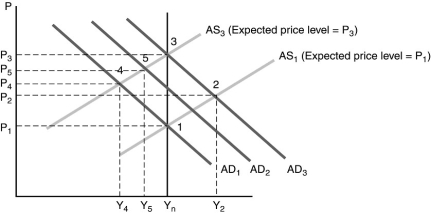 -In the new classical model in Figure 27-4,an anticipated increase in aggregate demand that is less than expected ________.
 (Multiple Choice)
4.9/5 (71)
(71) In response to the early Keynesians,monetarists contended that ________.
(Multiple Choice)
4.8/5 (82)
(82) Movements of ________ interest rates indicate that,contrary to the early Keynesians' beliefs,monetary policy was ________ during the Great Depression.
(Multiple Choice)
4.9/5 (96)
(96) If policymakers set a target for unemployment that is too low because it is less than the natural rate of unemployment,this can set the stage for a higher rate of money growth and ________.
(Multiple Choice)
4.8/5 (84)
(84) The ________ held the view that monetary policy does not matter at all for movements in aggregate output.
(Multiple Choice)
4.8/5 (92)
(92) 
Filters
- Essay(0)
- Multiple Choice(0)
- Short Answer(0)
- True False(0)
- Matching(0)