



 Chat with AI
Exam 25: Monetary Policy Theory


The legislative lag represents ________.

 (69)
 Verified
C
A criticism of the monetarist autonomous spending variable is that ________.
(99) VerifiedB
What is reverse causation and how does it relate to reduced-form evidence on monetary policy transmission?
(75) VerifiedA basic principle applicable to all scientific disciplines,including economics,states that correlation does not necessarily imply causation.The situation where after finding correlation between two variables say M and Y,we conclude erroneously that one causes the other is called reverse causation.The fact that the movement of one variable is linked to another doesn't necessarily mean that one variable causes the other.The reverse causation problem may be present when examining the link between changes in money and aggregate output or spending.If most of the correlation between M and Y occurs because of the Bank's interest-rate target,controlling the money supply will not help control aggregate output because it is actually changes in Y that are causing changes in M rather than the other way around.
Figure 27-4 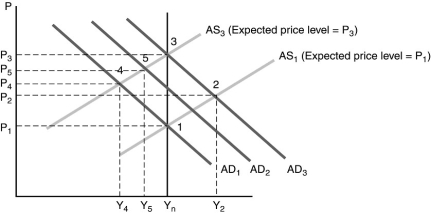 -In the new classical model in Figure 27-4,the initial impact of an anticipated increase in aggregate demand that is less than expected ________.
 (88) When the Bank of Canada has an interest rate target,________ output might lead to a ________ money supply.
(93) Milton Friedman and Anna Schwartz showed that monetary policy during the Great Depression had ________.
(84) Milton Friedman's proposition concerning the cause of inflation implies a simple solution to the inflation problem: ________.
(79) Why a cost-push inflation is a monetary phenomenon? Use the appropriate graph to support your answer.
(80) Figure 27-3  -In the new classical model in Figure 27-3,the initial impact of an unanticipated monetary expansion ________.
 (89) Predicting the impact of institutional change on the effectiveness of monetary policy is best done with a ________.
(69) An important feature of the new classical model is that an expansionary policy,such as an increase in the rate of money growth,can lead to a decline in aggregate output ________.
(77) In the new classical model,an anticipated increase in the money stock will cause ________.
(78) A basic principle in economics is that correlation ________ imply ________.
(92) The new classical model has the word classical associated with it because,when an increase in the money supply is anticipated,________.
(84) In the new classical model,an expansionary monetary policy causes ________.
(81) According to the new classical school of thought,a continually increasing money supply causes ________.
(81) 
Filters
- Essay(0)
- Multiple Choice(0)
- Short Answer(0)
- True False(0)
- Matching(0)