



 Chat with AI
Exam 15: Monetary Policy

Exam 1: Economics: Foundations and Models146 Questions
Exam 2: Trade-Offs, comparative Advantage, and the Market System153 Questions
Exam 3: Where Prices Come From: the Interaction of Demand and Supply147 Questions
Exam 4: Economic Efficiency, government Price Setting, and Taxes138 Questions
Exam 5: The Economics of Health Care115 Questions
Exam 6: Firms, the Stock Market, and Corporate Governance141 Questions
Exam 7: Comparative Advantage and the Gains From International Trade123 Questions
Exam 8: Gdp: Measuring Total Production and Income134 Questions
Exam 9: Unemployment and Inflation148 Questions
Exam 10: Economic Growth, the Financial System, and Business Cycles130 Questions
Exam 11: Long-Run Economic Growth: Sources and Policies141 Questions
Exam 12: Aggregate Expenditure and Output in the Short Run154 Questions
Exam 13: Aggregate Demand and Aggregate Supply Analysis145 Questions
Exam 14: Money, banks, and the Federal Reserve System146 Questions
Exam 15: Monetary Policy137 Questions
Exam 16: Fiscal Policy157 Questions
Exam 17: Inflation, unemployment, and Federal Reserve Policy130 Questions
Exam 18: Macroeconomics in an Open Economy142 Questions
Exam 19: The International Financial System132 Questions
Select questions type


The money market model is concerned with ________ and the loanable funds market model is concerned with ________.
(Multiple Choice)
4.9/5  (80)
(80) Use a graph to show the effects of a contractionary monetary policy to reduce inflation and move an economy back to potential real GDP.Explain what happens to aggregate demand,real GDP,and the price level.
(Essay)
4.8/5 (94)
(94) If the Fed orders an expansionary monetary policy,describe what will happen to the following variables relative to what would have happened without the policy:
a.The money supply
b.Interest rates
c.Investment
d.Consumption
e.Net Exports
f.The aggregate demand curve
g.Real GDP
h.The price level
(Essay)
4.8/5 (80)
(80) Figure 26-1
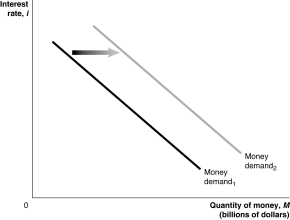 -Refer to Figure 26-1.In the figure above,the money demand curve would move from Money demand₁ to Money demand₂ if
 (Multiple Choice)
4.8/5 (73)
(73) Which of the following is not an argument against inflation targeting?
(Multiple Choice)
4.8/5 (80)
(80) The Federal Reserve did not lower interest rates to help the housing market in 2007 because
(Multiple Choice)
4.7/5 (82)
(82) Why doesn't the Fed have both a money supply target and an interest rate target?
(Multiple Choice)
4.7/5 (73)
(73) Table 26-3
 -Refer to Table 26-3.Consider the hypothetical information in the table above for potential real GDP,real GDP and the price level in 2014 and in 2015 if the Federal Reserve does not use monetary policy.If the Fed uses monetary policy successfully to keep real GDP at its potential level in 2015,which of the following will be higher than if the Fed had taken no action?
 (Multiple Choice)
4.9/5 (84)
(84) Table 26-1
 -Refer to Table 26-1.Consider the hypothetical information in the table above for potential real GDP,real GDP and the price level in 2014 and in 2015 if the Federal Reserve does not use monetary policy.If the Fed wants to keep real GDP at its potential level in 2015,it should
 (Multiple Choice)
4.8/5 (76)
(76) The body that is responsible for dating the beginning and ending dates for a recession is
(Multiple Choice)
4.8/5 (88)
(88) Monetary policy refers to the actions the Federal Reserve takes to manage
(Multiple Choice)
4.9/5 (83)
(83) Suppose the Fed increases the money supply.Which of the following is true?
(Multiple Choice)
4.9/5 (75)
(75) An advantage of the personal consumption expenditures price index (PCE)over the Consumer Price Index (CPI)as a measure of inflation is that the PCE
(Multiple Choice)
4.8/5 (67)
(67) 
Filters
- Essay(0)
- Multiple Choice(0)
- Short Answer(0)
- True False(0)
- Matching(0)