



 Chat with AI
Exam 15: Monetary Policy

Exam 1: Economics: Foundations and Models146 Questions
Exam 2: Trade-Offs, comparative Advantage, and the Market System153 Questions
Exam 3: Where Prices Come From: the Interaction of Demand and Supply147 Questions
Exam 4: Economic Efficiency, government Price Setting, and Taxes138 Questions
Exam 5: The Economics of Health Care115 Questions
Exam 6: Firms, the Stock Market, and Corporate Governance141 Questions
Exam 7: Comparative Advantage and the Gains From International Trade123 Questions
Exam 8: Gdp: Measuring Total Production and Income134 Questions
Exam 9: Unemployment and Inflation148 Questions
Exam 10: Economic Growth, the Financial System, and Business Cycles130 Questions
Exam 11: Long-Run Economic Growth: Sources and Policies141 Questions
Exam 12: Aggregate Expenditure and Output in the Short Run154 Questions
Exam 13: Aggregate Demand and Aggregate Supply Analysis145 Questions
Exam 14: Money, banks, and the Federal Reserve System146 Questions
Exam 15: Monetary Policy137 Questions
Exam 16: Fiscal Policy157 Questions
Exam 17: Inflation, unemployment, and Federal Reserve Policy130 Questions
Exam 18: Macroeconomics in an Open Economy142 Questions
Exam 19: The International Financial System132 Questions
Select questions type


Describe how the Fed uses open market operations to change short-term and long-term interest rates.
(Essay)
4.8/5  (80)
(80) Prior to 1970,mortgages were ________ resold in the secondary market.
(Multiple Choice)
4.8/5 (73)
(73) Write out the expression for the Taylor rule.Use the Taylor rule to explain how a decline in real GDP below potential GDP will affect the Federal Reserve's target for the federal funds rate.
(Essay)
4.8/5 (74)
(74) Suppose the equilibrium real federal funds rate is 5 percent,the target rate of inflation is 3 percent,the current inflation rate is 5 percent,and real GDP is 4 percent above potential real GDP. If the weights for the inflation gap and the output gap are both 1/2,then according to the Taylor rule the federal funds target rate equals
(Multiple Choice)
4.8/5 (89)
(89) Which of the following situations is one in which the Fed will potentially pursue expansionary monetary policy?
(Multiple Choice)
4.8/5 (92)
(92) Table 26-7
 -Refer to Table 26-7.Suppose the table above illustrates the values of real and potential GDP and the price level,if the Fed does not vote to change their current policy to be more contractionary or expansionary.Suppose that the Fed uses an appropriate policy and is successful in keeping real GDP at potential in 2013.Draw an aggregate demand and supply curve to illustrate your answer.
 (Essay)
4.9/5 (80)
(80) Between September 2007 and March 2008 there was a substantial reduction in the demand for housing.What action did the Fed take in response to the reduction in the demand for housing?
(Multiple Choice)
5.0/5 (82)
(82) Figure 26-4
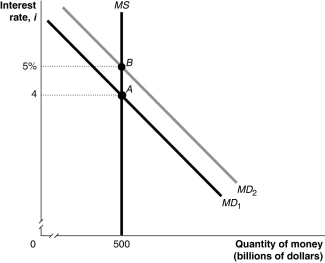 -Refer to Figure 26-4.In the figure above,the movement from point A to point B in the money market would be caused by
 (Multiple Choice)
4.9/5 (83)
(83) Rising nominal GDP will increase the demand for money and short-term interest rates.
(True/False)
5.0/5 (79)
(79) Suppose the Fed decreases the money supply.In response households and firms will ________ short term assets and this will drive ________ interest rates.
(Multiple Choice)
5.0/5 (88)
(88) Give an example of a monetary policy target.Explain why the Fed uses policy targets.
(Essay)
4.7/5 (65)
(65) Figure 26-9
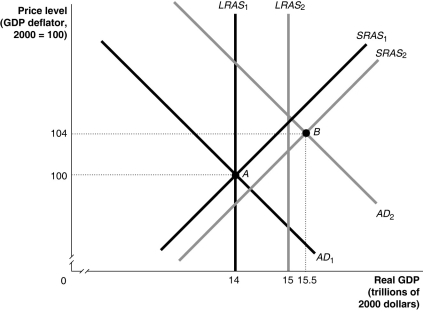 -Refer to Figure 26-9.In the figure above,if the economy in Year 1 is at point A and expected in Year 2 to be at point B,then the appropriate monetary policy by the Federal Reserve would be to
 (Multiple Choice)
4.9/5 (88)
(88) Maintaining a strong dollar in international currency markets is not one of the four monetary policy goals of the Fed listed in the textbook.
(True/False)
4.7/5 (75)
(75) Which of the following characterizes the Fed's ability to prevent recessions?
(Multiple Choice)
4.7/5 (90)
(90) An increase in the domestic interest rate relative to other interest rates should
(Multiple Choice)
4.8/5 (91)
(91) The Taylor rule accurately predicted the changes in the federal funds target during the period
(Multiple Choice)
5.0/5 (84)
(84) Table 26-4
 -Refer to Table 26-4.Suppose the following table illustrates the values of real and potential GDP and the price level,if the Fed does not vote to change their current policy to be more contractionary or expansionary.If the Fed wants to keep real GDP at its potential level in 2015,should the Fed use a contractionary or expansionary policy? How should it conduct open market operations to achieve its goal?
 (Essay)
5.0/5 (70)
(70) 
Filters
- Essay(0)
- Multiple Choice(0)
- Short Answer(0)
- True False(0)
- Matching(0)