



 Chat with AI
Exam 11: Long-Run Economic Growth: Sources and Policies

Exam 1: Economics: Foundations and Models146 Questions
Exam 2: Trade-Offs, comparative Advantage, and the Market System153 Questions
Exam 3: Where Prices Come From: the Interaction of Demand and Supply147 Questions
Exam 4: Economic Efficiency, government Price Setting, and Taxes138 Questions
Exam 5: The Economics of Health Care115 Questions
Exam 6: Firms, the Stock Market, and Corporate Governance141 Questions
Exam 7: Comparative Advantage and the Gains From International Trade123 Questions
Exam 8: Gdp: Measuring Total Production and Income134 Questions
Exam 9: Unemployment and Inflation148 Questions
Exam 10: Economic Growth, the Financial System, and Business Cycles130 Questions
Exam 11: Long-Run Economic Growth: Sources and Policies141 Questions
Exam 12: Aggregate Expenditure and Output in the Short Run154 Questions
Exam 13: Aggregate Demand and Aggregate Supply Analysis145 Questions
Exam 14: Money, banks, and the Federal Reserve System146 Questions
Exam 15: Monetary Policy137 Questions
Exam 16: Fiscal Policy157 Questions
Exam 17: Inflation, unemployment, and Federal Reserve Policy130 Questions
Exam 18: Macroeconomics in an Open Economy142 Questions
Exam 19: The International Financial System132 Questions
Select questions type


Table 22-5
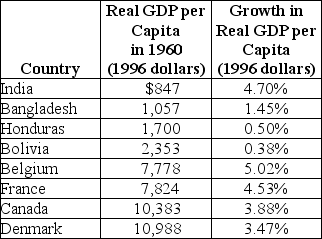 -Refer to Table 22-5.Consider the statistics in the table above in describing the following industrialized and developing countries.Are these consistent with the economic growth model? Briefly explain.
 (Essay)
5.0/5  (76)
(76) The easiest way for a country to obtain access to technology is through
(Multiple Choice)
4.8/5 (71)
(71) The productivity slowdown experience in the United States from the mid-1970s to the mid-1990s was actually a global phenomenon.
(True/False)
5.0/5 (85)
(85) Empirical evidence from 1960 to 2010 shows that convergence in economic growth is occurring in which of the following cases?
(Multiple Choice)
4.7/5 (84)
(84) Some economists argue that the productivity slowdown from mid-1970s to mid-1990s actually didn't happen,but just "appeared" to happen because
(Multiple Choice)
4.9/5 (82)
(82) The owner of a firm wants some advice on how to increase productivity.Suggest three ways the entrepreneur could increase labor productivity through improving technology.
(Essay)
4.9/5 (96)
(96) Figure 22-2
 -Refer to Figure 22-2.Which of the following combinations of points illustrates changes in the Soviet Union's economy from 1950 to 1980?
 (Multiple Choice)
4.9/5 (86)
(86) Which of the following countries actually experienced negative economic growth from 1960 to 2010?
(Multiple Choice)
4.8/5 (68)
(68) Over the last three decades in the United States,services have become a smaller fraction of GDP relative to goods.
(True/False)
4.9/5 (77)
(77) An explanation for the productivity slowdown from 1973 through 1995 is
(Multiple Choice)
4.7/5 (86)
(86) Which of the following policies are designed specifically to directly promote technological change in an economy?
(Multiple Choice)
4.8/5 (84)
(84) In 2010,GDP per capita was ________ in the United States than in China,and since 1980,the growth rate of real GDP per capita has been ________ in the United States than in China.
(Multiple Choice)
4.8/5 (85)
(85) Some economists argue that the productivity slowdown of the mid-1970s to the mid-1990s was due to changes in oil prices that
(Multiple Choice)
4.9/5 (82)
(82) According to Joseph Schumpeter,the theory of creative destruction describes a process by which
(Multiple Choice)
4.9/5 (86)
(86) Which of the following accurately describes growth rates in the United States from 1900 to the present?
(Multiple Choice)
4.7/5 (86)
(86) If there is a change in the ability of a firm to produce a given level of output with a given level of inputs,we say there is
(Multiple Choice)
4.9/5 (67)
(67) How might have the educational system of the United States contributed to the productivity slowdown of the mid-1970s to the mid-1990s?
(Essay)
4.9/5 (74)
(74) Unemployment insurance is usually available to workers in ________ for a shorter period of time than it is in ________.
(Multiple Choice)
5.0/5 (80)
(80) 
Filters
- Essay(0)
- Multiple Choice(0)
- Short Answer(0)
- True False(0)
- Matching(0)