



 Chat with AI
Exam 11: Long-Run Economic Growth: Sources and Policies

Exam 1: Economics: Foundations and Models146 Questions
Exam 2: Trade-Offs, comparative Advantage, and the Market System153 Questions
Exam 3: Where Prices Come From: the Interaction of Demand and Supply147 Questions
Exam 4: Economic Efficiency, government Price Setting, and Taxes138 Questions
Exam 5: The Economics of Health Care115 Questions
Exam 6: Firms, the Stock Market, and Corporate Governance141 Questions
Exam 7: Comparative Advantage and the Gains From International Trade123 Questions
Exam 8: Gdp: Measuring Total Production and Income134 Questions
Exam 9: Unemployment and Inflation148 Questions
Exam 10: Economic Growth, the Financial System, and Business Cycles130 Questions
Exam 11: Long-Run Economic Growth: Sources and Policies141 Questions
Exam 12: Aggregate Expenditure and Output in the Short Run154 Questions
Exam 13: Aggregate Demand and Aggregate Supply Analysis145 Questions
Exam 14: Money, banks, and the Federal Reserve System146 Questions
Exam 15: Monetary Policy137 Questions
Exam 16: Fiscal Policy157 Questions
Exam 17: Inflation, unemployment, and Federal Reserve Policy130 Questions
Exam 18: Macroeconomics in an Open Economy142 Questions
Exam 19: The International Financial System132 Questions
Select questions type


The purchase of stocks and bonds issued in another country is known as foreign direct investment.
(True/False)
4.8/5  (83)
(83) Of all industrialized nations,real GDP per capita was the highest in Japan in 2010.
(True/False)
4.9/5 (87)
(87) Knowledge capital is ________ in production and ________.As a result,firms ________ free ride.
(Multiple Choice)
4.8/5 (66)
(66) A small economy increased its capital per hour worked (K/L)from $40,000 to $50,000.As a result,real GDP per worker (Y/L)grew from $20,000 to $25,000.If the economy increases its capital per hour worked by another $10,000 to $60,000,but there is no change in technology,by how much more and in what direction will output per worker change?
(Multiple Choice)
4.9/5 (74)
(74) Lack of investment in strong education and health care systems
(Multiple Choice)
4.8/5 (72)
(72) An increase in ________ shifts the production function ________,and makes it possible to produce a higher level of GDP with ________ capital per hour worked.
(Multiple Choice)
4.9/5 (78)
(78) According to the text,there are three ways the government can help increase the accumulation of knowledge capital.What are they?
(Multiple Choice)
4.7/5 (85)
(85) If,after an outflow of workers in a country,it now takes more capital per hour worked to get the same amount of GDP per hour worked,this indicates ________ the per-worker production function in that country.
(Multiple Choice)
4.8/5 (70)
(70) According to Joseph Schumpeter,which of the factors of production is central to economic growth?
(Multiple Choice)
4.7/5 (78)
(78) ________ save a ________ of their income.This ________ capital in their economy and raises economic growth.
(Multiple Choice)
4.9/5 (74)
(74) Robert Lucas,a Nobel laureate in economics,argues that there are increasing returns to
(Multiple Choice)
4.8/5 (87)
(87) GDP in a country grew from $10 billion to $14 billion over the span of 5 years.The percentage change in GDP was
(Multiple Choice)
4.9/5 (80)
(80) List four types of government policies which can aid economic growth.
(Essay)
4.9/5 (86)
(86) Table 22-2
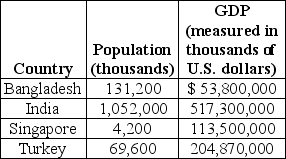 -Refer to Table 22-2.Calculate the GDP per capita for each country in the table.Which country has the highest standard of living? Why?
 (Essay)
5.0/5 (72)
(72) In a small Asian country,it is estimated that changing the level of capital from $8 million to $12 million will increase real GDP from $4 million to $6 million. What level of GDP would you expect the economy to be able to reach if spending on capital continued to rise to $16 million,assuming no technological change and no change in the hours of work?
(Multiple Choice)
4.8/5 (79)
(79) Which of the following countries had the highest GDP per capita in 2010?
(Multiple Choice)
4.7/5 (74)
(74) The key factors in raising standards of living in low-income countries have been increases in
(Multiple Choice)
4.9/5 (81)
(81) You have been hired as an economic advisor for a developing country.You have been asked to focus on education as a means for the country's development.Explain to the prime minister how improving education and training can contribute to his country's economic growth,and why it is important for the government to take a pro-active role in promoting education.
(Essay)
4.9/5 (79)
(79) The per-worker production function shows the relationship between ________ per hour worked and ________ per hour worked,holding ________ constant.
(Multiple Choice)
4.8/5 (92)
(92) 
Filters
- Essay(0)
- Multiple Choice(0)
- Short Answer(0)
- True False(0)
- Matching(0)