



 Chat with AI
Exam 17: Inflation, unemployment, and Federal Reserve Policy

Exam 1: Economics: Foundations and Models145 Questions
Exam 2: Trade-Offs, comparative Advantage, and the Market System152 Questions
Exam 3: Where Prices Come From: the Interaction of Demand and Supply149 Questions
Exam 4: Economic Efficiency,government Price Setting,and Taxes137 Questions
Exam 5: The Economics of Health Care117 Questions
Exam 6: Firms, the Stock Market, and Corporate Governance140 Questions
Exam 7: Comparative Advantage and the Gains From International Trade124 Questions
Exam 8: Gdp: Measuring Total Production and Income135 Questions
Exam 9: Unemployment and Inflation148 Questions
Exam 10: Economic Growth, the Financial System, and Business Cycles130 Questions
Exam 11: Long-Run Economic Growth: Sources and Policies134 Questions
Exam 12: Aggregate Expenditure and Output in the Short Run157 Questions
Exam 13: Aggregate Demand and Aggregate Supply Analysis145 Questions
Exam 14: Money,banks,and the Federal Reserve System144 Questions
Exam 15: Monetary Policy145 Questions
Exam 16: Fiscal Policy155 Questions
Exam 17: Inflation, unemployment, and Federal Reserve Policy135 Questions
Exam 18: Macroeconomics in an Open Economy145 Questions
Exam 19: The International Financial System139 Questions
Select questions type


In the long run,the Federal Reserve can control which of the following?
(Multiple Choice)
4.8/5  (72)
(72) The price level in the economy between 2009 and 2010 rose from 100 to 105.Between 2010 and 2011,the price level rose from 105 to 110.25.How does the short-run Phillips curve predict the unemployment rate will change as a result?
(Multiple Choice)
4.9/5 (75)
(75) In the long run,the Phillips curve is a ________ at ________.
(Multiple Choice)
4.9/5 (85)
(85) An increase in the inflation rate increases employment only if the increase in inflation is unexpected.
(True/False)
4.8/5 (84)
(84) Even if expectations of inflation are rational,sluggish adjustment of wages and prices will still create a short-run trade-off between inflation and unemployment.
(True/False)
4.8/5 (81)
(81) A higher inflation rate can lead to lower unemployment if ________ mistakenly expect the inflation rate to be lower than it turns out to be.
(Multiple Choice)
4.7/5 (72)
(72) Two actions by the Fed during Alan Greenspan's term as chairman have been identified as possibly contributing to the financial crisis in 2008.Which of the following was one of those actions?
(Multiple Choice)
4.9/5 (83)
(83) If people assume that future rates of inflation will follow the pattern of inflation rates in the past,they are said to have
(Multiple Choice)
4.9/5 (81)
(81) Figure 28-2
 -Refer to Figure 28-2.Suppose the economy is at point A in the figure above.Which of the following is true?
 (Multiple Choice)
4.9/5 (80)
(80) Figure 28-3
 -Refer to Figure 28-3.If firms and workers have adaptive expectations,an expansionary monetary policy will cause the short-run equilibrium to move from
 (Multiple Choice)
4.9/5 (78)
(78) If weak aggregate demand is pushing the economy into recession,which of the following must be true?
(Multiple Choice)
4.8/5 (67)
(67) The long-run aggregate supply curve is ________,while the long-run Phillips curve is ________.
(Multiple Choice)
4.8/5 (77)
(77) If the current unemployment rate is 5%,under which of the following circumstances would you expect the Fed to use expansionary monetary policy?
(Multiple Choice)
4.9/5 (70)
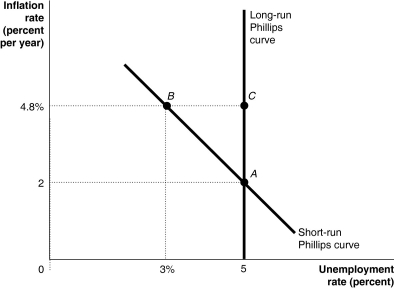
(70) Figure 28-1
 -Refer to Figure 28-1.What should the Federal Reserve do if it wants to move from point A to point B in the short-run Phillips curve depicted in the figure above?
 (Multiple Choice)
4.7/5 (83)
(83) When unemployment is below its natural rate,the inflation rate will eventually
(Multiple Choice)
4.9/5 (82)
(82) Figure 28-1
-Refer to Figure 28-1.Suppose that the economy is currently at point A.If the Federal Reserve engaged in contractionary monetary policy,where would the economy end up in the short run?
-Refer to Figure 28-1.Suppose that the economy is currently at point A.If the Federal Reserve engaged in contractionary monetary policy,where would the economy end up in the short run? (Multiple Choice)
4.9/5 (81)
(81) 
Filters
- Essay(0)
- Multiple Choice(0)
- Short Answer(0)
- True False(0)
- Matching(0)