



 Chat with AI
Exam 17: Inflation, unemployment, and Federal Reserve Policy

Exam 1: Economics: Foundations and Models145 Questions
Exam 2: Trade-Offs, comparative Advantage, and the Market System152 Questions
Exam 3: Where Prices Come From: the Interaction of Demand and Supply149 Questions
Exam 4: Economic Efficiency,government Price Setting,and Taxes137 Questions
Exam 5: The Economics of Health Care117 Questions
Exam 6: Firms, the Stock Market, and Corporate Governance140 Questions
Exam 7: Comparative Advantage and the Gains From International Trade124 Questions
Exam 8: Gdp: Measuring Total Production and Income135 Questions
Exam 9: Unemployment and Inflation148 Questions
Exam 10: Economic Growth, the Financial System, and Business Cycles130 Questions
Exam 11: Long-Run Economic Growth: Sources and Policies134 Questions
Exam 12: Aggregate Expenditure and Output in the Short Run157 Questions
Exam 13: Aggregate Demand and Aggregate Supply Analysis145 Questions
Exam 14: Money,banks,and the Federal Reserve System144 Questions
Exam 15: Monetary Policy145 Questions
Exam 16: Fiscal Policy155 Questions
Exam 17: Inflation, unemployment, and Federal Reserve Policy135 Questions
Exam 18: Macroeconomics in an Open Economy145 Questions
Exam 19: The International Financial System139 Questions
Select questions type


If the Fed decided to reverse its policy actions implemented during the heart of the recession,the Fed would be acting to try to prevent
(Multiple Choice)
5.0/5  (79)
(79) If firms and workers have adaptive expectations,what impact will expansionary monetary policy have on inflation,unemployment,and the Phillips curve?
(Essay)
4.9/5 (77)
(77) Last year,the unemployment rate was 4 percent and the inflation rate was 3 percent.If the natural rate of unemployment is 3 percent,how do you expect inflation to change?
(Essay)
5.0/5 (86)
(86) Which of the following would increase the natural rate of unemployment?
(Multiple Choice)
4.7/5 (79)
(79) The FOMC no longer sets targets for M1 and M2 to meet its goals of price stability and high employment.
(True/False)
4.7/5 (88)
(88) If workers and firms know that the Federal Reserve is following an expansionary monetary policy,workers and firms will expect inflation to ________ and will adjust wages so that the real wage ________.
(Multiple Choice)
4.8/5 (94)
(94) If expectations are adaptive,how will the economy adjust to a new long-run equilibrium in response to contractionary monetary policy? Support your answer with a graph of the Phillips curve.
(Essay)
4.7/5 (81)
(81) Figure 28-2
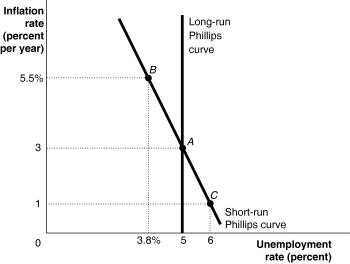 -Refer to Figure 28-2.Suppose the economy is at point A in the figure above.Which of the following is true?
 (Multiple Choice)
4.9/5 (91)
(91) Figure 28-2
-Refer to Figure 28-2.The nonaccelerating inflation rate of unemployment,or NAIRU,is associated with which point rate in the figure above?
-Refer to Figure 28-2.The nonaccelerating inflation rate of unemployment,or NAIRU,is associated with which point rate in the figure above? (Multiple Choice)
4.9/5 (78)
(78) Ceteris paribus,in the short run following a decrease in the rate of growth in Aggregate Demand,we would expect to see an increase in the rate of unemployment and a decrease in the rate of inflation.
(True/False)
4.9/5 (67)
(67) CarMax benefitted when the Federal Reserve slashed the federal funds rate to near-zero levels in 2008.Lower interest rates increased demand for its used cars,which would allow Carmax to ________ employment and ________ prices.
(Multiple Choice)
4.9/5 (79)
(79) If firms and workers have rational expectations,including knowledge of the policy being used by the Federal Reserve
(Multiple Choice)
4.9/5 (79)
(79) How would you expect the Fed to respond to a negative supply shock in the economy?
(Essay)
4.9/5 (91)
(91) Suppose a presidential candidate makes a statement in a debate whereby he promises that he would encourage the Fed to permanently lower the unemployment rate to 3%.His opponent claims that this type of policy idea is mired in the 1960s and would only cause inflation.Explain what the opponent means.
(Essay)
4.9/5 (86)
(86) If the Federal Reserve wants to reduce inflation from 4 percent to 3 percent permanently,how can that goal be achieved,and what impact will that have on employment in the short run and the long run? Support your answer with a graph of the Phillips curve in the short run and the long run.
(Essay)
4.9/5 (82)
(82) The expansionary monetary and fiscal policies of the 1960s resulted in
(Multiple Choice)
4.9/5 (78)
(78) Which of the following is not an appropriate policy for a central bank to follow if the economy is plagued with deflation?
(Multiple Choice)
4.7/5 (79)
(79) Empirical evidence shows that the short-run Phillips curve was vertical during the 1950s and 1960s.
(True/False)
5.0/5 (72)
(72) Figure 28-1
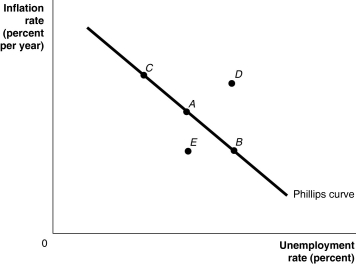 -Refer to Figure 28-1.Suppose that the economy is currently at point A,and the unemployment rate at A is the natural rate.What policy would the Federal Reserve pursue if it wanted the economy to move to point B in the long run?
 (Multiple Choice)
4.9/5 (83)
(83) 
Filters
- Essay(0)
- Multiple Choice(0)
- Short Answer(0)
- True False(0)
- Matching(0)