



 Chat with AI
Exam 11: Long-Run Economic Growth: Sources and Policies

Exam 1: Economics: Foundations and Models145 Questions
Exam 2: Trade-Offs, comparative Advantage, and the Market System152 Questions
Exam 3: Where Prices Come From: the Interaction of Demand and Supply149 Questions
Exam 4: Economic Efficiency,government Price Setting,and Taxes137 Questions
Exam 5: The Economics of Health Care117 Questions
Exam 6: Firms, the Stock Market, and Corporate Governance140 Questions
Exam 7: Comparative Advantage and the Gains From International Trade124 Questions
Exam 8: Gdp: Measuring Total Production and Income135 Questions
Exam 9: Unemployment and Inflation148 Questions
Exam 10: Economic Growth, the Financial System, and Business Cycles130 Questions
Exam 11: Long-Run Economic Growth: Sources and Policies134 Questions
Exam 12: Aggregate Expenditure and Output in the Short Run157 Questions
Exam 13: Aggregate Demand and Aggregate Supply Analysis145 Questions
Exam 14: Money,banks,and the Federal Reserve System144 Questions
Exam 15: Monetary Policy145 Questions
Exam 16: Fiscal Policy155 Questions
Exam 17: Inflation, unemployment, and Federal Reserve Policy135 Questions
Exam 18: Macroeconomics in an Open Economy145 Questions
Exam 19: The International Financial System139 Questions
Select questions type


How do government policies that enforce property rights affect economic growth?
(Essay)
4.8/5  (67)
(67) Is knowledge capital subject to the law of diminishing returns? Explain.
(Essay)
4.7/5 (73)
(73) Which of the following is true regarding the productivity slowdown in the United States during the mid-1970s?
(Multiple Choice)
4.8/5 (75)
(75) The labor productivity slowdown in the United States in the 1970s was due to declining quality of education in the United States,because no other industrialized country experienced the same labor productivity slowdown at the same time.
(True/False)
4.8/5 (92)
(92) According to Joseph Schumpeter,economic growth is achieved through
(Multiple Choice)
4.8/5 (81)
(81) Figure 22-1
 -Refer to Figure 22-1.Many countries in Africa strongly discouraged and prohibited foreign direct investment in the 1950s and 1960s.By doing so,these countries were essentially preventing a moment from
 (Multiple Choice)
4.9/5 (71)
(71) Disease,poor nutrition,and substandard health care in developing nations can reduce growth in an economy by
(Multiple Choice)
4.9/5 (86)
(86) The question of whether economic growth is desirable is a positive question,easily settled by economic analysis.
(True/False)
4.8/5 (73)
(73) Some economists argue that the apparent slowdown in economic growth in the United States during the mid-1970s may not really have reduced the standard of living because
(Multiple Choice)
4.9/5 (61)
(61) Describe the pattern of growth rates in real GDP per hour worked in the United States since the early nineteenth century.Has output per hour worked consistently increased at the same rate? Explain.
(Essay)
4.7/5 (82)
(82) Which of the following is not one of the three sources of technological change?
(Multiple Choice)
4.8/5 (61)
(61) Would you expect to see higher or lower growth rates for countries that start out with a relatively low level of real GDP per capita? Explain using the concept of "catch-up" and support your answer with a graph.
(Essay)
4.8/5 (92)
(92) Explain how market economies are generally better able to achieve technological progress than are centrally planned economies.
(Essay)
4.9/5 (76)
(76) Significant economic growth did not begin in the world until
(Multiple Choice)
4.8/5 (87)
(87) Figure 22-3
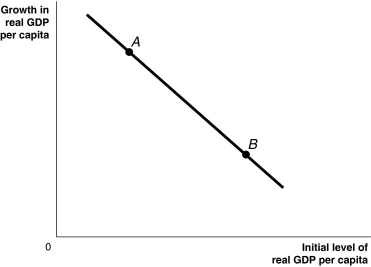 -Refer to Figure 22-3.Based on the "catch-up line" drawn above,poorer countries are more likely to be at a point like ________,where growth in GDP is relatively ________,while richer countries are more likely to be at a point like ________,where growth in GDP is relatively ________.
 (Multiple Choice)
4.8/5 (71)
(71) Starting at point B in the diagram below,identify which combinations of points illustrate technological change.Give a brief explanation to support your answer.

(Essay)
4.7/5 (78)
(78) 
Filters
- Essay(0)
- Multiple Choice(0)
- Short Answer(0)
- True False(0)
- Matching(0)