



 Chat with AI
Exam 11: Long-Run Economic Growth: Sources and Policies

Exam 1: Economics: Foundations and Models145 Questions
Exam 2: Trade-Offs, comparative Advantage, and the Market System152 Questions
Exam 3: Where Prices Come From: the Interaction of Demand and Supply149 Questions
Exam 4: Economic Efficiency,government Price Setting,and Taxes137 Questions
Exam 5: The Economics of Health Care117 Questions
Exam 6: Firms, the Stock Market, and Corporate Governance140 Questions
Exam 7: Comparative Advantage and the Gains From International Trade124 Questions
Exam 8: Gdp: Measuring Total Production and Income135 Questions
Exam 9: Unemployment and Inflation148 Questions
Exam 10: Economic Growth, the Financial System, and Business Cycles130 Questions
Exam 11: Long-Run Economic Growth: Sources and Policies134 Questions
Exam 12: Aggregate Expenditure and Output in the Short Run157 Questions
Exam 13: Aggregate Demand and Aggregate Supply Analysis145 Questions
Exam 14: Money,banks,and the Federal Reserve System144 Questions
Exam 15: Monetary Policy145 Questions
Exam 16: Fiscal Policy155 Questions
Exam 17: Inflation, unemployment, and Federal Reserve Policy135 Questions
Exam 18: Macroeconomics in an Open Economy145 Questions
Exam 19: The International Financial System139 Questions
Select questions type


Which of the following policies would not help promote economic growth?
(Multiple Choice)
4.9/5  (81)
(81) Small differences in economic growth rates result in small differences in living standards.
(True/False)
4.9/5 (83)
(83) Which of the following would you expect to result in faster economic growth?
(Multiple Choice)
4.8/5 (75)
(75) Foreign direct investment in the United States declined 42 percent in the first quarter of 2009.This means that
(Multiple Choice)
4.8/5 (81)
(81) Suppose that in 2011 real GDP grew in Estonia by 3% and that the population increased by 5%.Therefore in 2011,Estonia experienced
(Multiple Choice)
5.0/5 (76)
(76) Describe the process of "creative destruction" using a specific example.
(Essay)
4.7/5 (83)
(83) If real GDP per capita in Ireland is estimated to be $7,400 in 2012,what will real GDP per capita be in 2017 if real GDP per capita grows at an annual rate of 2.8%?
(Multiple Choice)
4.9/5 (72)
(72) Figure 22-2
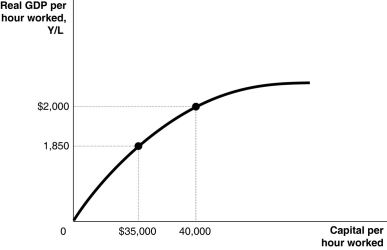 -Refer to Figure 22-2.Assuming no technological change,if the United States increases capital per hour worked by $40,000 every year between 2010 and 2014,we would expect to see
 (Multiple Choice)
4.8/5 (89)
(89) Which of the following advances contributed to the "new economy" of the mid-1990s?
(Multiple Choice)
4.9/5 (85)
(85) Why do some economists point to a decline in the quality of labor as an explanation for the productivity slowdown in the mid-1970s?
(Multiple Choice)
4.8/5 (94)
(94) A policy that offers parents a tax reduction based on how much they are saving for their children's college education should ________ the equilibrium level of loanable funds and ________ the rate of long-term growth.
(Multiple Choice)
4.9/5 (73)
(73) The Soviet Union's economy grew rapidly in terms of GDP per hour worked in the 1950s,but eventually this growth slowed.Why did this occur?
(Multiple Choice)
4.9/5 (81)
(81) Firms free ride on the research and development of other firms when they
(Multiple Choice)
4.9/5 (81)
(81) Which of the following best explains why productivity growth in the United States has been faster than in other leading industrialized nations?
(Multiple Choice)
4.8/5 (78)
(78) The purchase by an individual or firm of stock or bonds issued in another country is called
(Multiple Choice)
4.8/5 (68)
(68) The "new economy" that emerged in the mid-1990s is based on
(Multiple Choice)
4.9/5 (70)
(70) 
Filters
- Essay(0)
- Multiple Choice(0)
- Short Answer(0)
- True False(0)
- Matching(0)