



 Chat with AI
Exam 13: The Spinal Cord, Spinal Nerves, and Spinal Reflexes

Exam 1: An Introduction to Anatomy and Physiology95 Questions
Exam 2: The Chemical Level of Organization183 Questions
Exam 3: The Cellular Level of Organization190 Questions
Exam 4: The Tissue Level of Organization139 Questions
Exam 5: The Integumentary System118 Questions
Exam 6: Bones and Bone Structure165 Questions
Exam 7: The Axial Skeleton146 Questions
Exam 8: The Appendicular Skeleton119 Questions
Exam 9: Joints134 Questions
Exam 10: Muscle Tissue137 Questions
Exam 11: The Muscular System152 Questions
Exam 12: Nervous Tissue158 Questions
Exam 13: The Spinal Cord, Spinal Nerves, and Spinal Reflexes115 Questions
Exam 14: The Brain and Cranial Nerves187 Questions
Exam 15: Sensory Pathways and the Somatic Nervous System125 Questions
Exam 16: The Autonomic Nervous System and Higher-Order Functions129 Questions
Exam 17: The Special Senses170 Questions
Exam 18: The Endocrine System188 Questions
Exam 19: Blood162 Questions
Exam 20: The Heart178 Questions
Exam 21: Blood Vessels and Circulation225 Questions
Exam 22: The Lymphatic System and Immunity167 Questions
Exam 23: The Respiratory System200 Questions
Exam 24: The Digestive System213 Questions
Exam 25: Metabolism, Nutrition, and Energetics140 Questions
Exam 26: The Urinary System137 Questions
Exam 27: Fluid, Electrolyte, and Acid-Base Balance66 Questions
Exam 28: The Reproductive System203 Questions
Exam 29: Development and Inheritance146 Questions
Select questions type


The large anterior gray horns of the spinal cord contain mainly
(Multiple Choice)
4.8/5  (85)
(85) The reflex that prevents a muscle from exerting too much tension is the ________ reflex.
(Multiple Choice)
4.9/5 (72)
(72) In-Text Figure Based Questions
-What is the area between the arachnoid mater and the pia mater? (Figure 13-3)
(Multiple Choice)
4.7/5 (71)
(71) These structures extending from the pia mater through to the dura mater support the spinal cord by preventing lateral movement.
(Multiple Choice)
4.8/5 (73)
(73) The conus medullaris anchors the spinal cord to the coccygeal ligament via a strand of fibrous tissue calledthe
(Multiple Choice)
4.9/5 (83)
(83) Figure 13-2 Spinal Nerves
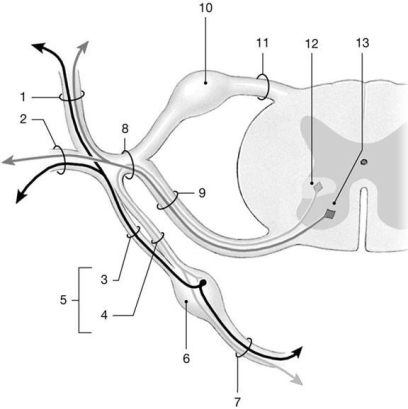 Use Figure 13-2 to answer the following questions:
-Damage to which structure would lead to paralysis of limbs?
Use Figure 13-2 to answer the following questions:
-Damage to which structure would lead to paralysis of limbs? (Multiple Choice)
4.8/5 (75)
(75) Figure 13-2 Spinal Nerves
Use Figure 13-2 to answer the following questions:
-Identify the structure labeled "6."
Use Figure 13-2 to answer the following questions:
-Identify the structure labeled "6." (Multiple Choice)
4.8/5 (64)
(64) In-Text Figure Based Questions
-What are the four ways reflexes can be classified? (Figure 13-15)
(Multiple Choice)
4.9/5 (86)
(86) Figure 13-2 Spinal Nerves
Use Figure 13-2 to answer the following questions:
-Which branch carries motor neurons to structures on the back of the body trunk?
Use Figure 13-2 to answer the following questions:
-Which branch carries motor neurons to structures on the back of the body trunk? (Multiple Choice)
4.8/5 (84)
(84) In-Text Figure Based Questions
-In which horn are somatic motor nuclei located? (Figure 13-5)
(Multiple Choice)
4.9/5 (66)
(66) Spinal nerves from the sacral region of the cord innervate the ________ muscles.
(Multiple Choice)
4.7/5 (76)
(76) Figure 13-1 The Spinal Cord
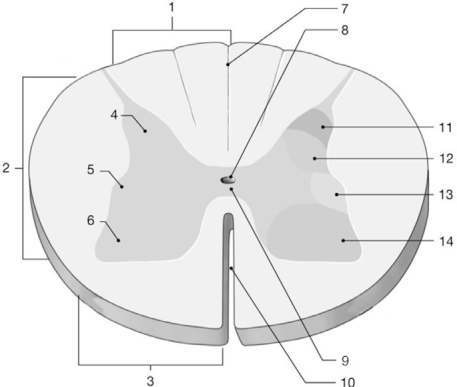 Use Figure 13-1 to answer the following questions:
-Where do somatic motor neurons reside?
Use Figure 13-1 to answer the following questions:
-Where do somatic motor neurons reside? (Multiple Choice)
4.9/5 (92)
(92) Arrange the spinal meninges from innermost layer to outermost layer.
(Multiple Choice)
4.8/5 (77)
(77) Blood vessels that supply the spinal cord run along the surface of the
(Multiple Choice)
4.8/5 (76)
(76) Figure 13-2 Spinal Nerves
Use Figure 13-2 to answer the following questions:
-What is the function of the structure labeled "12"?
Use Figure 13-2 to answer the following questions:
-What is the function of the structure labeled "12"? (Multiple Choice)
4.7/5 (72)
(72) If a person has a crush injury to the C3-C5 spinal segments, you would expect that he
(Multiple Choice)
4.9/5 (87)
(87) 
Filters
- Essay(0)
- Multiple Choice(0)
- Short Answer(0)
- True False(0)
- Matching(0)