



 Chat with AI
Exam 11: The Muscular System

Exam 1: An Introduction to Anatomy and Physiology95 Questions
Exam 2: The Chemical Level of Organization183 Questions
Exam 3: The Cellular Level of Organization190 Questions
Exam 4: The Tissue Level of Organization139 Questions
Exam 5: The Integumentary System118 Questions
Exam 6: Bones and Bone Structure165 Questions
Exam 7: The Axial Skeleton146 Questions
Exam 8: The Appendicular Skeleton119 Questions
Exam 9: Joints134 Questions
Exam 10: Muscle Tissue137 Questions
Exam 11: The Muscular System152 Questions
Exam 12: Nervous Tissue158 Questions
Exam 13: The Spinal Cord, Spinal Nerves, and Spinal Reflexes115 Questions
Exam 14: The Brain and Cranial Nerves187 Questions
Exam 15: Sensory Pathways and the Somatic Nervous System125 Questions
Exam 16: The Autonomic Nervous System and Higher-Order Functions129 Questions
Exam 17: The Special Senses170 Questions
Exam 18: The Endocrine System188 Questions
Exam 19: Blood162 Questions
Exam 20: The Heart178 Questions
Exam 21: Blood Vessels and Circulation225 Questions
Exam 22: The Lymphatic System and Immunity167 Questions
Exam 23: The Respiratory System200 Questions
Exam 24: The Digestive System213 Questions
Exam 25: Metabolism, Nutrition, and Energetics140 Questions
Exam 26: The Urinary System137 Questions
Exam 27: Fluid, Electrolyte, and Acid-Base Balance66 Questions
Exam 28: The Reproductive System203 Questions
Exam 29: Development and Inheritance146 Questions
Select questions type


Figure 11-1 Major Anterior Skeletal Muscles
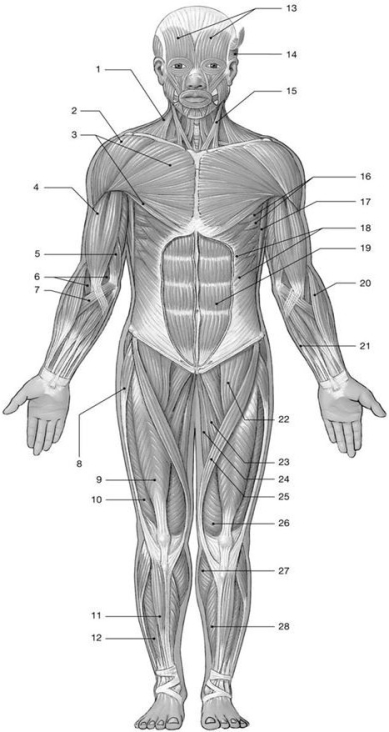 Use Figure 11-1 to answer the following questions:
-Identify the muscle labeled "15."
Use Figure 11-1 to answer the following questions:
-Identify the muscle labeled "15." (Multiple Choice)
4.8/5  (90)
(90) The end of a muscle that is attached to the point that moves when the muscle contracts is called the
(Multiple Choice)
4.7/5 (82)
(82) Jeff is interested in toning his abdomen. What muscles would you tell Jeff to exercise to accomplish hisgoal? What movements would best exercise these muscles?
(Essay)
4.9/5 (79)
(79) The muscle that raises the corners of the mouth as when smiling is the ________ muscle.
(Multiple Choice)
4.8/5 (61)
(61) The thick, flat sheet of tendon deep to the scalp is called the
(Multiple Choice)
5.0/5 (72)
(72) Muscles located close to the midline of the body may be called
(Multiple Choice)
4.9/5 (73)
(73) In-Text Figure Based Questions
-Which two intrinsic thumb muscles are an agonist-antagonist pair? (Figure 11-19)
(Multiple Choice)
4.9/5 (69)
(69) Which of the following is not primarily a muscle of facial expression?
(Multiple Choice)
4.9/5 (73)
(73) The muscle that inserts on the iliotibial tract and gluteal tuberosity of the femur is the
(Multiple Choice)
4.8/5 (70)
(70) In a convergent muscle, fascicles converge on a common attachment site that may be a slender band of collagen fibers known as a(n)
(Multiple Choice)
4.8/5 (100)
(100) Each of the following terms is a descriptive term for a muscle's action except
(Multiple Choice)
4.8/5 (79)
(79) Which of the following describes the action of the digastric muscle?
(Multiple Choice)
4.8/5 (87)
(87) The spinous processes of the upper thoracic vertebrae are the origin of the
(Multiple Choice)
4.9/5 (66)
(66) Contracting the gastrocnemius muscles to elevate the body on the toes involves a ________ lever.
(Multiple Choice)
4.9/5 (71)
(71) The muscle that originates from the superior surface of the pubis around the symphysis is the
(Multiple Choice)
4.8/5 (89)
(89) 
Filters
- Essay(0)
- Multiple Choice(0)
- Short Answer(0)
- True False(0)
- Matching(0)