



 Chat with AI
Exam 11: The Muscular System

Exam 1: An Introduction to Anatomy and Physiology95 Questions
Exam 2: The Chemical Level of Organization183 Questions
Exam 3: The Cellular Level of Organization190 Questions
Exam 4: The Tissue Level of Organization139 Questions
Exam 5: The Integumentary System118 Questions
Exam 6: Bones and Bone Structure165 Questions
Exam 7: The Axial Skeleton146 Questions
Exam 8: The Appendicular Skeleton119 Questions
Exam 9: Joints134 Questions
Exam 10: Muscle Tissue137 Questions
Exam 11: The Muscular System152 Questions
Exam 12: Nervous Tissue158 Questions
Exam 13: The Spinal Cord, Spinal Nerves, and Spinal Reflexes115 Questions
Exam 14: The Brain and Cranial Nerves187 Questions
Exam 15: Sensory Pathways and the Somatic Nervous System125 Questions
Exam 16: The Autonomic Nervous System and Higher-Order Functions129 Questions
Exam 17: The Special Senses170 Questions
Exam 18: The Endocrine System188 Questions
Exam 19: Blood162 Questions
Exam 20: The Heart178 Questions
Exam 21: Blood Vessels and Circulation225 Questions
Exam 22: The Lymphatic System and Immunity167 Questions
Exam 23: The Respiratory System200 Questions
Exam 24: The Digestive System213 Questions
Exam 25: Metabolism, Nutrition, and Energetics140 Questions
Exam 26: The Urinary System137 Questions
Exam 27: Fluid, Electrolyte, and Acid-Base Balance66 Questions
Exam 28: The Reproductive System203 Questions
Exam 29: Development and Inheritance146 Questions
Select questions type


Each of the following muscles is involved in the process of chewing or manipulating food in the mouth except the
(Multiple Choice)
4.9/5  (69)
(69) Damage to the pectoralis major would interfere with a person's ability to
(Multiple Choice)
4.8/5 (88)
(88) In a ________ muscle, the muscle fibers and fascicles lie in a slanted or oblique position to the tendon.
(Multiple Choice)
4.8/5 (85)
(85) Tom is having difficulty with plantar flexion and eversion of his foot. Which muscle is most likely involved in this problem?
(Multiple Choice)
4.9/5 (80)
(80) ________ muscle fibers pull in different directions, permitting different actions depending on stimulation.
(Multiple Choice)
4.9/5 (80)
(80) Muscles with fibers that run at an angle to the long axis of the body are called
(Multiple Choice)
4.8/5 (94)
(94) The muscle group on the posterior thigh is called the ________ group.
(Multiple Choice)
4.9/5 (80)
(80) Figure 11-2 Major Posterior Skeletal Muscles
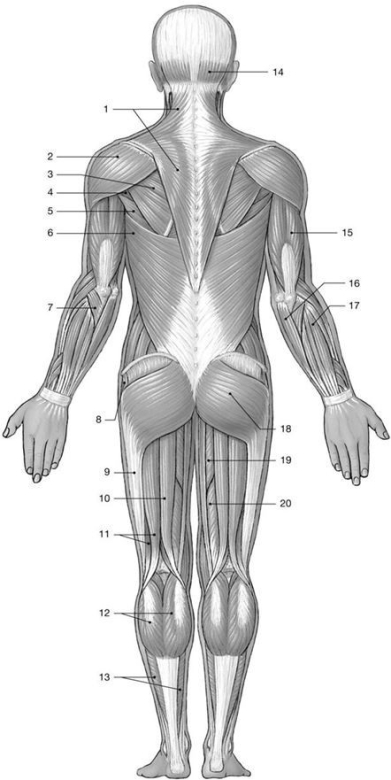 Use Figure 11-2 to answer the following questions:
-Identify the muscle labeled "2."
Use Figure 11-2 to answer the following questions:
-Identify the muscle labeled "2." (Multiple Choice)
4.9/5 (67)
(67) In assessing a stroke patient, you ask her to stick out (protract) her tongue. You note that it deviatestoone side. You suspect that damage to the neural control of the ________ muscle has occurred.
(Multiple Choice)
4.8/5 (86)
(86) If you bruised your gluteus maximus, you would expect to experience discomfort when
(Multiple Choice)
4.9/5 (68)
(68) The insertion end of the biceps brachii muscle of the anterior upper arm is
(Multiple Choice)
4.9/5 (83)
(83) A muscle whose name ends in the suffix -glossus would be found within or attached to the
(Multiple Choice)
4.9/5 (85)
(85) Which of the following controls abduction at the shoulder?
(Multiple Choice)
5.0/5 (81)
(81) Which of the following originates on the medial epicondyle of the humerus?
(Multiple Choice)
4.9/5 (71)
(71) Ryan hears a loud noise and quickly turns his eyes sideways in the direction of the sound. To accomplishthis action he must use his ________ muscles.
(Multiple Choice)
5.0/5 (79)
(79) 
Filters
- Essay(0)
- Multiple Choice(0)
- Short Answer(0)
- True False(0)
- Matching(0)