



 Chat with AI
Exam 9: Pointers

Exam 1: Introduction to Computers and Programming50 Questions
Exam 2: Introduction to C Plus Plus60 Questions
Exam 3: Expressions and Interactivity44 Questions
Exam 4: Making Decisions53 Questions
Exam 5: Loops and Files63 Questions
Exam 6: Functions49 Questions
Exam 7: Arrays58 Questions
Exam 8: Searching and Sorting Arrays20 Questions
Exam 9: Pointers45 Questions
Exam 10: Characters, C-Strings, and More About the String Class45 Questions
Exam 11: Structured Data53 Questions
Exam 12: Advanced File Operations38 Questions
Exam 13: Introduction to Classes47 Questions
Exam 14: More About Classes40 Questions
Exam 15: Inheritance, Polymorphism, and Virtual Functions40 Questions
Exam 16: Exceptions, Templates, and the Standard Template Library Stl39 Questions
Exam 17: Linked Lists40 Questions
Exam 18: Stacks and Queues47 Questions
Exam 19: Recursion22 Questions
Exam 20: Binary Trees38 Questions
Select questions type


 Has the same meaning as ________.
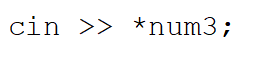

When you pass a pointer as an argument to a function, you must ________.
(Multiple Choice)
4.8/5  (82)
(82) To help prevent memory leaks from occurring in C++ 11, a ________ automatically deletes a chunk of dynamically allocated memory when the memory is no longer being used.
(Multiple Choice)
4.9/5 (82)
(82) When you work with a dereferenced pointer, you are actually working with ________.
(Multiple Choice)
4.8/5 (77)
(77) When the less than ( < )operator is used between two pointer variables, the expression is testing whether ________.
(Multiple Choice)
4.8/5 (94)
(94) With pointer variables you can access, but you cannot modify, data in other variables.
(True/False)
4.8/5 (76)
(76) In C++ 11, the nullptr key word was introduced to represent the address 0.
(True/False)
4.8/5 (85)
(85) With pointer variables, you can ________ manipulate data stored in other variables.
(Multiple Choice)
4.9/5 (77)
(77) 
The ________, also known as the address operator, returns the memory address of a variable.
(Multiple Choice)
5.0/5 (82)
(82) Use the delete operator only on pointers that were ________.
(Multiple Choice)
4.7/5 (78)
(78) A pointer can be used as a function argument, giving the function access to the original argument.
(True/False)
4.7/5 (90)
(90) A function may return a pointer, but the programmer must ensure that the pointer ________.
(Multiple Choice)
4.8/5 (82)
(82) An array name is a pointer constant because the address stored in it cannot be changed during runtime.
(True/False)
4.8/5 (78)
(78) If a variable uses more than one byte of memory, for pointer purposes its address is ________.
(Multiple Choice)
4.8/5 (77)
(77) 
Filters
- Essay(0)
- Multiple Choice(0)
- Short Answer(0)
- True False(0)
- Matching(0)