



 Chat with AI
Exam 13: Introduction to Classes

Exam 1: Introduction to Computers and Programming50 Questions
Exam 2: Introduction to C Plus Plus60 Questions
Exam 3: Expressions and Interactivity44 Questions
Exam 4: Making Decisions53 Questions
Exam 5: Loops and Files63 Questions
Exam 6: Functions49 Questions
Exam 7: Arrays58 Questions
Exam 8: Searching and Sorting Arrays20 Questions
Exam 9: Pointers45 Questions
Exam 10: Characters, C-Strings, and More About the String Class45 Questions
Exam 11: Structured Data53 Questions
Exam 12: Advanced File Operations38 Questions
Exam 13: Introduction to Classes47 Questions
Exam 14: More About Classes40 Questions
Exam 15: Inheritance, Polymorphism, and Virtual Functions40 Questions
Exam 16: Exceptions, Templates, and the Standard Template Library Stl39 Questions
Exam 17: Linked Lists40 Questions
Exam 18: Stacks and Queues47 Questions
Exam 19: Recursion22 Questions
Exam 20: Binary Trees38 Questions
Select questions type


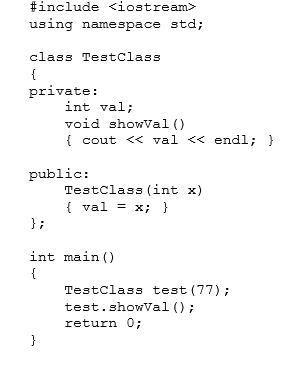
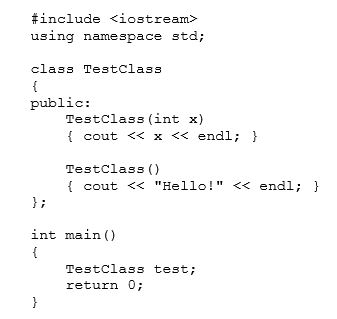
What is the output of the following program?

Free
(Multiple Choice)
4.9/5  (84)
(84) Correct Answer: Verified
D
You must use the private access specification for all data members of a class.
Free
(True/False)
4.9/5 (80)
(80) Correct Answer:Verified
VerifiedFalse
The destructor function's return type is ________.
Free
(Multiple Choice)
4.7/5 (85)
(85) Correct Answer:Verified
VerifiedD
If you do not declare an access specification, the default for members of a class is ________.
(Multiple Choice)
4.7/5 (75)
(75) When using smart pointers to dynamically allocate objects in C++ 11, it is unnecessary to delete the dynamically allocated objects because the smart pointer will automatically delete them.
(True/False)
4.8/5 (85)
(85) 
In OOP terminology, an object's member variables are often called its ________, and its member functions are sometimes referred to as its behaviors, or ________.
(Multiple Choice)
4.9/5 (69)
(69) Object-oriented programming is centered around the object, which encapsulate together both the data and the functions that operate on the data.
(True/False)
4.7/5 (76)
(76) This directive is used to create an "include guard," which allows a program to be conditionally compiled. This prevents a header file from accidentally being included more than once.
(Multiple Choice)
4.9/5 (83)
(83) One purpose that destructor functions are often used for is to free memory that was allocated by the object.
(True/False)
4.8/5 (74)
(74) This type of member function may be called from a statement outside the class.
(Multiple Choice)
4.8/5 (78)
(78) When a member function is defined outside of the class declaration, the function name must be qualified with the ________.
(Multiple Choice)
4.8/5 (78)
(78) One purpose that constructor functions are often used for is to allocate memory that will be needed by the object.
(True/False)
4.9/5 (71)
(71) A ________ is a member function that is automatically called when a class object is ________.
(Multiple Choice)
4.8/5 (70)
(70) 
Filters
- Essay(0)
- Multiple Choice(0)
- Short Answer(0)
- True False(0)
- Matching(0)