



 Chat with AI
Exam 16: Monopoly

Exam 1: Getting Started337 Questions
Exam 2: The Usand Global Economies201 Questions
Exam 3: The Economic Problem273 Questions
Exam 4: Demand and Supply322 Questions
Exam 5: Elasticities of Demand and Supply335 Questions
Exam 6: Efficiency and Fairness of Markets352 Questions
Exam 7: Government Actions in Markets239 Questions
Exam 8: Taxes267 Questions
Exam 9: Global Markets in Action276 Questions
Exam 10: Externalities300 Questions
Exam 11: Public Goods and Common Resources177 Questions
Exam 12: Markets With Private Information101 Questions
Exam 13: Consumer Choice and Demand287 Questions
Exam 14: Production and Cost266 Questions
Exam 15: Perfect Competition275 Questions
Exam 16: Monopoly377 Questions
Exam 17: Monopolistic Competition213 Questions
Exam 18: Oligopoly222 Questions
Exam 19: Markets for Factors of Production178 Questions
Exam 20: Economic Inequality155 Questions
Select questions type


Which of the following industries is most likely closest to achieving perfect price discrimination?
(Multiple Choice)
4.8/5  (57)
(57) A single-price monopoly can sell 10 units of its product at a price of $45 each but to sell 11 units, the monopoly must cut the price to $44.What is the marginal revenue of the extra unit sold?
(Multiple Choice)
4.8/5 (77)
(77) Which of the following statements about price discrimination is false?
(Multiple Choice)
4.9/5 (77)
(77) If the technology for producing a good enables one firm to meet the entire market demand at a lower average total cost than two or more firms could, then that firm has
(Multiple Choice)
4.9/5 (68)
(68) The maximum profit for a single-price monopoly is found when the firm produces the level of output so that
(Multiple Choice)
4.7/5 (76)
(76) The capture theory of regulation predicts that regulations bring ________ to producers and impose ________ on any individual consumer.
(Multiple Choice)
4.8/5 (69)
(69) Assume someone organizes all farms in the nation into a monopoly.What is the monopoly's marginal cost curve?
(Multiple Choice)
4.9/5 (75)
(75) 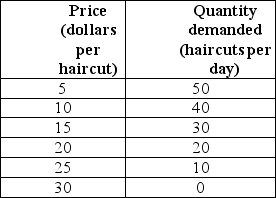 -Christy's Haircuts, the sole supplier of haircuts in a small town, faces the demand schedule shown in the table above.What is Christy's marginal revenue from the 25th haircut?
 (Multiple Choice)
5.0/5 (85)
(85) Which of the following is always true for a single-price monopolist?
(Multiple Choice)
4.9/5 (80)
(80)  -Suppose the grocery store market in Kansas City is perfectly competitive.Then one store buys all the others and becomes a single-price monopoly.The figure above shows the relevant demand and cost curves.When the market is a monopoly, the price of a pound of steak is
 (Multiple Choice)
4.9/5 (75)
(75) 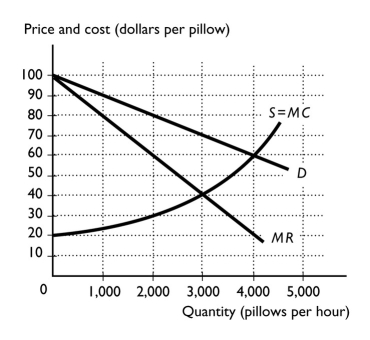 -The figure above shows the demand, marginal revenue, and marginal cost curves for Paul's Parrot pillows, a monopoly producer of pillows stuffed with parrot feathers.When Paul maximizes his profit, Paul produces ________ pillows per hour and if the market was perfectly competitive, ________ pillows per hour would be produced.
 (Multiple Choice)
4.9/5 (82)
(82) Why do some firms price discriminate? Relate your answer to the common practice of public colleges charging lower tuition to in-state students and higher tuition to out-of-state students.
(Essay)
4.8/5 (87)
(87) How does marginal revenue compare to price for a single-price monopoly?
(Essay)
4.7/5 (88)
(88) 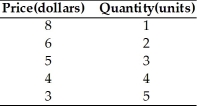 -The above table gives the demand schedule for a single-price monopoly.If the marginal cost is $3, the profit maximizing output for the monopoly will be between
 (Multiple Choice)
4.9/5 (90)
(90) 
Filters
- Essay(0)
- Multiple Choice(0)
- Short Answer(0)
- True False(0)
- Matching(0)