



 Chat with AI
Exam 16: Monopoly

Exam 1: Getting Started337 Questions
Exam 2: The Usand Global Economies201 Questions
Exam 3: The Economic Problem273 Questions
Exam 4: Demand and Supply322 Questions
Exam 5: Elasticities of Demand and Supply335 Questions
Exam 6: Efficiency and Fairness of Markets352 Questions
Exam 7: Government Actions in Markets239 Questions
Exam 8: Taxes267 Questions
Exam 9: Global Markets in Action276 Questions
Exam 10: Externalities300 Questions
Exam 11: Public Goods and Common Resources177 Questions
Exam 12: Markets With Private Information101 Questions
Exam 13: Consumer Choice and Demand287 Questions
Exam 14: Production and Cost266 Questions
Exam 15: Perfect Competition275 Questions
Exam 16: Monopoly377 Questions
Exam 17: Monopolistic Competition213 Questions
Exam 18: Oligopoly222 Questions
Exam 19: Markets for Factors of Production178 Questions
Exam 20: Economic Inequality155 Questions
Select questions type


Which creates a larger deadweight loss, perfect competition or a single-price monopoly?
(Essay)
5.0/5  (82)
(82) 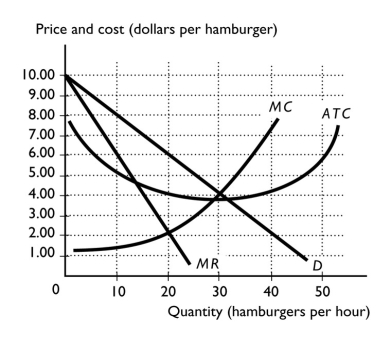 -Ron's Hamburger Joint is the only restaurant in town.The above figure represents Ron's cost, the market demand, and marginal revenue curves.Ron operates as a single-price monopoly.
a∙How many hamburgers does Ron produce?
b∙What price does Ron charge for a hamburger?
c∙What is Ron's total revenue?
d∙What is his total cost?
e∙What is Ron's economic profit?
-Ron's Hamburger Joint is the only restaurant in town.The above figure represents Ron's cost, the market demand, and marginal revenue curves.Ron operates as a single-price monopoly.
a∙How many hamburgers does Ron produce?
b∙What price does Ron charge for a hamburger?
c∙What is Ron's total revenue?
d∙What is his total cost?
e∙What is Ron's economic profit? (Essay)
4.7/5 (70)
(70) 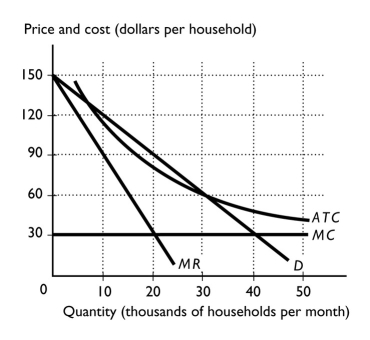 -The above figure shows the demand for cable and the cable company's cost of providing cable.
a∙What price and quantity will be produced if the company is unregulated and profit maximizes?
b∙What price and quantity will be produced if the company is regulated using the marginal cost pricing rule?
c∙What is the advantage of the marginal cost pricing rule?
d∙What price and quantity will be produced if the company is regulated using the average cost pricing rule?
e∙What is the advantage of the average cost pricing rule?
-The above figure shows the demand for cable and the cable company's cost of providing cable.
a∙What price and quantity will be produced if the company is unregulated and profit maximizes?
b∙What price and quantity will be produced if the company is regulated using the marginal cost pricing rule?
c∙What is the advantage of the marginal cost pricing rule?
d∙What price and quantity will be produced if the company is regulated using the average cost pricing rule?
e∙What is the advantage of the average cost pricing rule? (Essay)
4.8/5 (93)
(93) A single-price monopoly has a marginal revenue curve that is
(Multiple Choice)
4.9/5 (69)
(69) Assume someone organizes all farms in the nation into a single-price monopoly.As a result, the price consumers pay for food
(Multiple Choice)
4.8/5 (68)
(68) Which of the following is an example of price discrimination?
(Multiple Choice)
4.9/5 (86)
(86) Why do some utilities have an incentive to exaggerate their costs of production?
(Essay)
4.9/5 (84)
(84)
-"A single-price monopoly charges a higher price and produces more output than a perfectly competitive industry." Is the previous statement correct or incorrect? Explain your answer.
-"A single-price monopoly charges a higher price and produces more output than a perfectly competitive industry." Is the previous statement correct or incorrect? Explain your answer. (Essay)
4.8/5 (77)
(77) Which of the following must exist for a firm to engage in price discrimination?
(Multiple Choice)
4.8/5 (77)
(77) A natural monopoly's average cost curve
I∙intersects the demand curve while the average cost curve slopes downward.
Ii∙reaches its minimum before it intersects the demand curve.
Iii∙intersects the demand curve below the intersection of the marginal cost curve and the demand curve.
(Multiple Choice)
4.8/5 (82)
(82) At a level of output when regulators require a natural monopoly to set a price that is equal to marginal cost, the firm
(Multiple Choice)
4.8/5 (85)
(85) 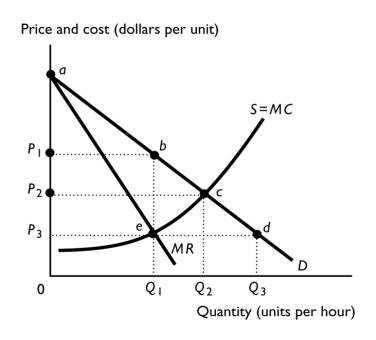 -In the above figure, for a single-price monopoly the deadweight loss is equal to the area
 (Multiple Choice)
5.0/5 (69)
(69) When a natural monopoly is regulated using an average cost pricing rule, what can you say about the firm's profit and the market's efficiency?
(Essay)
4.9/5 (87)
(87) Compare the outcome in a market with a single-price monopoly to that in a perfectly competitive market.
(Essay)
4.7/5 (80)
(80) Compared to setting a single price, if a firm can price discriminate it
(Multiple Choice)
4.8/5 (75)
(75) 
Filters
- Essay(0)
- Multiple Choice(0)
- Short Answer(0)
- True False(0)
- Matching(0)