



 Chat with AI
Exam 5: Properties of Enzymes

Exam 1: Introduction to Biochemistry72 Questions
Exam 2: Water94 Questions
Exam 3: Amino Acids and the Primary Structures of Proteins107 Questions
Exam 4: Proteins: Three-Dimensional Structure and Function116 Questions
Exam 5: Properties of Enzymes91 Questions
Exam 6: Mechanisms of Enzymes88 Questions
Exam 7: Coenzymes and Vitamins93 Questions
Exam 8: Carbohydrates92 Questions
Exam 9: Lipids and Membranes95 Questions
Exam 10: Introduction to Metabolism87 Questions
Exam 11: Glycolysis88 Questions
Exam 12: Gluconeogenesis, the Pentose Phosphate Pathway, and Glycogen Metabolism90 Questions
Exam 13: The Citric Acid Cycle93 Questions
Exam 14: Electron Transport and Atp Synthesis95 Questions
Exam 15: Photosynthesis89 Questions
Exam 16: Lipid Metabolism89 Questions
Exam 17: Amino Acid Metabolism84 Questions
Exam 18: Nucleotide Metabolism81 Questions
Exam 19: Nucleic Acids95 Questions
Exam 20: DNA Replication, repair, and Recombination89 Questions
Exam 21: Transcription and RNA Processing91 Questions
Exam 22: Protein Synthesis99 Questions
Select questions type


In the Lineweaver-Burk plot of an enzyme reaction,the Km is given by the ________.
(Multiple Choice)
4.7/5  (86)
(86) Which might be a method used for distinguishing among several mechanistic possibilities in a multi-substrate reaction?
(Multiple Choice)
4.9/5 (89)
(89) It is difficult to determine either Km or Vmax from a graph of velocity vs.substrate concentration because
(Multiple Choice)
4.8/5 (83)
(83) Which statement is true about the removal of reversible inhibitors from enzyme solutions?
(Multiple Choice)
4.9/5 (87)
(87) Affinity labels are radioactive competitive inhibitors used to identify the most important residues in an enzyme's active site.
(True/False)
4.9/5 (80)
(80) Increasing the concentration of a classic competitive inhibitor has no effect on the maximum velocity of an enzyme-substrate reaction.
(True/False)
4.8/5 (66)
(66) Which is appropriate for initial rate method experiments to analyze an enzyme-catalyzed reaction?
(Multiple Choice)
4.9/5 (76)
(76) The main difference between chemical and enzyme kinetics is that
(Multiple Choice)
4.9/5 (74)
(74) The ________ theory explains cooperative binding by suggesting all subunits of a given protein have the same conformation,either all R or all T.
(Multiple Choice)
4.9/5 (59)
(59) When varying the substrate concentration at a fixed concentration of enzyme it is observed that at low concentrations of substrate the reaction is ________,while at high concentrations of substrate the reaction is ________.
(Multiple Choice)
4.8/5 (70)
(70) The regulatory and active sites on an oligomeric enzyme can be on different subunits.
(True/False)
4.9/5 (78)
(78) The non-enzymatic hydrolysis of sucrose into glucose and fructose is an example of a pseudo first-order reaction because
(Multiple Choice)
4.8/5 (77)
(77) In bi-substrate reactions the substrates always bind to the enzyme in a specific order.
(True/False)
4.7/5 (88)
(88) Select the correct class of enzyme for each of these reactions.
-L-Glutamate + ATP + NH₄+ → L-glutamine + ADP + Pi
(Multiple Choice)
4.8/5 (74)
(74) Select the correct class of enzyme for each of these reactions.
-Pyruvate + H+ → Acetaldehyde + Carbon dioxide
(Multiple Choice)
4.7/5 (71)
(71) What distinguishes reversible inhibitors from irreversible inhibitors?
(Multiple Choice)
4.9/5 (90)
(90) What type of inhibition is indicated by the data graphed below? 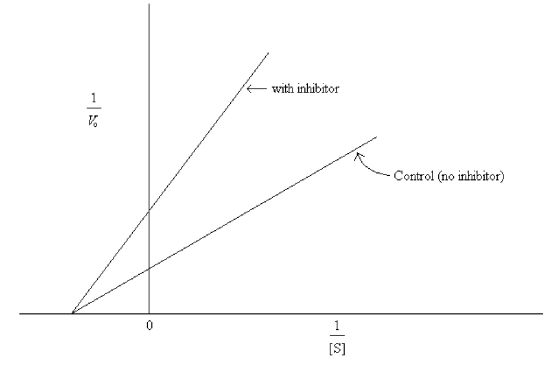
(Multiple Choice)
4.8/5 (74)
(74) 
Filters
- Essay(0)
- Multiple Choice(0)
- Short Answer(0)
- True False(0)
- Matching(0)