



 Chat with AI
Exam 7: The Economics of Health Care

Exam 1: Economics: Foundations and Models234 Questions
Exam 2: Trade-Offs, Comparative Advantage, and the Market System258 Questions
Exam 3: Where Prices Come From: the Interaction of Demand and Supply242 Questions
Exam 4: Economic Efficiency, Government Price Setting, and Taxes208 Questions
Exam 5: Externalities, Environmental Policy, and Public Goods263 Questions
Exam 6: Elasticity: the Responsiveness of Demand and Supply295 Questions
Exam 7: The Economics of Health Care171 Questions
Exam 8: Firms, the Stock Market, and Corporate Governance264 Questions
Exam 9: Comparative Advantage and the Gains From International Trade188 Questions
Exam 10: Consumer Choice and Behavioral Economics300 Questions
Exam 11: Technology, Production, and Costs328 Questions
Exam 12: Firms in Perfectly Competitive Markets296 Questions
Exam 13: Monopolistic Competition: the Competitive Model in a More Realistic Setting274 Questions
Exam 14: Oligopoly: Firms in Less Competitive Markets259 Questions
Exam 15: Monopoly and Antitrust Policy279 Questions
Exam 16: Pricing Strategy261 Questions
Exam 17: The Markets for Labor and Other Factors of Production281 Questions
Exam 18: Public Choice, Taxes, and the Distribution of Income258 Questions
Select questions type


Health insurance plans which typically reimburse doctors mainly by paying a flat fee per patient are known as
(Multiple Choice)
4.8/5  (83)
(83) A majority of people in the United States have private health insurance.
(True/False)
4.8/5 (82)
(82) The overall decline in death rates in the United States since 1981 was due to all of the following except
(Multiple Choice)
4.8/5 (88)
(88) The rising cost of malpractice insurance is one of the leading causes of the increase in health care spending as a percentage of GDP in the United States.
(True/False)
4.9/5 (79)
(79) In the United States in 2014, the percentage of people without any form of health insurance was about
(Multiple Choice)
4.9/5 (84)
(84) Figure 7-1
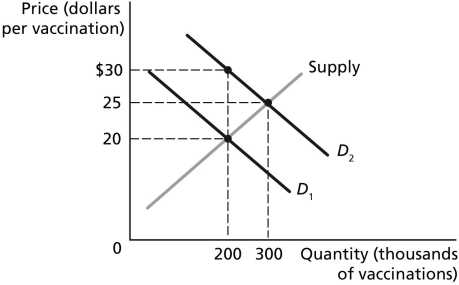 Figure 7-1 represents the market for vaccinations.Vaccinations are considered a benefit to society, and the figure shows both the marginal private benefit and the marginal social benefit from vaccinations.
-Refer to Figure 7-1.The efficient equilibrium price is
Figure 7-1 represents the market for vaccinations.Vaccinations are considered a benefit to society, and the figure shows both the marginal private benefit and the marginal social benefit from vaccinations.
-Refer to Figure 7-1.The efficient equilibrium price is (Multiple Choice)
4.9/5 (87)
(87) Life expectancy at birth in the United States has more than doubled since 1850.
(True/False)
4.9/5 (81)
(81) In the United States in 2014, the percentage of people that directly purchased an individual or family health insurance policy from an insurance company was about
(Multiple Choice)
5.0/5 (78)
(78) Typically, the higher the level of income per person in a country, the higher the level of spending per person on health care.This relationship between income and spending indicates that health care is a
(Multiple Choice)
4.8/5 (87)
(87) The aging of the U.S.population has tended to ________ spending on health care, and the development of new drugs and medical equipment has tended to ________ spending on health care.
(Multiple Choice)
4.9/5 (70)
(70) All of the following are part of the "regulation of health insurance" provision of the Patient Protection and Affordable Care Act (ACA)except
(Multiple Choice)
4.7/5 (78)
(78) The Congressional Budget Office estimates that the Patient Protection and Affordable Care Act (ACA)will
(Multiple Choice)
4.8/5 (85)
(85) Of the following high-income countries, which has the lowest mortality ratio for cancer?
(Multiple Choice)
4.9/5 (85)
(85) Because consumers who have insurance provided by their employers usually only pay a deductible for a visit to the doctor's office,
(Multiple Choice)
4.8/5 (84)
(84) What is the main difference between a single-payer health care system and socialized medicine?
(Essay)
4.9/5 (80)
(80) The Congressional Budget Office estimates that most of the increase in federal spending on Medicare and Medicaid will be due to
(Multiple Choice)
4.7/5 (79)
(79) In the United States, total health care spending per person has been ________, and out-of-pocket spending on health care per person has been ________.
(Multiple Choice)
4.9/5 (74)
(74) In a market with positive externalities, the market equilibrium price will be less than the efficient equilibrium price.
(True/False)
4.7/5 (77)
(77) 
Filters
- Essay(0)
- Multiple Choice(0)
- Short Answer(0)
- True False(0)
- Matching(0)