



 Chat with AI
Exam 7: The Economics of Health Care

Exam 1: Economics: Foundations and Models234 Questions
Exam 2: Trade-Offs, Comparative Advantage, and the Market System258 Questions
Exam 3: Where Prices Come From: the Interaction of Demand and Supply242 Questions
Exam 4: Economic Efficiency, Government Price Setting, and Taxes208 Questions
Exam 5: Externalities, Environmental Policy, and Public Goods263 Questions
Exam 6: Elasticity: the Responsiveness of Demand and Supply295 Questions
Exam 7: The Economics of Health Care171 Questions
Exam 8: Firms, the Stock Market, and Corporate Governance264 Questions
Exam 9: Comparative Advantage and the Gains From International Trade188 Questions
Exam 10: Consumer Choice and Behavioral Economics300 Questions
Exam 11: Technology, Production, and Costs328 Questions
Exam 12: Firms in Perfectly Competitive Markets296 Questions
Exam 13: Monopolistic Competition: the Competitive Model in a More Realistic Setting274 Questions
Exam 14: Oligopoly: Firms in Less Competitive Markets259 Questions
Exam 15: Monopoly and Antitrust Policy279 Questions
Exam 16: Pricing Strategy261 Questions
Exam 17: The Markets for Labor and Other Factors of Production281 Questions
Exam 18: Public Choice, Taxes, and the Distribution of Income258 Questions
Select questions type


Vaccinations tend to result in a positive externality.Draw a graph showing the market for vaccinations, including both the marginal private benefit curve and the marginal social benefit curve.Identify the market equilibrium price and quantity, the efficient equilibrium price and quantity, and the deadweight loss.
(Essay)
4.8/5  (84)
(84) Consider a used car market in which half the cars are good and half are bad (lemons).If buyers are rational, the prices being offered for used cars will result in
(Multiple Choice)
4.8/5 (76)
(76) Of the following high-income countries, which has the highest infant mortality rate?
(Multiple Choice)
4.9/5 (67)
(67) When consumers pay only a fraction of the true cost of medical services, their demand increases.The marginal cost of producing these extra services
(Multiple Choice)
4.8/5 (73)
(73) Which of the following factors help to explain the sustained increases in health care spending in the United States, and which do not?
a.the additional paperwork, duplication, and waste generated in the U.S.health care system compared to systems in other countries
b.the increasing costs of malpractice insurance and malpractice lawsuit settlements
c.the number of uninsured patients receiving hospital treatment that could have been preformed at a lower cost in doctors' offices
d.the slow growth in labor productivity in health care compared to that in the economy as a whole
e.the aging population
f.increases in the cost of providing health care
(Essay)
4.7/5 (89)
(89) Uninsured patients receiving treatments at hospital emergency rooms that could have been provided less expensively at doctor's offices account for ________ of health care costs in the United States.
(Multiple Choice)
5.0/5 (75)
(75) Briefly describe the 6 main provisions of the Patient Protection and Affordable Care Act (ACA)?
(Essay)
4.8/5 (87)
(87) All of the following are part of the "taxes" provision of the Patient Protection and Affordable Care Act (ACA)except
(Multiple Choice)
4.9/5 (76)
(76) The cost of group health insurance is lower than if an individual buys a policy on his own because
(Multiple Choice)
4.9/5 (75)
(75) In the United States, health care spending on people over age 65 is ________ on people aged 18 to 24.
(Multiple Choice)
4.8/5 (81)
(81) Growth in labor productivity in health care has been ________ labor productivity in the economy as a whole.
(Multiple Choice)
4.9/5 (81)
(81) Suppose that in a market for used cars, there are good used cars and bad used cars (lemons).Consumers are willing to pay as much as $6,000 for a good used car but only $1,000 for a lemon.Sellers of good used cars value their cars at $5,000 each and sellers of lemons value their cars at $800 each.Buyers cannot tell if a used car is reliable or is a lemon.Based on this information, what is the likely outcome in the market for used cars?
(Multiple Choice)
4.8/5 (86)
(86) The U.S.Bureau of Labor Statistics forecasts that ________ fastest-growing occupations over the next 10 years will be in health care.
(Multiple Choice)
4.8/5 (72)
(72) "Cost disease" refers to the tendency for low productivity in the service sector to lead to higher costs in those industries.
(True/False)
4.8/5 (91)
(91) Figure 7-1
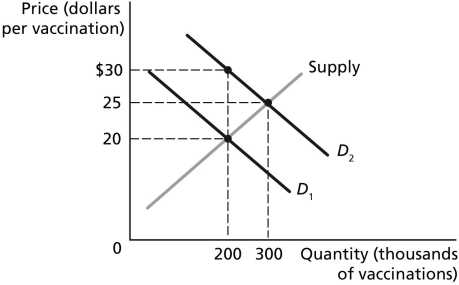 Figure 7-1 represents the market for vaccinations.Vaccinations are considered a benefit to society, and the figure shows both the marginal private benefit and the marginal social benefit from vaccinations.
-Refer to Figure 7-1.The efficient equilibrium quantity is ________ thousand vaccinations.
Figure 7-1 represents the market for vaccinations.Vaccinations are considered a benefit to society, and the figure shows both the marginal private benefit and the marginal social benefit from vaccinations.
-Refer to Figure 7-1.The efficient equilibrium quantity is ________ thousand vaccinations. (Multiple Choice)
4.8/5 (79)
(79) In the United States, the bulk of health care spending is paid by health insurance companies.Such a system is also called a third-party payer system where consumers of health care pay a nominal fee and the rest are paid by the health insurance provider.Why might such a system lead to an inefficient outcome?
(Multiple Choice)
4.8/5 (83)
(83) Figure 7-2
 Figure 7-2 represents the market for medical services with and without insurance, and the effect of a third-party payer system on the demand for medical services.
-Refer to Figure 7-2.With insurance and a third-party payer system, what is the amount of the deadweight loss?
Figure 7-2 represents the market for medical services with and without insurance, and the effect of a third-party payer system on the demand for medical services.
-Refer to Figure 7-2.With insurance and a third-party payer system, what is the amount of the deadweight loss? (Multiple Choice)
4.7/5 (75)
(75) Figure 7-2
Figure 7-2 represents the market for medical services with and without insurance, and the effect of a third-party payer system on the demand for medical services.
-Refer to Figure 7-2.If consumers paid the full price of medical services, the equilibrium quantity would be
Figure 7-2 represents the market for medical services with and without insurance, and the effect of a third-party payer system on the demand for medical services.
-Refer to Figure 7-2.If consumers paid the full price of medical services, the equilibrium quantity would be (Multiple Choice)
4.7/5 (77)
(77) Due to adverse selection, very few lemons will be sold in the market for used cars.
(True/False)
4.8/5 (78)
(78) Briefly describe the most important differences between the market for health care and the market for other goods and services.
(Essay)
4.9/5 (93)
(93) 
Filters
- Essay(0)
- Multiple Choice(0)
- Short Answer(0)
- True False(0)
- Matching(0)