



 Chat with AI
Exam 2: Trade-Offs, Comparative Advantage, and the Market System

Exam 1: Economics: Foundations and Models234 Questions
Exam 2: Trade-Offs, Comparative Advantage, and the Market System258 Questions
Exam 3: Where Prices Come From: the Interaction of Demand and Supply242 Questions
Exam 4: Economic Efficiency, Government Price Setting, and Taxes208 Questions
Exam 5: Externalities, Environmental Policy, and Public Goods263 Questions
Exam 6: Elasticity: the Responsiveness of Demand and Supply295 Questions
Exam 7: The Economics of Health Care171 Questions
Exam 8: Firms, the Stock Market, and Corporate Governance264 Questions
Exam 9: Comparative Advantage and the Gains From International Trade188 Questions
Exam 10: Consumer Choice and Behavioral Economics300 Questions
Exam 11: Technology, Production, and Costs328 Questions
Exam 12: Firms in Perfectly Competitive Markets296 Questions
Exam 13: Monopolistic Competition: the Competitive Model in a More Realistic Setting274 Questions
Exam 14: Oligopoly: Firms in Less Competitive Markets259 Questions
Exam 15: Monopoly and Antitrust Policy279 Questions
Exam 16: Pricing Strategy261 Questions
Exam 17: The Markets for Labor and Other Factors of Production281 Questions
Exam 18: Public Choice, Taxes, and the Distribution of Income258 Questions
Select questions type


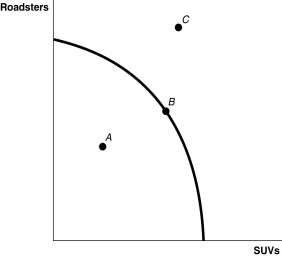 -Refer to Figure 2-1.Point C is

To increase gas mileage, automobile manufacturers make cars small and light.Large cars absorb more of the impact of an accident than small cars but yield lower gas mileage.These facts suggest that a negative relationship exists between safety and gas mileage.
(True/False)
4.9/5  (79)
(79) Figure 2-10
 Figure 2-10 shows the production possibilities frontiers for Tahiti and Bora Bora.Each country produces two goods, milk and honey.
-Refer to Figure 2-10.If the two countries have the same amount of resources and the same technological knowledge, which country has an absolute advantage in the production of milk?
Figure 2-10 shows the production possibilities frontiers for Tahiti and Bora Bora.Each country produces two goods, milk and honey.
-Refer to Figure 2-10.If the two countries have the same amount of resources and the same technological knowledge, which country has an absolute advantage in the production of milk? (Multiple Choice)
4.8/5 (80)
(80) Figure 2-9
 Figure 2-9 shows the production possibilities frontiers for Pakistan and Indonesia.Each country produces two goods, cotton and cashews.
-Refer to Figure 2-9.Which country has a comparative advantage in the production of cashews?
Figure 2-9 shows the production possibilities frontiers for Pakistan and Indonesia.Each country produces two goods, cotton and cashews.
-Refer to Figure 2-9.Which country has a comparative advantage in the production of cashews? (Multiple Choice)
4.8/5 (83)
(83) Figure 2-9
Figure 2-9 shows the production possibilities frontiers for Pakistan and Indonesia.Each country produces two goods, cotton and cashews.
-Refer to Figure 2-9.If the two countries have the same amount of resources and the same technological knowledge, which country has an absolute advantage in the production of cotton?
Figure 2-9 shows the production possibilities frontiers for Pakistan and Indonesia.Each country produces two goods, cotton and cashews.
-Refer to Figure 2-9.If the two countries have the same amount of resources and the same technological knowledge, which country has an absolute advantage in the production of cotton? (Multiple Choice)
4.8/5 (92)
(92) Table 2-2
Production choices for Billie's Bedroom Shop
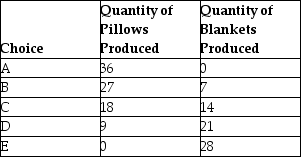 -Refer to Table 2-2.Assume Billie's Bedroom Shop only produces pillows and blankets.A combination of 9 pillows and 21 blankets would appear
 (Multiple Choice)
4.7/5 (89)
(89) Table 2-8
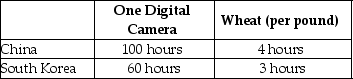 Table 2-8 shows the number of labor hours required to produce a digital camera and a pound of wheat in China and South Korea.
-Refer to Table 2-8.What is China's opportunity cost of producing one pound of wheat?
Table 2-8 shows the number of labor hours required to produce a digital camera and a pound of wheat in China and South Korea.
-Refer to Table 2-8.What is China's opportunity cost of producing one pound of wheat? (Multiple Choice)
4.7/5 (63)
(63) Table 2-8
Table 2-8 shows the number of labor hours required to produce a digital camera and a pound of wheat in China and South Korea.
-Refer to Table 2-8.What is China's opportunity cost of producing one digital camera?
Table 2-8 shows the number of labor hours required to produce a digital camera and a pound of wheat in China and South Korea.
-Refer to Table 2-8.What is China's opportunity cost of producing one digital camera? (Multiple Choice)
4.8/5 (70)
(70) Figure 2-14
 -Refer to Figure 2-14.Which two arrows in the diagram depict the following transaction: LaDonna sells 20 pairs of sunglasses at the Oakley store.
 (Multiple Choice)
4.8/5 (75)
(75) A decrease in population shifts the production possibilities frontier outwards over time.
(True/False)
4.7/5 (94)
(94) Which of the following is an example of spending on factors of production in the circular flow model?
(Multiple Choice)
4.8/5 (66)
(66) Table 2-8
Table 2-8 shows the number of labor hours required to produce a digital camera and a pound of wheat in China and South Korea.
-Refer to Table 2-8.What is South Korea's opportunity cost of producing one pound of wheat?
Table 2-8 shows the number of labor hours required to produce a digital camera and a pound of wheat in China and South Korea.
-Refer to Table 2-8.What is South Korea's opportunity cost of producing one pound of wheat? (Multiple Choice)
4.7/5 (77)
(77) Figure 2-4
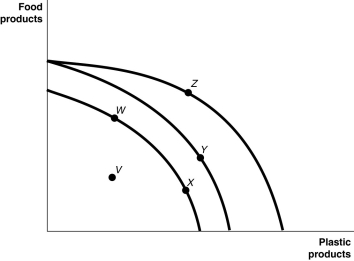 Figure 2-4 shows various points on three different production possibilities frontiers for a nation.
-Refer to Figure 2-4.Consider the following movements:
A.from point V to point W
B.from point W to point Y
C.from point Y to point Z
Which of the movements listed above represents economic growth?
Figure 2-4 shows various points on three different production possibilities frontiers for a nation.
-Refer to Figure 2-4.Consider the following movements:
A.from point V to point W
B.from point W to point Y
C.from point Y to point Z
Which of the movements listed above represents economic growth? (Multiple Choice)
4.8/5 (72)
(72) Table 2-6
 Table 2-6 shows the output per week of two jewelers, Serena and Haley.They can either devote their time to making bracelets or making necklaces.
-Refer to Table 2-6.What is Serena's opportunity cost of making a necklace?
Table 2-6 shows the output per week of two jewelers, Serena and Haley.They can either devote their time to making bracelets or making necklaces.
-Refer to Table 2-6.What is Serena's opportunity cost of making a necklace? (Multiple Choice)
4.8/5 (71)
(71) The attainable production points on a production possibilities curve are
(Multiple Choice)
5.0/5 (84)
(84) Figure 2-6
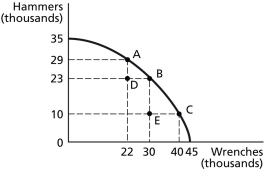 -Refer to Figure 2-6.If the economy is currently producing at point D, what is the opportunity cost of moving to point B?
 (Multiple Choice)
4.7/5 (82)
(82) 
Filters
- Essay(0)
- Multiple Choice(0)
- Short Answer(0)
- True False(0)
- Matching(0)