



 Chat with AI
Exam 2: Trade-Offs, Comparative Advantage, and the Market System

Exam 1: Economics: Foundations and Models234 Questions
Exam 2: Trade-Offs, Comparative Advantage, and the Market System258 Questions
Exam 3: Where Prices Come From: the Interaction of Demand and Supply242 Questions
Exam 4: Economic Efficiency, Government Price Setting, and Taxes208 Questions
Exam 5: Externalities, Environmental Policy, and Public Goods263 Questions
Exam 6: Elasticity: the Responsiveness of Demand and Supply295 Questions
Exam 7: The Economics of Health Care171 Questions
Exam 8: Firms, the Stock Market, and Corporate Governance264 Questions
Exam 9: Comparative Advantage and the Gains From International Trade188 Questions
Exam 10: Consumer Choice and Behavioral Economics300 Questions
Exam 11: Technology, Production, and Costs328 Questions
Exam 12: Firms in Perfectly Competitive Markets296 Questions
Exam 13: Monopolistic Competition: the Competitive Model in a More Realistic Setting274 Questions
Exam 14: Oligopoly: Firms in Less Competitive Markets259 Questions
Exam 15: Monopoly and Antitrust Policy279 Questions
Exam 16: Pricing Strategy261 Questions
Exam 17: The Markets for Labor and Other Factors of Production281 Questions
Exam 18: Public Choice, Taxes, and the Distribution of Income258 Questions
Select questions type


According to the production possibilities model, if more resources are allocated to the production of physical and human capital, then which of the following is likely to happen?
(Multiple Choice)
4.7/5  (83)
(83) Figure 2-4
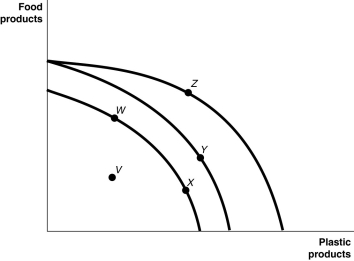 Figure 2-4 shows various points on three different production possibilities frontiers for a nation.
-Refer to Figure 2-4.Consider the following events:
A.a decrease in the unemployment rate
B.an increase in a nation's money supply
C.an influx of immigrant workers
Which of the events listed above could cause a movement from X to Z?
Figure 2-4 shows various points on three different production possibilities frontiers for a nation.
-Refer to Figure 2-4.Consider the following events:
A.a decrease in the unemployment rate
B.an increase in a nation's money supply
C.an influx of immigrant workers
Which of the events listed above could cause a movement from X to Z? (Multiple Choice)
4.9/5 (95)
(95) Table 2-12
 -Refer to Table 2-12.This table shows the number of labor hours required to produce a digital camera and a bushel of wheat in China and South Korea.
a.Which country has an absolute advantage in the production of digital cameras?
b.Which country has an absolute advantage in the production of wheat?
c.What is China's opportunity cost of producing one digital camera?
d.What is South Korea's opportunity cost of producing one digital camera?
e.What is China's opportunity cost of producing one bushel of wheat?
f.What is South Korea's opportunity cost of producing one pound of wheat?
g.If each country specializes in the production of the product in which it has a comparative advantage, who should produce digital cameras?
h.If each country specializes in the production of the product in which it has a comparative advantage, who should produce wheat?
-Refer to Table 2-12.This table shows the number of labor hours required to produce a digital camera and a bushel of wheat in China and South Korea.
a.Which country has an absolute advantage in the production of digital cameras?
b.Which country has an absolute advantage in the production of wheat?
c.What is China's opportunity cost of producing one digital camera?
d.What is South Korea's opportunity cost of producing one digital camera?
e.What is China's opportunity cost of producing one bushel of wheat?
f.What is South Korea's opportunity cost of producing one pound of wheat?
g.If each country specializes in the production of the product in which it has a comparative advantage, who should produce digital cameras?
h.If each country specializes in the production of the product in which it has a comparative advantage, who should produce wheat? (Essay)
4.9/5 (80)
(80) Table 2-9
 Table 2-9 shows the number of labor hours required to produce a canoe and a sailboat in Guatemala and Honduras.
-Refer to Table 2-9.What is Guatemala's opportunity cost of producing one sailboat?
Table 2-9 shows the number of labor hours required to produce a canoe and a sailboat in Guatemala and Honduras.
-Refer to Table 2-9.What is Guatemala's opportunity cost of producing one sailboat? (Multiple Choice)
4.8/5 (89)
(89) Figure 2-2
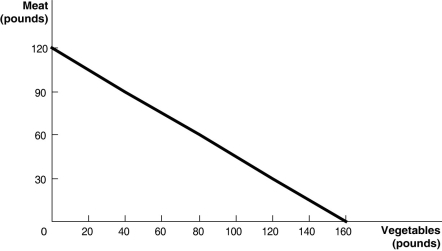 Figure 2-2 above shows the production possibilities frontier for Mendonca, an agrarian nation that produces two goods, meat and vegetables.
-Refer to Figure 2-2.If Mendonca chooses to produce 120 pounds of meat, how much vegetables can it produce to maximize production?
Figure 2-2 above shows the production possibilities frontier for Mendonca, an agrarian nation that produces two goods, meat and vegetables.
-Refer to Figure 2-2.If Mendonca chooses to produce 120 pounds of meat, how much vegetables can it produce to maximize production? (Multiple Choice)
4.9/5 (69)
(69) Table 2-7
 Table 2-7 shows the output per month of two people, Fred and Barney.They can either devote their time to making pogo sticks or making unicycles.
-Refer to Table 2-7.What is Fred's opportunity cost of making a pogo stick?
Table 2-7 shows the output per month of two people, Fred and Barney.They can either devote their time to making pogo sticks or making unicycles.
-Refer to Table 2-7.What is Fred's opportunity cost of making a pogo stick? (Multiple Choice)
4.8/5 (71)
(71) Table 2-7
Table 2-7 shows the output per month of two people, Fred and Barney.They can either devote their time to making pogo sticks or making unicycles.
-Refer to Table 2-7.What is Barney's opportunity cost of making a pogo stick?
Table 2-7 shows the output per month of two people, Fred and Barney.They can either devote their time to making pogo sticks or making unicycles.
-Refer to Table 2-7.What is Barney's opportunity cost of making a pogo stick? (Multiple Choice)
4.9/5 (86)
(86) The opportunity cost of taking a semester-long economics class is
(Multiple Choice)
4.8/5 (86)
(86) Suppose your expenses for this term are as follows: tuition: $28,000, room and board: $9,000, books and other educational supplies: $2,500.Further, during the term, you can only work part-time and earn $16,000 instead of your full-time salary of $42,000.What is the opportunity cost of going to college this term, assuming that your room and board expenses would be the same even if you did not go to college?
(Multiple Choice)
4.8/5 (73)
(73) Which of the following would shift a nation's production possibilities frontier outward?
(Multiple Choice)
4.9/5 (74)
(74) Figure 2-6
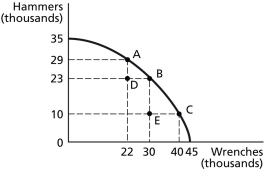 -Refer to Figure 2-6.If the economy is currently producing at point E, what is the opportunity cost of moving to point B?
 (Multiple Choice)
5.0/5 (80)
(80) In a production possibilities frontier model, a point ________ the frontier is productively inefficient.
(Multiple Choice)
4.8/5 (91)
(91) In a free market there are significant restrictions on how a good or service can be produced or sold.
(True/False)
5.0/5 (86)
(86) Figure 2-9
 Figure 2-9 shows the production possibilities frontiers for Pakistan and Indonesia.Each country produces two goods, cotton and cashews.
-Refer to Figure 2-9.What is the opportunity cost of producing 1 pound of cashews in Indonesia?
Figure 2-9 shows the production possibilities frontiers for Pakistan and Indonesia.Each country produces two goods, cotton and cashews.
-Refer to Figure 2-9.What is the opportunity cost of producing 1 pound of cashews in Indonesia? (Multiple Choice)
4.8/5 (75)
(75) If the best surgeon in town is also the best at cleaning swimming pools, then according to economic reasoning, this person should
(Multiple Choice)
4.9/5 (76)
(76) Households ________ final goods and services in the ________ market.
(Multiple Choice)
5.0/5 (78)
(78) 
Filters
- Essay(0)
- Multiple Choice(0)
- Short Answer(0)
- True False(0)
- Matching(0)