



 Chat with AI
Exam 18: Markets for Factors of Production

Exam 1: What Is Economics212 Questions
Exam 2: The Economic Problem159 Questions
Exam 3: Demand and Supply198 Questions
Exam 4: Elasticity186 Questions
Exam 5: Efficiency and Equity121 Questions
Exam 6: Government Actions in Markets130 Questions
Exam 7: Global Markets in Action138 Questions
Exam 8: Utility and Demand120 Questions
Exam 9: Possibilities, Preferences, and Choices124 Questions
Exam 10: Organizing Production111 Questions
Exam 11: Output and Costs142 Questions
Exam 12: Perfect Competition117 Questions
Exam 13: Monopoly118 Questions
Exam 14: Monopolistic Competition122 Questions
Exam 15: Oligopoly106 Questions
Exam 16: Externalities116 Questions
Exam 17: Public Goods and Common Resources98 Questions
Exam 18: Markets for Factors of Production252 Questions
Select questions type


Use the figure below to answer the following questions.
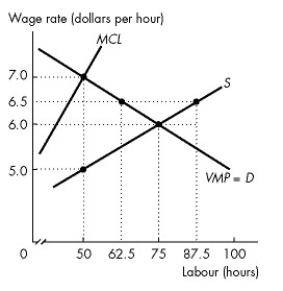 Figure 18.3.1
-Refer to Figure 18.3.1.This figure shows the value of marginal product of labour curve, the labour supply curve, and the marginal cost of labour curve.If this labour market is controlled by a monopsony, then the monopsonist hires
Figure 18.3.1
-Refer to Figure 18.3.1.This figure shows the value of marginal product of labour curve, the labour supply curve, and the marginal cost of labour curve.If this labour market is controlled by a monopsony, then the monopsonist hires (Multiple Choice)
5.0/5  (88)
(88) Use the figure below to answer the following questions.
 Figure 19.3.2
-Refer to Figure 19.3.2.At an employment level of 20 hours per week, firms are willing to pay
Figure 19.3.2
-Refer to Figure 19.3.2.At an employment level of 20 hours per week, firms are willing to pay (Multiple Choice)
4.8/5 (76)
(76) Which one of the following would unions be most likely to support?
(Multiple Choice)
4.8/5 (80)
(80) Which one of the following reduces the inequality of income or wealth relative to the market distribution?
(Multiple Choice)
4.8/5 (73)
(73) Use the figure below to answer the following questions.
 Figure 18.3.2
-If a union forms to face the monopsonist in Figure 18.3.2, the situation is one of
Figure 18.3.2
-If a union forms to face the monopsonist in Figure 18.3.2, the situation is one of (Multiple Choice)
4.9/5 (78)
(78) A generation that is wealthy and leaves assets to another generation that is not wealthy
(Multiple Choice)
4.8/5 (93)
(93) A union is formed to restrict labour supply in a previously perfectly competitive labour market.If the union succeeds in raising the wage, everything else remaining the same,
(Multiple Choice)
4.7/5 (86)
(86) Discrimination results in ________ compared to a situation with no discrimination.
(Multiple Choice)
4.8/5 (72)
(72) Measured wealth distributions that do not consider the distribution of human capital
(Multiple Choice)
4.8/5 (85)
(85) Use the table below to answer the following questions.
Table 19.4.1
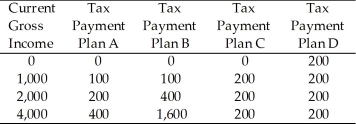 -In Table 19.4.1, which tax plan is proportional?
 (Multiple Choice)
4.8/5 (82)
(82) Use the information below to answer the following questions.
Fact 18.4.1
Water is a natural resource that is plentiful in Canada but not plentiful in Arizona and southern California. Suppose Canadians start to export bulk water to Arizona and southern California.
-Refer to Fact 18.4.1.The Hotelling Principle ________ apply to Canada's water because the Hotelling Principle ________.
(Multiple Choice)
4.8/5 (79)
(79) Use the figure below to answer the following questions.
 Figure 19.3.5
-Refer to Figure 19.3.5.This figure shows the labour supply curves and the value of marginal product curves for high-skilled and low-skilled workers.The equilibrium wage rate for low-skilled workers is
Figure 19.3.5
-Refer to Figure 19.3.5.This figure shows the labour supply curves and the value of marginal product curves for high-skilled and low-skilled workers.The equilibrium wage rate for low-skilled workers is (Multiple Choice)
4.9/5 (82)
(82) In 2011, the mode income received by 6.0 percent of households in Canada was between
(Multiple Choice)
4.8/5 (81)
(81) A decrease in the price of factors of production that are substitutes for labour shifts the labour
(Multiple Choice)
4.9/5 (86)
(86) Use the figure below to answer the following questions.
 Figure 19.1.2
-Consider the Lorenz curves in Figure 19.1.2.Which Lorenz curve corresponds to the greatest income inequality?
Figure 19.1.2
-Consider the Lorenz curves in Figure 19.1.2.Which Lorenz curve corresponds to the greatest income inequality? (Multiple Choice)
4.8/5 (71)
(71) 
Filters
- Essay(0)
- Multiple Choice(0)
- Short Answer(0)
- True False(0)
- Matching(0)