



 Chat with AI
Exam 7: Global Markets in Action

Exam 1: What Is Economics212 Questions
Exam 2: The Economic Problem159 Questions
Exam 3: Demand and Supply198 Questions
Exam 4: Elasticity186 Questions
Exam 5: Efficiency and Equity121 Questions
Exam 6: Government Actions in Markets130 Questions
Exam 7: Global Markets in Action138 Questions
Exam 8: Utility and Demand120 Questions
Exam 9: Possibilities, Preferences, and Choices124 Questions
Exam 10: Organizing Production111 Questions
Exam 11: Output and Costs142 Questions
Exam 12: Perfect Competition117 Questions
Exam 13: Monopoly118 Questions
Exam 14: Monopolistic Competition122 Questions
Exam 15: Oligopoly106 Questions
Exam 16: Externalities116 Questions
Exam 17: Public Goods and Common Resources98 Questions
Exam 18: Markets for Factors of Production252 Questions
Select questions type


A tariff is a tax that is imposed by the ________ country when an ________ good crosses its international boundary.
(Multiple Choice)
4.9/5  (91)
(91) Among the following, the domestic government gains the most revenue when it
(Multiple Choice)
4.9/5 (68)
(68) Table 7.3.1
Canada's Market for Widgets
 -Table 7.3.1 shows the Canadian supply of and demand for widgets.Widgets are available on the world market for $7.Canadian widget producers convince the government to protect the domestic industry from cheap imports.If the Canadian government sets an import quota of 8 million widgets, the resulting price of a widget in Canada will be ________, and domestic production will be ________.
 (Multiple Choice)
4.9/5 (85)
(85) Refer to the figure below to answer the following questions.
 Figure 7.2.2
The figure shows the market for helicopters in Canada, where D is the domestic demand curve and S is the domestic supply curve. Canada trades helicopters with the rest of the world at a price of $36 million per helicopter.
-In Figure 7.2.2, international trade ________ consumer surplus in Canada by ________.
Figure 7.2.2
The figure shows the market for helicopters in Canada, where D is the domestic demand curve and S is the domestic supply curve. Canada trades helicopters with the rest of the world at a price of $36 million per helicopter.
-In Figure 7.2.2, international trade ________ consumer surplus in Canada by ________. (Multiple Choice)
5.0/5 (92)
(92) If a country imposes a tariff on an imported good, the tariff ________ the price in the importing country and ________ the quantity of imports.
(Multiple Choice)
4.8/5 (92)
(92) Refer to the figure below to answer the following questions.
 Figure 7.3.1
The figure shows the market for shirts in Canada, where D is the domestic demand curve and S is the domestic supply curve. The world price is $20 per shirt. Canada imposes a tariff on imported shirts of $4 per shirt.
-Refer to Figure 7.3.1.The Canadian government's revenue from the tariff is ________.
Figure 7.3.1
The figure shows the market for shirts in Canada, where D is the domestic demand curve and S is the domestic supply curve. The world price is $20 per shirt. Canada imposes a tariff on imported shirts of $4 per shirt.
-Refer to Figure 7.3.1.The Canadian government's revenue from the tariff is ________. (Multiple Choice)
4.7/5 (70)
(70) A country moves from a situation of no trade to a situation where it imports a good.Which of the following does not occur in the market for this good in the importing country?
(Multiple Choice)
4.9/5 (84)
(84) Table 7.2.1
 -Table 7.2.1 shows a country's demand and supply schedules.Based on Table 7.2.1, at what world price would the country import?
 (Multiple Choice)
4.8/5 (80)
(80) Canada exports athletic coaching services and imports computer tech support.The price of computer tech support in Canada is ________ with international trade than without international trade.As a result of trade in computer tech support, the Canadian producer surplus from computer tech support ________.
(Multiple Choice)
4.7/5 (85)
(85) Which of the following statements about Canada's international trade in 2013 is correct?
(Multiple Choice)
4.8/5 (70)
(70) Refer to the figure below to answer the following question.
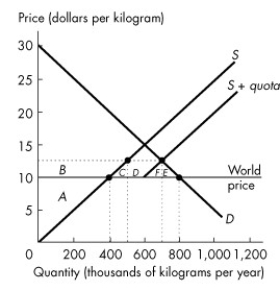 Figure 7.3.2
-Refer to Figure 7.3.2.The supply of peanuts in Canada is made up of Canadian grown peanuts and imported peanuts.Initially, Canada engages in free trade in the peanut market.Then Canada puts a quota on peanut imports.The graph shows the Canadian market for peanuts when the Canadian government puts a quota on peanut imports.The Canadian consumer surplus that is redistributed to Canadian producers is ________ and the quota creates a deadweight loss equal to ________.
Figure 7.3.2
-Refer to Figure 7.3.2.The supply of peanuts in Canada is made up of Canadian grown peanuts and imported peanuts.Initially, Canada engages in free trade in the peanut market.Then Canada puts a quota on peanut imports.The graph shows the Canadian market for peanuts when the Canadian government puts a quota on peanut imports.The Canadian consumer surplus that is redistributed to Canadian producers is ________ and the quota creates a deadweight loss equal to ________. (Multiple Choice)
4.8/5 (79)
(79) Refer to the figure below to answer the following questions.
Figure 7.2.2
The figure shows the market for helicopters in Canada, where D is the domestic demand curve and S is the domestic supply curve. Canada trades helicopters with the rest of the world at a price of $36 million per helicopter.
-In Figure 7.2.2, Canada ________ helicopters per year.
Figure 7.2.2
The figure shows the market for helicopters in Canada, where D is the domestic demand curve and S is the domestic supply curve. Canada trades helicopters with the rest of the world at a price of $36 million per helicopter.
-In Figure 7.2.2, Canada ________ helicopters per year. (Multiple Choice)
4.8/5 (78)
(78) A market is open to international trade.At the world price, the quantity demanded is 150 units and the quantity supplied is 200 units.This country will
(Multiple Choice)
4.9/5 (79)
(79) ________ occurs when a foreign firm sells its exports at a lower price than its cost of production.
(Multiple Choice)
4.9/5 (90)
(90) 
Filters
- Essay(0)
- Multiple Choice(0)
- Short Answer(0)
- True False(0)
- Matching(0)