



 Chat with AI
Exam 2: The Economic Problem

Exam 1: What Is Economics212 Questions
Exam 2: The Economic Problem159 Questions
Exam 3: Demand and Supply198 Questions
Exam 4: Elasticity186 Questions
Exam 5: Efficiency and Equity121 Questions
Exam 6: Government Actions in Markets130 Questions
Exam 7: Global Markets in Action138 Questions
Exam 8: Utility and Demand120 Questions
Exam 9: Possibilities, Preferences, and Choices124 Questions
Exam 10: Organizing Production111 Questions
Exam 11: Output and Costs142 Questions
Exam 12: Perfect Competition117 Questions
Exam 13: Monopoly118 Questions
Exam 14: Monopolistic Competition122 Questions
Exam 15: Oligopoly106 Questions
Exam 16: Externalities116 Questions
Exam 17: Public Goods and Common Resources98 Questions
Exam 18: Markets for Factors of Production252 Questions
Select questions type


Use the figure below to answer the following questions.
 Figure 2.1.2
-Refer to the production possibilities frontier in Figure 2.1.2.At point C, what is the opportunity cost of increasing the production of Y from 20 to 50 units?
Figure 2.1.2
-Refer to the production possibilities frontier in Figure 2.1.2.At point C, what is the opportunity cost of increasing the production of Y from 20 to 50 units? (Multiple Choice)
4.9/5  (71)
(71) Use the figure below to answer the following questions.
Figure 2.1.2
-Consider the production possibilities frontier in Figure 2.1.2.Which of the following statements is false?
Figure 2.1.2
-Consider the production possibilities frontier in Figure 2.1.2.Which of the following statements is false? (Multiple Choice)
4.9/5 (67)
(67) In 1963, the production possibilities per person in Canada were ________ than those in Hong Kong. Between 1963 and 2013, Hong Kong's production possibilities have ________ Canada's production possibilities.
(Multiple Choice)
4.7/5 (79)
(79) In general, if country A is accumulating capital at a faster rate than country B, then country A
(Multiple Choice)
4.9/5 (78)
(78) The principle of decreasing marginal benefit implies that the
(Multiple Choice)
4.7/5 (63)
(63) Use the table below to answer the following question.
Table 2.2.1
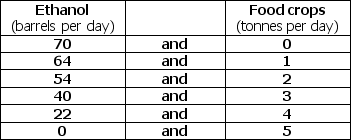 -Refer to Table 2.2.1.Marginal benefit from food crops
 (Multiple Choice)
4.9/5 (88)
(88) Which one of the following would cause a production possibilities frontier to shift outward?
(Multiple Choice)
4.8/5 (75)
(75) Consider the following household.In 5 hours, Bob can cook 5 meals or clean 6 rooms.In 5 hours, Mary can cook 30 meals or clean 10 rooms.Select the best statement.
(Multiple Choice)
4.8/5 (73)
(73) Use the information below to answer the following questions.
Fact 2.4.2
Agnes can produce either 1 unit of X or 1 unit of Y in an hour, while Brenda can produce either 2 units of X or 4 units of Y in an hour.
-Refer to Fact 2.4.2.Which one of the following statements is true?
(Multiple Choice)
4.9/5 (92)
(92) The depletion of fish stocks in Eastern Canada, with its accompanying unemployment, will lead to a
(Multiple Choice)
4.8/5 (80)
(80) Which one of the following would likely shift a production possibilities frontier inward?
(Multiple Choice)
4.8/5 (74)
(74) Use the figure below to answer the following questions.
Table 2.4.1
The planets of Vulcan and Romulus each produce goods X and Y.
The following table gives points on their production possibilities frontiers.
 -Refer to Table 2.4.1.Which one of the following is true?
 (Multiple Choice)
4.8/5 (73)
(73) The flows in the market economy that go from firms to households are ________. The flows in the market economy that go from households to firms are ________.
(Multiple Choice)
4.9/5 (75)
(75) Use the figure below to answer the following questions.
 Figure 2.1.3
-Figure 2.1.3 illustrates Mary's production possibilities frontier.If Mary wants to move from point D to point C,
Figure 2.1.3
-Figure 2.1.3 illustrates Mary's production possibilities frontier.If Mary wants to move from point D to point C, (Multiple Choice)
4.7/5 (91)
(91) Use the information below to answer the following questions.
Fact 2.4.1
In one hour, Sue can produce 50 caps or 10 jackets, and Tessa can produce 70 caps or 7 jackets.
-Refer to Fact 2.4.1.Sue's opportunity cost of producing a cap is ________ jackets and Tessa's opportunity cost of producing a cap is ________ jackets.
(Multiple Choice)
4.8/5 (76)
(76) Use the information below to answer the following questions.
Fact 2.4.2
Agnes can produce either 1 unit of X or 1 unit of Y in an hour, while Brenda can produce either 2 units of X or 4 units of Y in an hour.
-Complete the following sentence.Given Fact 2.4.2,
(Multiple Choice)
4.8/5 (90)
(90) Which of the following is true regarding marginal benefit? I. The marginal benefit curve shows the benefit firms receive by producing another unit of a good.
II. Marginal benefit increases as more and more of a good is consumed.
III. Marginal benefit is the maximum amount a person is willing to pay to obtain one more unit of a good.
(Multiple Choice)
4.8/5 (66)
(66) 
Filters
- Essay(0)
- Multiple Choice(0)
- Short Answer(0)
- True False(0)
- Matching(0)