



 Chat with AI
Exam 17: Oligopoly

Exam 1: Ten Principles of Economics218 Questions
Exam 2: Thinking Like an Economist239 Questions
Exam 3: Interdependence and the Gains From Trade207 Questions
Exam 4: The Market Forces of Supply and Demand351 Questions
Exam 5: Elasticity and Its Application230 Questions
Exam 6: Supply, demand, and Government Policies248 Questions
Exam 7: Consumers, producers, and the Efficiency of Markets216 Questions
Exam 8: Application: the Costs of Taxation222 Questions
Exam 9: Application: International Trade182 Questions
Exam 10: Externalities210 Questions
Exam 11: Public Goods and Common Resources173 Questions
Exam 12: The Design of the Tax System200 Questions
Exam 13: The Costs of Production209 Questions
Exam 14: Firms in Competitive Markets261 Questions
Exam 15: Monopoly239 Questions
Exam 16: Monopolistic Competition191 Questions
Exam 17: Oligopoly198 Questions
Exam 18: The Markets for the Factors of Production180 Questions
Exam 19: Earnings and Discrimination167 Questions
Exam 20: Income Inequality and Poverty163 Questions
Exam 21: The Theory of Consumer Choice191 Questions
Exam 22: Frontiers of Microeconomics141 Questions
Select questions type


If nations such as Germany,Japan,and Canada prohibited international trade in automobiles,what would a likely effect be
(Multiple Choice)
4.8/5  (76)
(76) What is the general term for market structures that fall somewhere in between monopoly and perfect competition
(Multiple Choice)
4.8/5 (84)
(84) What is one key difference between an oligopoly market and a competitive market
(Multiple Choice)
4.9/5 (76)
(76) In a typical cartel agreement,when does the cartel maximize profit
(Multiple Choice)
4.9/5 (79)
(79) Noncooperative outcomes typically imply what kind of outcome
(Multiple Choice)
4.9/5 (68)
(68) Table 17-4
Consider trade relations between Canada and Germany. Assume that the leaders of the two countries believe the payoffs to alternative trade policies are as follows:
 -Refer to Table 17-4.If trade negotiators are able to communicate effectively about the consequences of various trade policies (i.e.,enter into an agreement about the policy they should adopt),then what would we expect the game outcome to be
 (Multiple Choice)
4.8/5 (81)
(81) Table 17-1
Imagine a small town in which only two residents, Matthew and Anna, own wells that produce water for safe drinking. Each Saturday, Matthew and Anna work together to decide how many litres of water to pump, bring the water to town, and sell it at whatever price the market will bear. To keep things simple, suppose that Matthew and Anna can pump as much water as they want without cost; therefore, the marginal cost of water equals zero.
The weekly town demand schedule and total revenue schedule for water is reflected in the table.
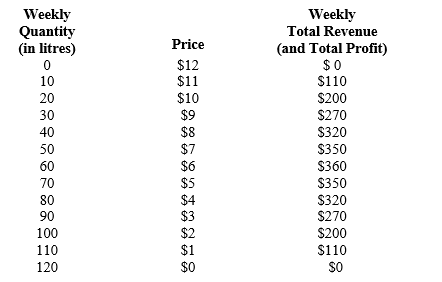 -Refer to Table 17-1.Suppose the town enacts new competition laws that prohibit Matthew and Anna from operating as a monopolist.What will the new price of water end up being once the Nash equilibrium is reached
 (Multiple Choice)
4.7/5 (82)
(82) Assume that oligopoly firms are profit maximizers,do not form a cartel,and take other firms' production levels as given.How does the output effect compare with the price effect
(Multiple Choice)
4.9/5 (76)
(76) Table 17-1
Imagine a small town in which only two residents, Matthew and Anna, own wells that produce water for safe drinking. Each Saturday, Matthew and Anna work together to decide how many litres of water to pump, bring the water to town, and sell it at whatever price the market will bear. To keep things simple, suppose that Matthew and Anna can pump as much water as they want without cost; therefore, the marginal cost of water equals zero.
The weekly town demand schedule and total revenue schedule for water is reflected in the table.
-Refer to Table 17-1.If the market for water was perfectly competitive instead of monopolistic,how many litres of water would be produced and sold
-Refer to Table 17-1.If the market for water was perfectly competitive instead of monopolistic,how many litres of water would be produced and sold (Multiple Choice)
4.8/5 (71)
(71) An oligopolist will increase production if the output effect is which of the following
(Multiple Choice)
4.9/5 (87)
(87) What is a group of firms that are acting in unison to maximize collective profits called
(Multiple Choice)
4.8/5 (82)
(82) Firms in industries that have competitors but,at the same time,do not face so much competition that they are price takers,are operating in either of which types of markets
(Multiple Choice)
5.0/5 (88)
(88) Explain the practice of resale price maintenance and discuss why it is controversial.
(Essay)
4.9/5 (74)
(74) What is the practice of requiring someone to buy two or more items together,rather than separately,called
(Multiple Choice)
4.8/5 (69)
(69) In a competitive market,strategic interactions among the firms are not important.
(True/False)
4.8/5 (71)
(71) Firms do not need to be concerned about striking a balance between the price effect and the output effect when making production decisions in which type of markets
(Multiple Choice)
4.7/5 (89)
(89) If all the oligopolists in a market collude to form a cartel,total profit for the cartel is less than that of a monopolist.
(True/False)
4.8/5 (79)
(79) Increasing production will increase quantity sold,which will decrease the price of all units sold.What is this concept known as
(Multiple Choice)
4.9/5 (67)
(67) 
Filters
- Essay(0)
- Multiple Choice(0)
- Short Answer(0)
- True False(0)
- Matching(0)