



 Chat with AI
Exam 16: Monopolistic Competition

Exam 1: Ten Principles of Economics218 Questions
Exam 2: Thinking Like an Economist239 Questions
Exam 3: Interdependence and the Gains From Trade207 Questions
Exam 4: The Market Forces of Supply and Demand351 Questions
Exam 5: Elasticity and Its Application230 Questions
Exam 6: Supply, demand, and Government Policies248 Questions
Exam 7: Consumers, producers, and the Efficiency of Markets216 Questions
Exam 8: Application: the Costs of Taxation222 Questions
Exam 9: Application: International Trade182 Questions
Exam 10: Externalities210 Questions
Exam 11: Public Goods and Common Resources173 Questions
Exam 12: The Design of the Tax System200 Questions
Exam 13: The Costs of Production209 Questions
Exam 14: Firms in Competitive Markets261 Questions
Exam 15: Monopoly239 Questions
Exam 16: Monopolistic Competition191 Questions
Exam 17: Oligopoly198 Questions
Exam 18: The Markets for the Factors of Production180 Questions
Exam 19: Earnings and Discrimination167 Questions
Exam 20: Income Inequality and Poverty163 Questions
Exam 21: The Theory of Consumer Choice191 Questions
Exam 22: Frontiers of Microeconomics141 Questions
Select questions type


Firm A produces and sells in a market that is characterized by highly differentiated consumer goods.Firm B produces and sells industrial products.Firm C produces and sells an agricultural commodity.Which firm is likely to spend the greatest portion of its total revenue on advertising
(Multiple Choice)
4.8/5  (81)
(81) On a vacation to Cancun,Mexico,you find yourself eating every meal at the local Burger King rather than having a hamburger from one of the street vendors.Your travelling companion claims that you are irrational,since you very rarely eat Burger King hamburgers when you are home and Burger King hamburgers cost more than those prepared and sold by Cancun's street vendors.How would an economist most likely explain your behaviour
(Multiple Choice)
4.9/5 (88)
(88) When advertising encourages customers to become more informed about all firms in the market,what is the result
(Multiple Choice)
4.8/5 (74)
(74) When advertising enhances the ability of markets to allocate resources,what is it most likely to be doing
(Multiple Choice)
4.8/5 (74)
(74) In a monopolistically competitive industry,how does price compare with marginal cost
(Multiple Choice)
4.9/5 (86)
(86) Why does each firm in a monopolistically competitive market face a downward-sloping demand curve
(Multiple Choice)
4.8/5 (79)
(79) What is the likely intent of advertising that uses celebrity endorsements
(Multiple Choice)
4.9/5 (88)
(88) Table 16-1
A monopolistically competitive firm faces the following demand curve for its product:
 -Refer to Table 16-1.The firm has total fixed costs of $20 and a constant marginal cost of $3 per unit.What will the firm do
 (Multiple Choice)
4.8/5 (76)
(76) A profit-maximizing firm in a monopolistically competitive market generally operates on the downward-sloping portion of its marginal-cost curve.
(True/False)
4.8/5 (82)
(82) In the long run,a monopolistically competitive firm produces a quantity that is which of the following
(Multiple Choice)
4.8/5 (92)
(92) Ignoring oligopoly and focusing on the other three types of market structure,in which of those market structures does a profit-maximizing firm experience a zero economic profit
(Multiple Choice)
4.9/5 (90)
(90) When a market is monopolistically competitive,what is the typical firm in the market likely to experience in the short and long run
(Multiple Choice)
4.8/5 (92)
(92) Evaluate the following statement: "Advertisements that use celebrity endorsements are devoid of any value and do not enhance the efficient functioning of markets."
(Essay)
4.8/5 (81)
(81) Figure 16-2
 -Refer to Figure 16-2.If a firm in a monopolistically competitive market was producing the level of output depicted as QD in panel (d),what would it experience
 (Multiple Choice)
5.0/5 (75)
(75) What will happen if firms in a monopolistically competitive market are earning positive profits
(Multiple Choice)
4.8/5 (70)
(70) New firms will necessarily enter a monopolistically competitive market when price exceeds what amount
(Multiple Choice)
4.9/5 (79)
(79) Frank is an ice-cream maker in a monopolistic competitive market.He has developed a recipe by using low fat yogurt.Suppose that the marginal cost of producing one scoop of this special ice cream is $0.40 and there is no fixed cost.The demand for Frank's special ice cream per hour is given by the table below. 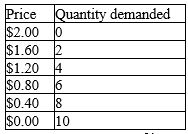 a. How many scoops of ice cream should Frank produce in the short run to maximize profits? What price should he charge?
b. Calculate his economic profits in the short run.
c. Lucy also has a special recipe to make low-fat ice cream. Supposing her cost of making a scoop of ice
cream is the same as Frank’s, should she enter the market?
d. If Lucy enters the market, the demand for Frank’s ice cream will decrease by 2 at each price. Find Frank’s new profit-maximizing quantity, price, and profits.
a. How many scoops of ice cream should Frank produce in the short run to maximize profits? What price should he charge?
b. Calculate his economic profits in the short run.
c. Lucy also has a special recipe to make low-fat ice cream. Supposing her cost of making a scoop of ice
cream is the same as Frank’s, should she enter the market?
d. If Lucy enters the market, the demand for Frank’s ice cream will decrease by 2 at each price. Find Frank’s new profit-maximizing quantity, price, and profits. (Essay)
4.9/5 (76)
(76) What is an important difference between the situations faced by a profit-maximizing monopolistically competitive firm in the short run and in the long run
(Multiple Choice)
4.9/5 (74)
(74) 
Filters
- Essay(0)
- Multiple Choice(0)
- Short Answer(0)
- True False(0)
- Matching(0)