



 Chat with AI
Exam 13: The Costs of Production

Exam 1: Ten Principles of Economics218 Questions
Exam 2: Thinking Like an Economist239 Questions
Exam 3: Interdependence and the Gains From Trade207 Questions
Exam 4: The Market Forces of Supply and Demand351 Questions
Exam 5: Elasticity and Its Application230 Questions
Exam 6: Supply, demand, and Government Policies248 Questions
Exam 7: Consumers, producers, and the Efficiency of Markets216 Questions
Exam 8: Application: the Costs of Taxation222 Questions
Exam 9: Application: International Trade182 Questions
Exam 10: Externalities210 Questions
Exam 11: Public Goods and Common Resources173 Questions
Exam 12: The Design of the Tax System200 Questions
Exam 13: The Costs of Production209 Questions
Exam 14: Firms in Competitive Markets261 Questions
Exam 15: Monopoly239 Questions
Exam 16: Monopolistic Competition191 Questions
Exam 17: Oligopoly198 Questions
Exam 18: The Markets for the Factors of Production180 Questions
Exam 19: Earnings and Discrimination167 Questions
Exam 20: Income Inequality and Poverty163 Questions
Exam 21: The Theory of Consumer Choice191 Questions
Exam 22: Frontiers of Microeconomics141 Questions
Select questions type


Figure 13-6
 -Refer to Figure 13-6.What do the three average-total-cost curves on the diagram correspond to
 (Multiple Choice)
4.9/5  (78)
(78) When marginal cost is rising,what must happen to average variable cost
(Multiple Choice)
4.8/5 (82)
(82) Examination of the costs of production is unnecessary to the field of industrial organization.
(True/False)
5.0/5 (90)
(90) Figure 13-6
-Refer to Figure 13-6.When does the firm experience economies of scale
-Refer to Figure 13-6.When does the firm experience economies of scale (Multiple Choice)
4.8/5 (72)
(72) 
In some cases,specialization allows larger factories to produce goods at a lower average cost than smaller factories.
(True/False)
4.9/5 (80)
(80) Let L represent the number of workers hired by a firm and let Q represent that firm's quantity of output.Assume two points on the firm's production function are (L = 12,Q = 122) and (L = 13,Q = 132).What is the marginal product of the 13th worker
(Multiple Choice)
4.7/5 (80)
(80) Which statement explains the relationship among different cost functions
(Multiple Choice)
4.9/5 (85)
(85) What are opportunity costs? How do explicit and implicit costs relate to opportunity costs?
(Essay)
4.8/5 (81)
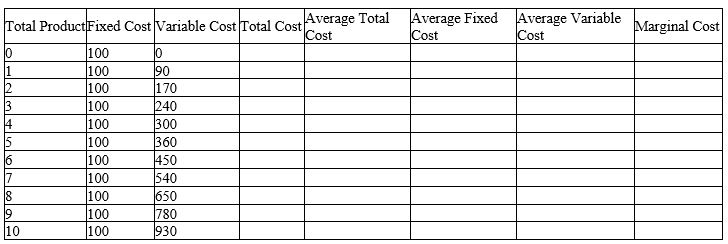
(81) Table 13-3  -Refer to Table 13-3.What is the average fixed cost for the month if nine instructional modules are produced
 (Multiple Choice)
4.8/5 (74)
(74) Thelma owns and operates a small meat pie stand at a local farmer's market.When Thelma is producing a small quantity of meat pies,she has few workers and her equipment is not being fully utilized.If she can easily put her idle resources to use,what will happen to the costs of production
(Multiple Choice)
4.9/5 (68)
(68) According to the mathematical laws that govern the relationship between average total cost and marginal cost, where must these two curves intersect?
(Essay)
4.7/5 (76)
(76) What do a firm's opportunity costs of production amount to
(Multiple Choice)
4.9/5 (77)
(77) When a firm's only variable input is labour,what does the slope of the production function measure
(Multiple Choice)
4.8/5 (90)
(90) Table 13-4
At Beth’s Bakery, Beth pays all her workers the same wage and labour is her only variable cost. Consider the following information about bread production at Beth’s Bakery:
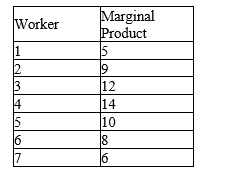 -From the information in Table 13-4,what can we conclude about Beth's marginal cost
 (Multiple Choice)
4.9/5 (71)
(71) Which costs do NOT vary with the amount of output a firm produces
(Multiple Choice)
4.9/5 (67)
(67) Why is average total cost very high when a small amount of output is produced
(Multiple Choice)
5.0/5 (79)
(79) 
Filters
- Essay(0)
- Multiple Choice(0)
- Short Answer(0)
- True False(0)
- Matching(0)