



 Chat with AI
Exam 7: Consumers, producers, and the Efficiency of Markets

Exam 1: Ten Principles of Economics218 Questions
Exam 2: Thinking Like an Economist239 Questions
Exam 3: Interdependence and the Gains From Trade207 Questions
Exam 4: The Market Forces of Supply and Demand351 Questions
Exam 5: Elasticity and Its Application230 Questions
Exam 6: Supply, demand, and Government Policies248 Questions
Exam 7: Consumers, producers, and the Efficiency of Markets216 Questions
Exam 8: Application: the Costs of Taxation222 Questions
Exam 9: Application: International Trade182 Questions
Exam 10: Externalities210 Questions
Exam 11: Public Goods and Common Resources173 Questions
Exam 12: The Design of the Tax System200 Questions
Exam 13: The Costs of Production209 Questions
Exam 14: Firms in Competitive Markets261 Questions
Exam 15: Monopoly239 Questions
Exam 16: Monopolistic Competition191 Questions
Exam 17: Oligopoly198 Questions
Exam 18: The Markets for the Factors of Production180 Questions
Exam 19: Earnings and Discrimination167 Questions
Exam 20: Income Inequality and Poverty163 Questions
Exam 21: The Theory of Consumer Choice191 Questions
Exam 22: Frontiers of Microeconomics141 Questions
Select questions type


Figure 7-6
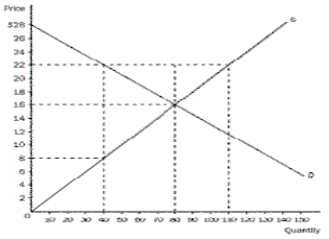 -Refer to Figure 7-6.At the equilibrium price,what would total surplus be
 (Multiple Choice)
5.0/5  (73)
(73) Shannon buys a new audio system for her car for $335.She receives consumer surplus of $25 on her purchase.What is her willingness to pay
(Multiple Choice)
4.9/5 (69)
(69) Suppose Lauren,Leslie,and Lyndsay all purchase bulletin boards for their rooms for $20 each.Lauren's willingness to pay was $35,Leslie's willingness to pay was $25,and Lyndsay's willingness to pay was $30.What is the total consumer surplus for these three
(Multiple Choice)
4.8/5 (90)
(90) Figure 7-3
 -Refer to Figure 7-3.Which area represents the increase in producer surplus when the price rises from P₁ to P₂
 (Multiple Choice)
4.8/5 (76)
(76) What will result if production is moved from a high-cost producer to a low-cost producer
(Multiple Choice)
4.8/5 (76)
(76) Table 7-2
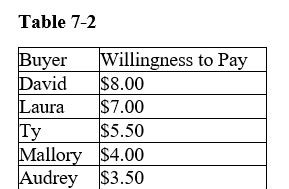 -Refer to Table 7-2.If the market price is $6.90,who will purchase the good
 (Multiple Choice)
4.8/5 (86)
(86) Consumer surplus is the amount a buyer actually has to pay for a good minus the amount the buyer is willing to pay for it.
(True/False)
5.0/5 (84)
(84) Market demand is given as QD = 280 - 4P.Market supply is given as QS = - 40 + 2P.In a perfectly competitive equilibrium,what will be the value of producer surplus
(Multiple Choice)
5.0/5 (80)
(80) What does the equilibrium of supply and demand in a market do
(Multiple Choice)
4.8/5 (83)
(83) Table 7-4
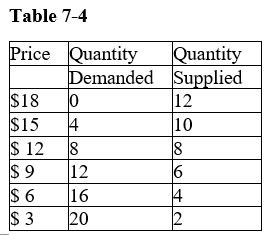 -Refer to Table 7-4.At the equilibrium price,what would producer surplus be
 (Multiple Choice)
4.8/5 (80)
(80) Figure 7-5
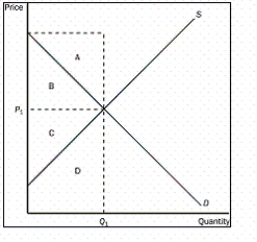 -Refer to Figure 7-5.What area represents producer surplus when the price is P₁
 (Multiple Choice)
4.8/5 (69)
(69) Suppose that the equilibrium price in the market for widgets is $8.If a law increased the minimum legal price for widgets to $9,what would happen to producer surplus
(Multiple Choice)
4.8/5 (79)
(79) The willingness to pay is the maximum amount that a buyer will pay for a good and measures how much the buyer values the good.
(True/False)
4.8/5 (80)
(80) Figure 7-4
 -Refer to Figure 7-4.When the price falls from P₂ to P₁,what happens to producer surplus
 (Multiple Choice)
4.9/5 (78)
(78) Figure 7-4
-Refer to Figure 7-4.At the price of P₁,what is producer surplus
-Refer to Figure 7-4.At the price of P₁,what is producer surplus (Multiple Choice)
4.8/5 (90)
(90) Consider the following equation: P = 100 - 2Q.Answer the following questions.
a.What is the consumer surplus when price is equal to $60
b.What is the change of the consumer surplus when price changes to $40
(Essay)
5.0/5 (86)
(86) Table 7-4
-Refer to Table 7-4.What is the equilibrium or market-clearing price
-Refer to Table 7-4.What is the equilibrium or market-clearing price (Multiple Choice)
4.8/5 (79)
(79) 
Filters
- Essay(0)
- Multiple Choice(0)
- Short Answer(0)
- True False(0)
- Matching(0)