



 Chat with AI
Exam 3: Interdependence and the Gains From Trade

Exam 1: Ten Principles of Economics218 Questions
Exam 2: Thinking Like an Economist239 Questions
Exam 3: Interdependence and the Gains From Trade207 Questions
Exam 4: The Market Forces of Supply and Demand351 Questions
Exam 5: Elasticity and Its Application230 Questions
Exam 6: Supply, demand, and Government Policies248 Questions
Exam 7: Consumers, producers, and the Efficiency of Markets216 Questions
Exam 8: Application: the Costs of Taxation222 Questions
Exam 9: Application: International Trade182 Questions
Exam 10: Externalities210 Questions
Exam 11: Public Goods and Common Resources173 Questions
Exam 12: The Design of the Tax System200 Questions
Exam 13: The Costs of Production209 Questions
Exam 14: Firms in Competitive Markets261 Questions
Exam 15: Monopoly239 Questions
Exam 16: Monopolistic Competition191 Questions
Exam 17: Oligopoly198 Questions
Exam 18: The Markets for the Factors of Production180 Questions
Exam 19: Earnings and Discrimination167 Questions
Exam 20: Income Inequality and Poverty163 Questions
Exam 21: The Theory of Consumer Choice191 Questions
Exam 22: Frontiers of Microeconomics141 Questions
Select questions type


Jonathan can make a birdhouse in three hours.He can make a bird feeder in three hours.The opportunity cost to Jonathan of making a birdhouse is 1/3 bird feeder.
(True/False)
4.9/5  (83)
(83) Figure 3-2
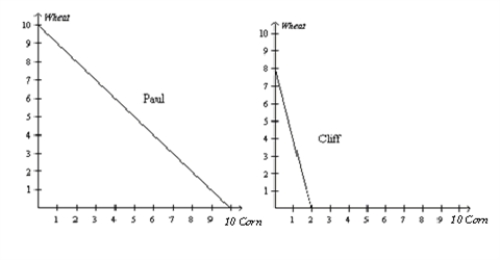 -Refer to Figure 3-2.Assume that both Paul and Cliff divide their time equally between the production of corn and wheat,and they do not trade.If they were the only producers of corn and wheat,what would the total production of wheat and corn be
 (Multiple Choice)
4.7/5 (80)
(80) Table 3-2
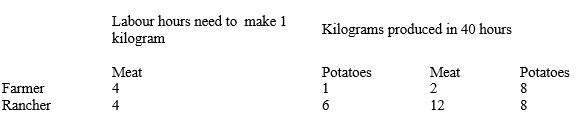 -Refer to Table 3-2.What does each producer have an absolute or comparative advantage in
 (Multiple Choice)
4.8/5 (80)
(80) Figure 3-2
-Refer to Figure 3-2.What do the two producers have an absolute or comparative advantage in
-Refer to Figure 3-2.What do the two producers have an absolute or comparative advantage in (Multiple Choice)
4.8/5 (69)
(69) Both Canada and the U.S.can produce equally tasty maple syrup.What determines which country will export maple syrup
(Multiple Choice)
4.9/5 (71)
(71) Why does total output in an economy increase when each person specializes
(Multiple Choice)
4.9/5 (77)
(77) The "two-country,two-good" model (sometimes called the 2×2 model) of comparative advantage that we have studied so far is simple,insightful,and compelling.However,its very simplicity turns out to be its weakness.In the real world,when many countries produce many goods,the simple 2×2 model is of limited use in predicting patterns of trade.To see how complex such a model can become,let us consider a 2×3 model (two countries,1 and 2,and three goods,A,B,and C.) The following table gives the maximum amounts (units) of each good that each country can produce if all the country's resources were used in the production of the respective good.In other words,the table describes each country's production possibilities frontier.  a.How do the production possibilities frontiers for each of the two countries look in a three-dimensional coordinate system? (Draw three axes like a corner in your room, and label them after the three goods: A, B, and C.Then, place the number of units for each good for Country 1on its respective axis and connect the three intercepts by straight lines.Repeat for Country 2 on a separate graph.)?
b.Calculate the opportunity costs of good A in terms of B and C in each country and call these prices PA1 and PA2 respectively.?
c.Calculate the opportunity costs of good B in terms of A and C in each country and call these prices PB1 and PB2 respectively.?
d.Calculate the opportunity costs of good C in terms of A and B in each country and call these prices PC1 and PC2 respectively.?
e.Based on your calculations, can you tell which country should export or import each product based on comparative advantage?
a.How do the production possibilities frontiers for each of the two countries look in a three-dimensional coordinate system? (Draw three axes like a corner in your room, and label them after the three goods: A, B, and C.Then, place the number of units for each good for Country 1on its respective axis and connect the three intercepts by straight lines.Repeat for Country 2 on a separate graph.)?
b.Calculate the opportunity costs of good A in terms of B and C in each country and call these prices PA1 and PA2 respectively.?
c.Calculate the opportunity costs of good B in terms of A and C in each country and call these prices PB1 and PB2 respectively.?
d.Calculate the opportunity costs of good C in terms of A and B in each country and call these prices PC1 and PC2 respectively.?
e.Based on your calculations, can you tell which country should export or import each product based on comparative advantage? (Essay)
4.9/5 (66)
(66) Suppose that a worker in Agland can produce either 10 units of organic grain or 2 units of incense per year,and a worker in Zenland can produce either 5 units of organic grain or 15 units of incense per year.There are 10 workers in Agland and 20 workers in Zenland.Currently the two countries do not trade.Agland produces and consumes 50 units of grain and 10 units of incense per year.Zenland produces and consumes 100 units of grain and no incense per year.The combined output of the two countries is therefore 150 units of grain and 10 units of incense per year.If the two countries decided to trade and completely specialize in producing the good for which each has a comparative advantage,what would the combined yearly output of the two countries be
(Multiple Choice)
4.9/5 (89)
(89) According to Adam Smith,what should a person never attempt to make at home
(Multiple Choice)
4.8/5 (71)
(71) Suppose that a worker in Radioland can produce either 4 radios or 1 television per year,and a worker in Teeveeland can produce either 2 radios or 5 televisions per year.Each nation has 100 workers.If Radioland trades 100 televisions to Teeveeland in exchange for 100 radios each year,what is the impact on each country's maximum consumption of new radios and televisions per year
(Multiple Choice)
4.8/5 (75)
(75) Table 3-5
 -Refer to Table 3-5.How could Canada and Japan both benefit
 (Multiple Choice)
4.7/5 (84)
(84) Egypt has a comparative advantage in the production of linen and an absolute advantage in the production of beer,compared to Russia.If these two countries decide to trade,what would the pattern of trade be
(Multiple Choice)
4.8/5 (76)
(76) Table 3-6
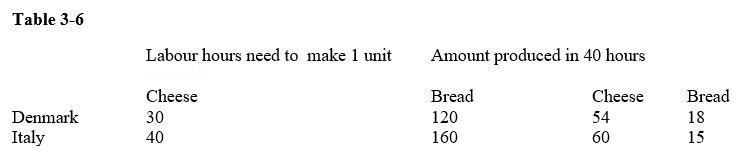 -Refer to Table 3-6.Denmark and Italy trade according to the principle of comparative advantage.If the international price of bread is 2.5 units of cheese for 1 unit of bread,what is the gain from trade to Italy per unit of bread traded
 (Multiple Choice)
4.9/5 (78)
(78) Regan grows flowers and makes vases.Jayson also grows flowers and makes vases,but Regan is better at producing both.Who has an absolute or comparative advantage in what activity
(Multiple Choice)
4.7/5 (89)
(89) Table 3-2
-Refer to Table 3-2.What is the opportunity cost of 1 kilogram of potatoes for the rancher
-Refer to Table 3-2.What is the opportunity cost of 1 kilogram of potatoes for the rancher (Multiple Choice)
4.8/5 (79)
(79) Suppose labour in Mexico is less productive than labour in Canada.What can we conclude from this information
(Multiple Choice)
4.8/5 (80)
(80) Two countries can achieve gains from trade even if one country has an absolute advantage in the production of both goods.
(True/False)
4.8/5 (82)
(82) Figure 3-1
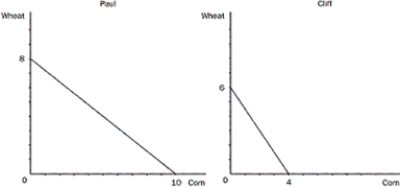 -Refer to Figure 3-1.What do the two producers have an absolute advantage in
 (Multiple Choice)
4.8/5 (91)
(91) 
Filters
- Essay(0)
- Multiple Choice(0)
- Short Answer(0)
- True False(0)
- Matching(0)