



 Chat with AI
Exam 2: Thinking Like an Economist

Exam 1: Ten Principles of Economics218 Questions
Exam 2: Thinking Like an Economist239 Questions
Exam 3: Interdependence and the Gains From Trade207 Questions
Exam 4: The Market Forces of Supply and Demand351 Questions
Exam 5: Elasticity and Its Application230 Questions
Exam 6: Supply, demand, and Government Policies248 Questions
Exam 7: Consumers, producers, and the Efficiency of Markets216 Questions
Exam 8: Application: the Costs of Taxation222 Questions
Exam 9: Application: International Trade182 Questions
Exam 10: Externalities210 Questions
Exam 11: Public Goods and Common Resources173 Questions
Exam 12: The Design of the Tax System200 Questions
Exam 13: The Costs of Production209 Questions
Exam 14: Firms in Competitive Markets261 Questions
Exam 15: Monopoly239 Questions
Exam 16: Monopolistic Competition191 Questions
Exam 17: Oligopoly198 Questions
Exam 18: The Markets for the Factors of Production180 Questions
Exam 19: Earnings and Discrimination167 Questions
Exam 20: Income Inequality and Poverty163 Questions
Exam 21: The Theory of Consumer Choice191 Questions
Exam 22: Frontiers of Microeconomics141 Questions
Select questions type


Table 2-1
Production Possibilities for Toyland
 -Refer to Table 2-1.What is the opportunity cost to Toyland of increasing the production of dolls from 200 to 300
 (Multiple Choice)
4.8/5  (90)
(90) Figure 2-8
 -Refer to Figure 2-8.What would be an efficient combination of bathtubs and barrels
 (Multiple Choice)
4.9/5 (81)
(81) Table 2-1
Production Possibilities for Toyland
-Refer to Table 2-1.What is the opportunity cost to Toyland of increasing the production of fire trucks from 0 to 200
-Refer to Table 2-1.What is the opportunity cost to Toyland of increasing the production of fire trucks from 0 to 200 (Multiple Choice)
5.0/5 (84)
(84) Figure 2-9
 -Refer to Figure 2-9.What would you say about the relationship between coffee and hours without sleep
 (Multiple Choice)
4.9/5 (75)
(75) Figure 2-8
-Refer to Figure 2-8.If this economy puts all of its resources into the production of bathtubs,how many could it produce
-Refer to Figure 2-8.If this economy puts all of its resources into the production of bathtubs,how many could it produce (Multiple Choice)
4.9/5 (90)
(90) What happens when a variable on an axis of a graph changes
(Multiple Choice)
4.8/5 (89)
(89) Suppose an economy produces two goods: food and machines.This economy always operates on its production possibilities frontier.Last year,it produced 65 units of food and 23 machines.This year,it is producing 72 units of food and 25 machines.Which of the following would NOT explain the increase in output
(Multiple Choice)
4.8/5 (84)
(84) Figure 2-4
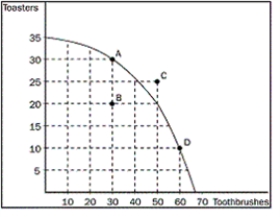 -Refer to Figure 2-4.What is the opportunity cost to the economy of getting 30 additional toothbrushes by moving from point A to point D
 (Multiple Choice)
4.9/5 (77)
(77) Figure 2-3
 -Refer to Figure 2-3.At which point or points can the economy NOT produce
 (Multiple Choice)
4.9/5 (64)
(64) An economy can produce at any point on or outside the production possibilities frontier,but it cannot produce at points inside the frontier.
(True/False)
4.9/5 (87)
(87) Table 2-1
Production Possibilities for Toyland
-Refer to Table 2-1.What is the opportunity cost to Toyland of increasing the production of dolls from 100 to 200
-Refer to Table 2-1.What is the opportunity cost to Toyland of increasing the production of dolls from 100 to 200 (Multiple Choice)
4.8/5 (89)
(89) An efficient outcome in economics is one in which the economy is conserving the largest possible amount of resources,while still meeting the needs of society.
(True/False)
4.9/5 (84)
(84) While the scientific method is applicable to studying natural sciences,it is not useful in studying an economic system.
(True/False)
4.9/5 (75)
(75) What are the two basic reasons why economists often appear to give conflicting advice to policymakers
(Multiple Choice)
4.9/5 (85)
(85) An economy is being efficient if it is impossible to produce more of one good without producing less of another.
(True/False)
4.8/5 (86)
(86) 
Filters
- Essay(0)
- Multiple Choice(0)
- Short Answer(0)
- True False(0)
- Matching(0)