



 Chat with AI
Exam 7: The Demand for Health Insurance

Exam 1: An Introduction to the Economics of Medical Care20 Questions
Exam 2: The Role of Government in Health and Medical Care20 Questions
Exam 3: Health Policy and the Legislative Marketplace20 Questions
Exam 4: The Production of Health: the Impact of Medical Services on Health20 Questions
Exam 5: An Overview of the Medical Care Sector20 Questions
Exam 6: The Demand for Medical Care19 Questions
Exam 7: The Demand for Health Insurance20 Questions
Exam 8: The Supply of Medical Care: an Overview20 Questions
Exam 9: Market Competition in Medical Care20 Questions
Exam 10: The Market for Health Insurance: Its Performance and Structure20 Questions
Exam 11: The Physician Services Market20 Questions
Exam 12: The Market for Hospital Services20 Questions
Exam 13: The Pharmaceutical Industry20 Questions
Exam 14: Health Manpower Shortages and Surpluses: Definitions, measurement, and Policies18 Questions
Exam 15: The Market for Physician Manpower20 Questions
Exam 16: The Market for Medical Education: Equity and Efficiency20 Questions
Exam 17: The Market for Registered Nurses20 Questions
Exam 18: National Health Insurance: an Approach to the Redistribution of Medical Care20 Questions
Select questions type


Purchasing additional medical services because you are covered by health insurance is an illustration of

Free
(Multiple Choice)
4.9/5  (68)
(68) Correct Answer: Verified
B
As it applies to health insurance,the adverse selection problem is the tendency for:
Free
(Multiple Choice)
4.8/5 (72)
(72) Correct Answer:Verified
VerifiedA
Suppose there are two types of people in an insurance market: high and low risks.The high-risk person is sick 10% of the time and the low-risk person is sick 5% of the time.The probability of any individual being high risk is 40%.Upon getting sick,an individual loses $10,000 in medical expenses.If the insurer cannot distinguish between the two types,but the two individuals know their types,what will be the equilibrium premium?
(Essay)
5.0/5 (78)
(78) Suppose there are two types of people in an insurance market: high and low risks.The high-risk person is sick 10% of the time and the low-risk person is sick 5% of the time.The probability of any individual being high risk is 40%.Upon getting sick,an individual loses $10,000 in medical expenses.What if the individuals do not know their type?
(Essay)
4.9/5 (79)
(79) It is flu season,and you are trying to decide if you should get a flu shot.When you are healthy,you earn $144 a day,but if you become ill,you will only earn $100 a day.There is a 25% chance you will get the flu without a flu shot.If you do receive the flu shot,then you definitely will not get the flu.What is the actuarially fair price for the flu shot given this information?
(Multiple Choice)
4.8/5 (79)
(79) Suppose there are two types of people in an insurance market: high and low risks.The high-risk person is sick 10% of the time and the low-risk person is sick 5% of the time.The probability that any individual is high risk is 40%.Upon getting sick,an individual loses $10,000 in medical expenses.What are the actuarially fair premiums for the types?
(Essay)
4.8/5 (80)
(80) A public option in the health insurance market has been proposed as a remedy to the increasing cost of health care.Critics state that a public option requiring all citizens to purchase health insurance would decrease health insurance premiums on average by mitigating
(Multiple Choice)
4.8/5 (84)
(84) 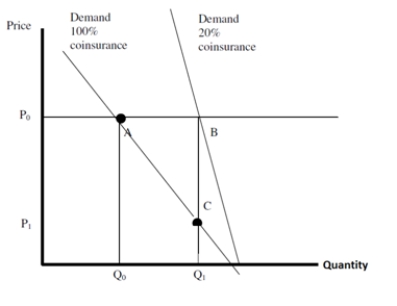 In the figure, the change in insurance coverage causes a social welfare loss equal to:
 (Multiple Choice)
4.8/5 (92)
(92) Calculate the expected return (or expected winnings)in a game where a person wins $1 with the probability of 1/3 ,$5 with the probability of1/6 ,and $0 with the probability of 1/2 .
(Multiple Choice)
5.0/5 (81)
(81) Use the following figure for questions 8 through 10
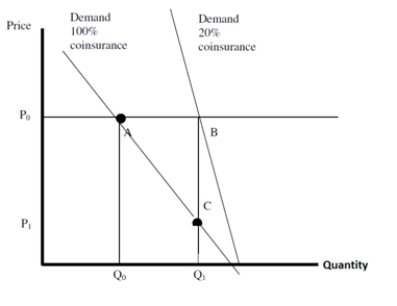 Suppose that Q₀ = 10 office visits,Q₁ = 20 office visits,P₀ = 10,and P₁ = 2.The increased expenditures due to insurance are:
 (Multiple Choice)
4.8/5 (75)
(75) 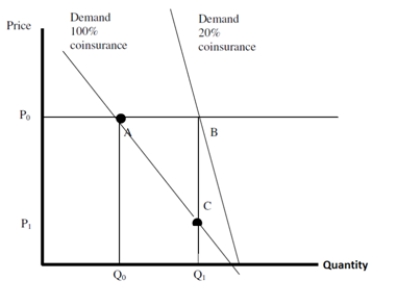 In the figure above, the change in insurance coverage causes a consumer's private benefits to increase (area under the demand curve) by:
 (Multiple Choice)
4.8/5 (86)
(86) When an insurer promises to pay 30% of treatment costs,this amount is known as a
(Multiple Choice)
4.9/5 (72)
(72) Which of the following policies limits the extent of moral hazard in the health insurance market?
(Multiple Choice)
4.7/5 (77)
(77) It is flu season.When you are healthy,you will earn $144 a day,but if you become ill,you will only earn $100 a day.There is a 25% chance you will get the flu.If your utility function is equal to  where W is equal to wealth,then what is your expected utility of catching the flu?
 (Multiple Choice)
4.9/5 (79)
(79) In the figure below: By how much do expenditures increase with insurance? What is the deadweight loss to society for insurance?
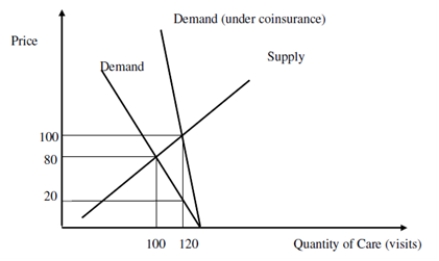
(Essay)
4.9/5 (86)
(86) Suppose the inverse demand for physician office visits is P = 1000 - 20Q.Now suppose an insurance policy provides a co-insurance rate of 50%.Graph the new demand function with health insurance.
(Essay)
4.8/5 (67)
(67) Lucy Ramirez has $22,500 in income.After a recent trip to Cuba,she discovers that there is a 25% chance of acquiring Cubanitis.The disease is 100% curable but requires the Fidelonomy procedure (at a cost of $12,500).The Kuba-Kuba Insurance Company offers a policy that will cover the Fidelonomy.The premium they charge is $4,000.Of this premium,the pure premium is __________ and the loading fee is _______.
(Multiple Choice)
4.8/5 (88)
(88) Which of the following types of reimbursement would hospitals support?
(Multiple Choice)
4.7/5 (82)
(82) 
Filters
- Essay(0)
- Multiple Choice(0)
- Short Answer(0)
- True False(0)
- Matching(0)