



 Chat with AI
Exam 16: Pricing Strategy

Exam 1: Economics: Foundations and Models240 Questions
Exam 2: Trade-Offs, Comparative Advantage, and the Market System258 Questions
Exam 3: Where Prices Come From: the Interaction of Demand and Supply242 Questions
Exam 4: Economic Efficiency, Government Price Setting, and Taxes208 Questions
Exam 5: Externalities, Environmental Policy, and Public Goods262 Questions
Exam 6: Elasticity: the Responsiveness of Demand and Supply293 Questions
Exam 7: The Economics of Health Care171 Questions
Exam 8: Firms, the Stock Market, and Corporate Governance261 Questions
Exam 9: Comparative Advantage and the Gains From International Trade188 Questions
Exam 10: Consumer Choice and Behavioral Economics304 Questions
Exam 11: Technology, Production, and Costs327 Questions
Exam 12: Firms in Perfectly Competitive Markets297 Questions
Exam 13: Monopolistic Competition: the Competitive Model in a272 Questions
Exam 14: Oligopoly: Firms in Less Competitive Markets257 Questions
Exam 15: Monopoly and Antitrust Policy279 Questions
Exam 16: Pricing Strategy258 Questions
Exam 17: The Markets for Labor and Other Factors of Production279 Questions
Exam 18: Public Choice, Taxes, and the Distribution of Income258 Questions
Select questions type


Figure 16-3
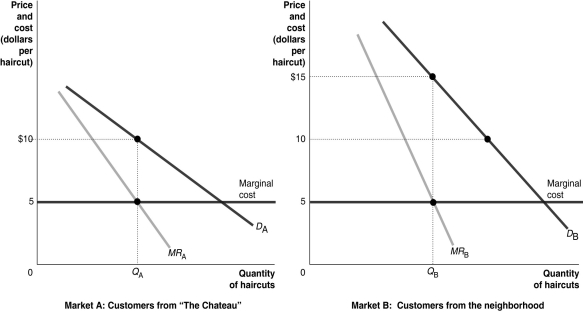 Chantal owns a hairdressing salon which caters to two main groups of customers: residents of "The Chateau," a retirement community, and other residents in the neighborhood. Figure 16-3 shows the demand curves for the residents of the retirement community, labeled Market A, and other residents in the neighborhood, labeled Market B. The demand curves are not identical.
-Refer to Figure 16-3.Which group of customers is likely to have a more elastic demand curve (more sensitive to price)?
Chantal owns a hairdressing salon which caters to two main groups of customers: residents of "The Chateau," a retirement community, and other residents in the neighborhood. Figure 16-3 shows the demand curves for the residents of the retirement community, labeled Market A, and other residents in the neighborhood, labeled Market B. The demand curves are not identical.
-Refer to Figure 16-3.Which group of customers is likely to have a more elastic demand curve (more sensitive to price)? (Multiple Choice)
4.9/5  (82)
(82) Table 16-3
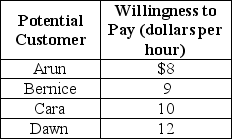 Julie plans to start a pet-sitting service. She surveyed her neighborhood to determine the demand for this service. Assume that each person surveyed demands only one hour of pet sitting services per period. Table 16-3 above shows a portion of her survey results.
-Refer to Table 16-3.Suppose Julie's marginal cost of providing this service is constant at $7 and she charges $7.How many hours will be purchased and what is her total revenue?
Julie plans to start a pet-sitting service. She surveyed her neighborhood to determine the demand for this service. Assume that each person surveyed demands only one hour of pet sitting services per period. Table 16-3 above shows a portion of her survey results.
-Refer to Table 16-3.Suppose Julie's marginal cost of providing this service is constant at $7 and she charges $7.How many hours will be purchased and what is her total revenue? (Multiple Choice)
4.9/5 (88)
(88) A firm that engages in price discrimination must be able to identify the preferences of every customer it serves.
(True/False)
4.9/5 (88)
(88) Which of the following is not a requirement for a successful price discrimination strategy?
(Multiple Choice)
4.8/5 (82)
(82) Publishers practice price discrimination when they sell books at high prices to
(Multiple Choice)
4.8/5 (88)
(88) Dell Computers allows potential consumers to customize personal computers to their desires.Dell's strategy is successful because offering bundles that more exactly meet a consumer's preference allows Dell to extract more consumer surplus.
(True/False)
4.8/5 (73)
(73) Which of the following is not a way by which price-discriminating firms can segment a market?
(Multiple Choice)
5.0/5 (85)
(85) Figure 16-5
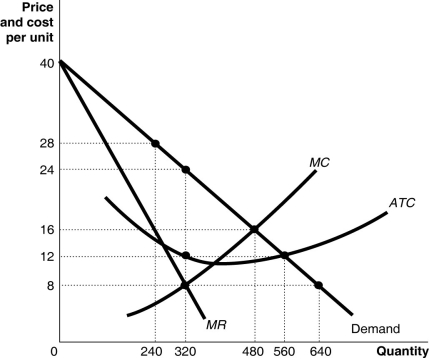 -Refer to Figure 16-5.Suppose the firm represented in the diagram decides to practice perfect price discrimination.What is the total revenue collected by the firm?
 (Multiple Choice)
4.9/5 (67)
(67) Suppose Dublin Electronics charges regular customers $60 for a Blu-ray player but allows senior citizens to purchase the same item for $45.Is this likely to be a successful price discriminating strategy?
(Multiple Choice)
4.9/5 (70)
(70) Figure 16-5
-Refer to Figure 16-5.Consider the following two pricing strategies:
A.a fixed fee and a per-unit price equal to the monopoly price
B.a fixed fee and a per-unit price equal to the competitive price
The firm represented in the diagram earns a higher profit under strategy ________ and deadweight loss is eliminated under ________.
-Refer to Figure 16-5.Consider the following two pricing strategies:
A.a fixed fee and a per-unit price equal to the monopoly price
B.a fixed fee and a per-unit price equal to the competitive price
The firm represented in the diagram earns a higher profit under strategy ________ and deadweight loss is eliminated under ________. (Multiple Choice)
4.9/5 (76)
(76) According to the law of one price, identical products should sell for the same price everywhere if
(Multiple Choice)
4.9/5 (81)
(81) Table 16-2
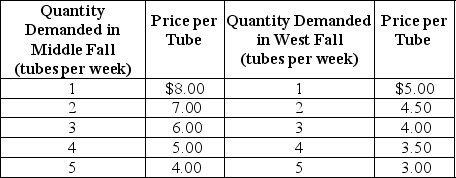 Neem Products sells its Ayurvedic Neem toothpaste in two completely isolated markets with demand schedules as shown in Table 16-2. The average cost of production is constant at $2 per tube.
-Refer to Table 16-2.Which of the following statements is true about the two markets?
Neem Products sells its Ayurvedic Neem toothpaste in two completely isolated markets with demand schedules as shown in Table 16-2. The average cost of production is constant at $2 per tube.
-Refer to Table 16-2.Which of the following statements is true about the two markets? (Multiple Choice)
4.9/5 (75)
(75) The practice of continually adjusting prices to take into account fluctuations in demand is called "yield management."
(True/False)
4.7/5 (72)
(72) Racial discrimination and other forms of discrimination based on irrelevant factors are illegal.Can price discrimination be illegal as well?
(Essay)
4.7/5 (74)
(74) College students and faculty members have a more elastic demand than the general public for Apple's MacBook Pro laptop computers.From this we can conclude that
(Multiple Choice)
4.7/5 (86)
(86) Figure 16-5
-Refer to Figure 16-5.Suppose the firm represented in the diagram decides to use a two-part pricing strategy such that it charges a fixed fee and a per-unit price equal to the competitive price.(This is also called an optimal two-part tariff.)What is the total revenue it can expect to collect from the fixed fee portion of the price?
-Refer to Figure 16-5.Suppose the firm represented in the diagram decides to use a two-part pricing strategy such that it charges a fixed fee and a per-unit price equal to the competitive price.(This is also called an optimal two-part tariff.)What is the total revenue it can expect to collect from the fixed fee portion of the price? (Multiple Choice)
4.9/5 (84)
(84) One reason why McDonald's charges a single price for its products is that it is difficult and costly for the company to determine each individual consumer's willingness to pay.
(True/False)
4.8/5 (94)
(94) Figure 16-2
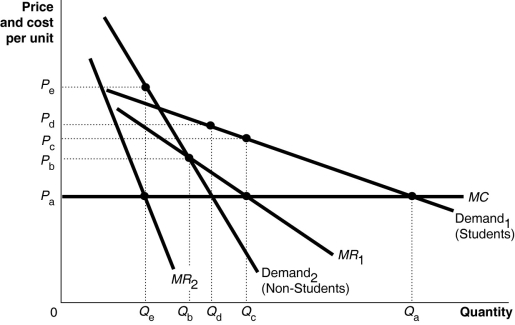 Plato Playhouse, a theatre company in the university town of Wegg, caters to two groups of customers:
students and the non-student population.
Figure 16-2 shows the demand curves for the two groups of customers.
-Refer to Figure 16-2.Suppose Plato Playhouse price discriminates.What is the quantity sold to each group of customers and what is the total quantity sold?
Plato Playhouse, a theatre company in the university town of Wegg, caters to two groups of customers:
students and the non-student population.
Figure 16-2 shows the demand curves for the two groups of customers.
-Refer to Figure 16-2.Suppose Plato Playhouse price discriminates.What is the quantity sold to each group of customers and what is the total quantity sold? (Multiple Choice)
4.9/5 (77)
(77) Figure 16-1
 -Refer to Figure 16-1.With perfect price discrimination, the firm will produce and sell
 (Multiple Choice)
4.8/5 (76)
(76) 
Filters
- Essay(0)
- Multiple Choice(0)
- Short Answer(0)
- True False(0)
- Matching(0)