



 Chat with AI
Exam 16: Pricing Strategy

Exam 1: Economics: Foundations and Models240 Questions
Exam 2: Trade-Offs, Comparative Advantage, and the Market System258 Questions
Exam 3: Where Prices Come From: the Interaction of Demand and Supply242 Questions
Exam 4: Economic Efficiency, Government Price Setting, and Taxes208 Questions
Exam 5: Externalities, Environmental Policy, and Public Goods262 Questions
Exam 6: Elasticity: the Responsiveness of Demand and Supply293 Questions
Exam 7: The Economics of Health Care171 Questions
Exam 8: Firms, the Stock Market, and Corporate Governance261 Questions
Exam 9: Comparative Advantage and the Gains From International Trade188 Questions
Exam 10: Consumer Choice and Behavioral Economics304 Questions
Exam 11: Technology, Production, and Costs327 Questions
Exam 12: Firms in Perfectly Competitive Markets297 Questions
Exam 13: Monopolistic Competition: the Competitive Model in a272 Questions
Exam 14: Oligopoly: Firms in Less Competitive Markets257 Questions
Exam 15: Monopoly and Antitrust Policy279 Questions
Exam 16: Pricing Strategy258 Questions
Exam 17: The Markets for Labor and Other Factors of Production279 Questions
Exam 18: Public Choice, Taxes, and the Distribution of Income258 Questions
Select questions type


The Walt Disney Company is in a position to use a two-part tariff policy in setting prices for admission and rides at Disney World.If this strategy resulted in maximum profit, Disney would convert all consumer surplus into profit.Which of the following explains why Disney does not maximize its profits from admission and rides?
(Multiple Choice)
4.9/5  (70)
(70) Which of the following products allows the seller to identify different groups of consumers (segment the market)at virtually no cost?
(Multiple Choice)
4.9/5 (80)
(80) Consider the following pricing strategies:
A.perfect price discrimination
B.charging different prices to different groups of customers
C.optimal two-part tariff
D.single-price monopoly pricing
Which of the pricing strategies leads to the economically efficient output level?
(Multiple Choice)
4.9/5 (79)
(79) Which of the following is a necessary condition for successful price discrimination?
(Multiple Choice)
4.8/5 (73)
(73) When a monopolist engages in perfect price discrimination, the quantity produced and sold
(Multiple Choice)
4.8/5 (75)
(75) Price discrimination is possible in which of the following market structures?
A.perfect competition
B.monopoly
C.oligopoly
D.monopolistic competition
(Multiple Choice)
4.8/5 (83)
(83) Even though it often does not result in profit maximization, some small firms use a cost-plus pricing strategy anyway because
(Multiple Choice)
4.9/5 (81)
(81) A perfectly competitive firm cannot practice price discrimination because
(Multiple Choice)
4.8/5 (80)
(80) Figure 16-6
 Watanabe Sensei operates the only martial arts school in Hartfield. For simplicity, assume that consumers have identical demand curves and that Sensei knows what this demand curve is. Figure 16-6 shows this demand curve.
-Refer to Figure 16-6.If Sensei charges the competitive price for his classes, what is the maximum amount of admission fee that he can collect from his customers?
Watanabe Sensei operates the only martial arts school in Hartfield. For simplicity, assume that consumers have identical demand curves and that Sensei knows what this demand curve is. Figure 16-6 shows this demand curve.
-Refer to Figure 16-6.If Sensei charges the competitive price for his classes, what is the maximum amount of admission fee that he can collect from his customers? (Multiple Choice)
4.9/5 (77)
(77) Table 16-2
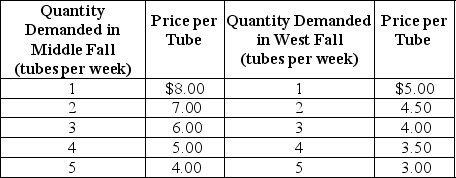 Neem Products sells its Ayurvedic Neem toothpaste in two completely isolated markets with demand schedules as shown in Table 16-2. The average cost of production is constant at $2 per tube.
-Refer to Table 16-2.What are the total profits from both markets combined?
Neem Products sells its Ayurvedic Neem toothpaste in two completely isolated markets with demand schedules as shown in Table 16-2. The average cost of production is constant at $2 per tube.
-Refer to Table 16-2.What are the total profits from both markets combined? (Multiple Choice)
5.0/5 (88)
(88) Figure 16-5
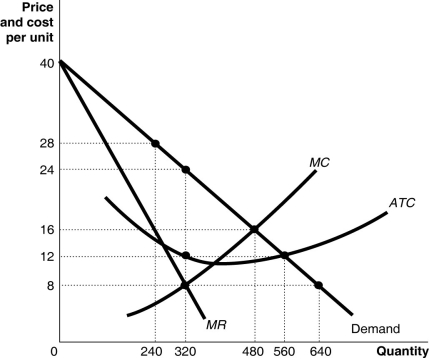 -Refer to Figure 16-5.Suppose the firm represented in the diagram decides to use a two-part pricing strategy such that it charges a fixed fee and a per-unit price equal to the monopoly price.(This is also called a two-part tariff.)What is the quantity it should produce?
 (Multiple Choice)
4.8/5 (80)
(80) Figure 16-3
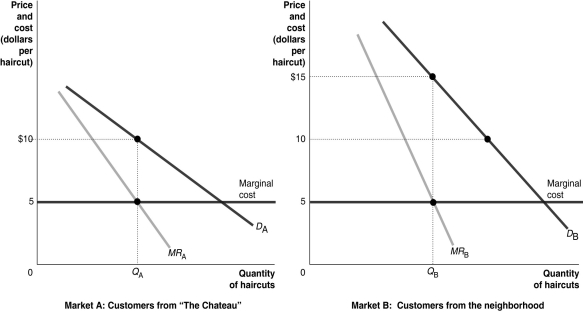 Chantal owns a hairdressing salon which caters to two main groups of customers: residents of "The Chateau," a retirement community, and other residents in the neighborhood. Figure 16-3 shows the demand curves for the residents of the retirement community, labeled Market A, and other residents in the neighborhood, labeled Market B. The demand curves are not identical.
-Refer to Figure 16-3.Suppose the salon price discriminates.What prices are charged in the two markets?
Chantal owns a hairdressing salon which caters to two main groups of customers: residents of "The Chateau," a retirement community, and other residents in the neighborhood. Figure 16-3 shows the demand curves for the residents of the retirement community, labeled Market A, and other residents in the neighborhood, labeled Market B. The demand curves are not identical.
-Refer to Figure 16-3.Suppose the salon price discriminates.What prices are charged in the two markets? (Multiple Choice)
4.8/5 (73)
(73) What is cost-plus pricing? Why do some firms use cost-plus pricing even when the firms' managers have the resources to devise a pricing strategy that would result in greater profits?
(Essay)
5.0/5 (81)
(81) If demand is taken into account, firms that use cost-plus pricing can adjust price by
(Multiple Choice)
4.8/5 (84)
(84) Which of the following is a reason why airline yield management is an effective method to increase revenue?
(Multiple Choice)
4.9/5 (67)
(67) Joss is a marketing consultant.Iris and Daphne are potential customers interested in commissioning Joss to undertake a market survey and compile the findings in a report.Iris is willing to pay $500 for the service while Daphne is willing to pay $800.Suppose that the opportunity cost of Joss's time is $1,200.Assume that Iris and Daphne do not know each other.If Joss charges the same price per copy of the report to both Iris and Daphne,
(Multiple Choice)
4.9/5 (85)
(85) Joss is a marketing consultant.Iris and Daphne are potential customers interested in commissioning Joss to undertake a market survey and compile the findings in a report.Iris is willing to pay $500 for the service while Daphne is willing to pay $800.Suppose that the opportunity cost of Joss's time is $1,200.Assume that Iris and Daphne do not know each other.If the price of the report is $800 per copy,
(Multiple Choice)
4.7/5 (91)
(91) 
Filters
- Essay(0)
- Multiple Choice(0)
- Short Answer(0)
- True False(0)
- Matching(0)