



 Chat with AI
Exam 7: The Economics of Health Care

Exam 1: Economics: Foundations and Models240 Questions
Exam 2: Trade-Offs, Comparative Advantage, and the Market System258 Questions
Exam 3: Where Prices Come From: the Interaction of Demand and Supply242 Questions
Exam 4: Economic Efficiency, Government Price Setting, and Taxes208 Questions
Exam 5: Externalities, Environmental Policy, and Public Goods262 Questions
Exam 6: Elasticity: the Responsiveness of Demand and Supply293 Questions
Exam 7: The Economics of Health Care171 Questions
Exam 8: Firms, the Stock Market, and Corporate Governance261 Questions
Exam 9: Comparative Advantage and the Gains From International Trade188 Questions
Exam 10: Consumer Choice and Behavioral Economics304 Questions
Exam 11: Technology, Production, and Costs327 Questions
Exam 12: Firms in Perfectly Competitive Markets297 Questions
Exam 13: Monopolistic Competition: the Competitive Model in a272 Questions
Exam 14: Oligopoly: Firms in Less Competitive Markets257 Questions
Exam 15: Monopoly and Antitrust Policy279 Questions
Exam 16: Pricing Strategy258 Questions
Exam 17: The Markets for Labor and Other Factors of Production279 Questions
Exam 18: Public Choice, Taxes, and the Distribution of Income258 Questions
Select questions type


In the United States in 2016, the percentage of firms that employed more than 200 workers and offered health insurance as a fringe benefit to the workers was about
(Multiple Choice)
5.0/5  (72)
(72) If a buyer in an economic transaction has more information than the seller, the buyer benefits at the expense of the seller.This phenomenon is due to
(Multiple Choice)
4.9/5 (84)
(84) Because consumers who have insurance provided by their employers usually only pay a deductible for a visit to the doctor's office,
(Multiple Choice)
4.8/5 (86)
(86) Because of the positive externality of vaccinations, economic efficiency would be improved
(Multiple Choice)
4.9/5 (71)
(71) In the United States, health care spending per person is ________ the average for most other countries, even taking into account the effects of higher income per person.
(Multiple Choice)
4.9/5 (58)
(58) All of the following are part of the "taxes" provision of the Patient Protection and Affordable Care Act (ACA)except
(Multiple Choice)
4.8/5 (81)
(81) The situation in which one party to a transaction takes advantage of knowing more than the other party to the transaction is known as asymmetric information.
(True/False)
4.8/5 (76)
(76) Figure 7-1
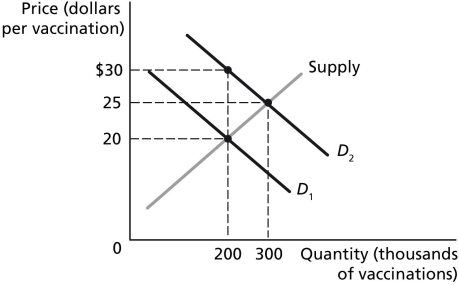 Figure 7-1 represents the market for vaccinations. Vaccinations are considered a benefit to society, and the figure shows both the marginal private benefit and the marginal social benefit from vaccinations.
-Refer to Figure 7-1.At the market equilibrium, the deadweight loss is equal to
Figure 7-1 represents the market for vaccinations. Vaccinations are considered a benefit to society, and the figure shows both the marginal private benefit and the marginal social benefit from vaccinations.
-Refer to Figure 7-1.At the market equilibrium, the deadweight loss is equal to (Multiple Choice)
4.7/5 (66)
(66) Figure 7-1
Figure 7-1 represents the market for vaccinations. Vaccinations are considered a benefit to society, and the figure shows both the marginal private benefit and the marginal social benefit from vaccinations.
-Refer to Figure 7-1.The market equilibrium price is
Figure 7-1 represents the market for vaccinations. Vaccinations are considered a benefit to society, and the figure shows both the marginal private benefit and the marginal social benefit from vaccinations.
-Refer to Figure 7-1.The market equilibrium price is (Multiple Choice)
4.8/5 (69)
(69) Suppose that in a market for used cars, there are good used cars and bad used cars (lemons).Consumers are willing to pay as much as $6,000 for a good used car but only $1,000 for a lemon.Sellers of good used cars value their cars at $5,000 each and sellers of lemons value their cars at $800 each.Buyers cannot tell if a used car is reliable or is a lemon.Based on this information, what is the likely outcome in the market for used cars?
(Multiple Choice)
4.8/5 (82)
(82) Due to adverse selection, very few lemons will be sold in the market for used cars.
(True/False)
4.8/5 (94)
(94) 
Filters
- Essay(0)
- Multiple Choice(0)
- Short Answer(0)
- True False(0)
- Matching(0)