



 Chat with AI
Exam 7: The Economics of Health Care

Exam 1: Economics: Foundations and Models240 Questions
Exam 2: Trade-Offs, Comparative Advantage, and the Market System258 Questions
Exam 3: Where Prices Come From: the Interaction of Demand and Supply242 Questions
Exam 4: Economic Efficiency, Government Price Setting, and Taxes208 Questions
Exam 5: Externalities, Environmental Policy, and Public Goods262 Questions
Exam 6: Elasticity: the Responsiveness of Demand and Supply293 Questions
Exam 7: The Economics of Health Care171 Questions
Exam 8: Firms, the Stock Market, and Corporate Governance261 Questions
Exam 9: Comparative Advantage and the Gains From International Trade188 Questions
Exam 10: Consumer Choice and Behavioral Economics304 Questions
Exam 11: Technology, Production, and Costs327 Questions
Exam 12: Firms in Perfectly Competitive Markets297 Questions
Exam 13: Monopolistic Competition: the Competitive Model in a272 Questions
Exam 14: Oligopoly: Firms in Less Competitive Markets257 Questions
Exam 15: Monopoly and Antitrust Policy279 Questions
Exam 16: Pricing Strategy258 Questions
Exam 17: The Markets for Labor and Other Factors of Production279 Questions
Exam 18: Public Choice, Taxes, and the Distribution of Income258 Questions
Select questions type


In 2017, health care's share of gross domestic product in the United States
(Multiple Choice)
4.9/5  (70)
(70) In the United States, out-of-pocket spending on health care is about ________ percent of all health care spending.
(Multiple Choice)
4.8/5 (82)
(82) Health insurance plans which typically reimburse doctors mainly by paying a flat fee per patient are known as
(Multiple Choice)
4.8/5 (77)
(77) College education tends to result in a negative externality because the recipient does not receive the full benefit of the education.
(True/False)
4.8/5 (81)
(81) Figure 7-1
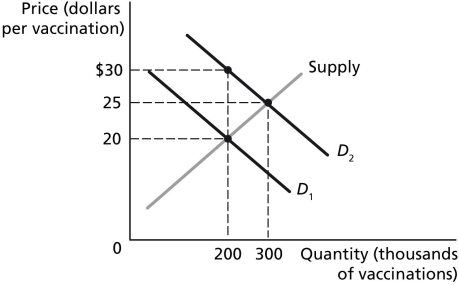 Figure 7-1 represents the market for vaccinations. Vaccinations are considered a benefit to society, and the figure shows both the marginal private benefit and the marginal social benefit from vaccinations.
-Refer to Figure 7-1.Marginal social benefit is represented by which curve?
Figure 7-1 represents the market for vaccinations. Vaccinations are considered a benefit to society, and the figure shows both the marginal private benefit and the marginal social benefit from vaccinations.
-Refer to Figure 7-1.Marginal social benefit is represented by which curve? (Multiple Choice)
4.8/5 (65)
(65) Which of the following is not an advantage of risk pooling?
(Multiple Choice)
4.9/5 (86)
(86) Figure 7-1
Figure 7-1 represents the market for vaccinations. Vaccinations are considered a benefit to society, and the figure shows both the marginal private benefit and the marginal social benefit from vaccinations.
-Refer to Figure 7-1.Marginal private benefit is represented by which curve?
Figure 7-1 represents the market for vaccinations. Vaccinations are considered a benefit to society, and the figure shows both the marginal private benefit and the marginal social benefit from vaccinations.
-Refer to Figure 7-1.Marginal private benefit is represented by which curve? (Multiple Choice)
4.9/5 (84)
(84) Figure 7-2
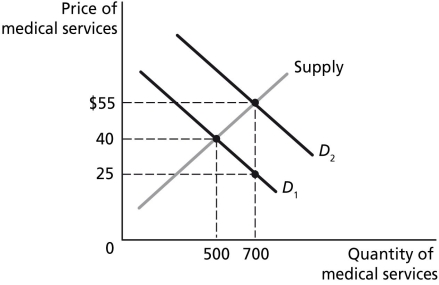 Figure 7-2 represents the market for medical services with and without insurance, and the effect of a third-party payer system on the demand for medical services.
-Refer to Figure 7-2.With insurance and a third-party payer system, what price do consumers pay for medical services?
Figure 7-2 represents the market for medical services with and without insurance, and the effect of a third-party payer system on the demand for medical services.
-Refer to Figure 7-2.With insurance and a third-party payer system, what price do consumers pay for medical services? (Multiple Choice)
4.9/5 (92)
(92) Article Summary
An Organisation for Economic Co-operation and Development (OECD) report states that administration costs for health care in the United States are the highest in the developed world, accounting for over 8 percent of spending in the health care sector, compared to a global average of about 3 percent. According to the report, expensive surgeries, high pharmaceutical costs, and corrupt practices increased global health care costs, and poor coordination between health care providers, duplication of tasks, and excessive time spent on paperwork all contributed to higher administrative costs. The report also noted that administrative costs are generally lower under government-managed health care systems than with private insurance, but governments could still significantly cut spending and improve patients' health.
Source: Alanna Petroff, "U.S. health care admin costs are double the average," money.cnn.com, January 11 2017.
-For a given level of compensation, the ________ a firm pays for your health insurance, the ________ it will pay you in wages.
(Multiple Choice)
4.8/5 (76)
(76) In addition to covering the costs of unpredictable events, health insurance typically covers many planned expenses, such as routine checkups, annual physicals, and the cost of vaccinations.Because of this, health insurance
(Multiple Choice)
4.9/5 (81)
(81) Automobile insurance companies have a problem with people who buy insurance and then drive recklessly or take less care to avoid losses after being insured.In other words, the automobile insurance market is subject to
(Multiple Choice)
4.9/5 (74)
(74) Which of the following parties is likely to have the most information about the health of an individual who is trying to purchase a health insurance policy?
(Multiple Choice)
4.9/5 (88)
(88) A doctor pursuing his own interests rather than the interests of his patients is an example of the principal-agent problem.
(True/False)
4.9/5 (66)
(66) The aging of the U.S.population has tended to ________ spending on health care, and the development of new drugs and medical equipment has tended to ________ spending on health care.
(Multiple Choice)
4.9/5 (81)
(81) Adverse selection is a situation in which one party to a transaction takes advantage of knowing more than the other party to the transaction.
(True/False)
4.8/5 (67)
(67) Typically, the higher the level of income per person in a country, the higher the level of spending per person on health care.This relationship between income and spending indicates that health care is a
(Multiple Choice)
4.7/5 (74)
(74) Figure 7-1
Figure 7-1 represents the market for vaccinations. Vaccinations are considered a benefit to society, and the figure shows both the marginal private benefit and the marginal social benefit from vaccinations.
-Refer to Figure 7-1.The market equilibrium quantity is ________ thousand vaccinations.
Figure 7-1 represents the market for vaccinations. Vaccinations are considered a benefit to society, and the figure shows both the marginal private benefit and the marginal social benefit from vaccinations.
-Refer to Figure 7-1.The market equilibrium quantity is ________ thousand vaccinations. (Multiple Choice)
4.8/5 (76)
(76) A key difficulty facing insurance companies is that people know more about their health than do insurance companies.What is this phenomenon called?
(Multiple Choice)
4.8/5 (90)
(90) 
Filters
- Essay(0)
- Multiple Choice(0)
- Short Answer(0)
- True False(0)
- Matching(0)