



 Chat with AI
Exam 2: Trade-Offs, Comparative Advantage, and the Market System

Exam 1: Economics: Foundations and Models240 Questions
Exam 2: Trade-Offs, Comparative Advantage, and the Market System258 Questions
Exam 3: Where Prices Come From: the Interaction of Demand and Supply242 Questions
Exam 4: Economic Efficiency, Government Price Setting, and Taxes208 Questions
Exam 5: Externalities, Environmental Policy, and Public Goods262 Questions
Exam 6: Elasticity: the Responsiveness of Demand and Supply293 Questions
Exam 7: The Economics of Health Care171 Questions
Exam 8: Firms, the Stock Market, and Corporate Governance261 Questions
Exam 9: Comparative Advantage and the Gains From International Trade188 Questions
Exam 10: Consumer Choice and Behavioral Economics304 Questions
Exam 11: Technology, Production, and Costs327 Questions
Exam 12: Firms in Perfectly Competitive Markets297 Questions
Exam 13: Monopolistic Competition: the Competitive Model in a272 Questions
Exam 14: Oligopoly: Firms in Less Competitive Markets257 Questions
Exam 15: Monopoly and Antitrust Policy279 Questions
Exam 16: Pricing Strategy258 Questions
Exam 17: The Markets for Labor and Other Factors of Production279 Questions
Exam 18: Public Choice, Taxes, and the Distribution of Income258 Questions
Select questions type


Which of the following would shift a nation's production possibilities frontier outward?
(Multiple Choice)
4.8/5  (75)
(75) Figure 2-4
 Figure 2-4 shows various points on three different production possibilities frontiers for a nation.
-Refer to Figure 2-4.Consider the following events:
A.a reduction in the patent protection period to no more than 2 years
B.a war that destroys a substantial portion of a nation's capital stock
C.the lack of a secure and enforceable property rights system
Which of the events listed above could cause a movement from W to V?
Figure 2-4 shows various points on three different production possibilities frontiers for a nation.
-Refer to Figure 2-4.Consider the following events:
A.a reduction in the patent protection period to no more than 2 years
B.a war that destroys a substantial portion of a nation's capital stock
C.the lack of a secure and enforceable property rights system
Which of the events listed above could cause a movement from W to V? (Multiple Choice)
4.8/5 (94)
(94) Table 2-8
 Table 2-8 shows the number of labor hours required to produce a digital camera and a pound of wheat in China and South Korea.
-Refer to Table 2-8.China has a comparative advantage in the production of
Table 2-8 shows the number of labor hours required to produce a digital camera and a pound of wheat in China and South Korea.
-Refer to Table 2-8.China has a comparative advantage in the production of (Multiple Choice)
4.8/5 (85)
(85) Table 2-10
 Table 2-10 shows the output per day of two pet groomers, Tammi and Horace. They can either devote their time to grooming dogs or bathing cats.
-Refer to Table 2-10.What is Tammi's opportunity cost of bathing a cat?
Table 2-10 shows the output per day of two pet groomers, Tammi and Horace. They can either devote their time to grooming dogs or bathing cats.
-Refer to Table 2-10.What is Tammi's opportunity cost of bathing a cat? (Multiple Choice)
4.7/5 (89)
(89) The primary purpose of ________ is to encourage the expenditure of funds on research and development to create new products.
(Multiple Choice)
4.8/5 (76)
(76) Figure 2-2
 Figure 2-2 above shows the production possibilities frontier for Mendonca, an agrarian nation that produces two goods, meat and vegetables.
-Refer to Figure 2-2.The linear production possibilities frontier in the figure indicates that
Figure 2-2 above shows the production possibilities frontier for Mendonca, an agrarian nation that produces two goods, meat and vegetables.
-Refer to Figure 2-2.The linear production possibilities frontier in the figure indicates that (Multiple Choice)
4.8/5 (86)
(86) Table 2-1
Production choices for Tomaso's Trattoria
 -Refer to Table 2-1.Assume that Tomaso's Trattoria only produces pizzas and calzones.A combination of 24 pizzas and 15 calzones would appear
 (Multiple Choice)
4.9/5 (80)
(80) Entrepreneurs bring together the factors of production to produce goods and services.
(True/False)
4.9/5 (72)
(72) If a brewery wants to raise funds to purchase a new fermenting vat, it does so in the
(Multiple Choice)
4.9/5 (89)
(89) Figure 2-6
 -Refer to Figure 2-6.If the economy is currently producing at point D, what is the opportunity cost of moving to point B?
 (Multiple Choice)
5.0/5 (90)
(90) Table 2-6
 Table 2-6 shows the output per week of two jewelers, Serena and Haley. They can either devote their time to making bracelets or making necklaces.
-Refer to Table 2-6.Which of the following statements is true?
Table 2-6 shows the output per week of two jewelers, Serena and Haley. They can either devote their time to making bracelets or making necklaces.
-Refer to Table 2-6.Which of the following statements is true? (Multiple Choice)
4.9/5 (70)
(70) Table 2-7
 Table 2-7 shows the output per month of two people, Fred and Barney. They can either devote their time to making pogo sticks or making unicycles.
-Refer to Table 2-7.What is Fred's opportunity cost of making a pogo stick?
Table 2-7 shows the output per month of two people, Fred and Barney. They can either devote their time to making pogo sticks or making unicycles.
-Refer to Table 2-7.What is Fred's opportunity cost of making a pogo stick? (Multiple Choice)
4.8/5 (78)
(78) For each surfboard that Australia produces, it gives up the opportunity to make 25 boomerangs.New Zealand can produce 1 surfboard for every 15 boomerangs it produces.Which of the following is true about the comparative advantage between the two countries?
(Multiple Choice)
5.0/5 (82)
(82) In the circular flow model, households supply resources such as labor services in the factor market.
(True/False)
5.0/5 (81)
(81) Table 2-5
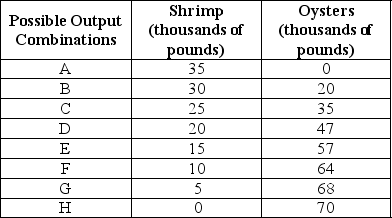 -Refer to Table 2-5.The Shellfish Shack produces only shrimp and oysters.The table above shows the maximum possible output combinations of the two types of shellfish using all resources and currently available technology.
a.Suppose The Shellfish Shack is currently producing at point E.What is the opportunity cost of producing an additional 11,000 pounds of oysters?
b.Suppose The Shellfish Shack is currently producing at point E.What happens to the opportunity cost of producing more and more shrimp? Does it increase, decrease, or remain constant? Explain your answer.
c.Suppose The Shellfish Shack is currently producing at point B.What happens to the opportunity cost of producing more and more oysters? Does it increase, decrease, or remain constant? Explain your answer.
d.Suppose The Shellfish Shack is plagued by a disease which destroys oyster beds but not shrimp habitats.What would happen to its PPF?
-Refer to Table 2-5.The Shellfish Shack produces only shrimp and oysters.The table above shows the maximum possible output combinations of the two types of shellfish using all resources and currently available technology.
a.Suppose The Shellfish Shack is currently producing at point E.What is the opportunity cost of producing an additional 11,000 pounds of oysters?
b.Suppose The Shellfish Shack is currently producing at point E.What happens to the opportunity cost of producing more and more shrimp? Does it increase, decrease, or remain constant? Explain your answer.
c.Suppose The Shellfish Shack is currently producing at point B.What happens to the opportunity cost of producing more and more oysters? Does it increase, decrease, or remain constant? Explain your answer.
d.Suppose The Shellfish Shack is plagued by a disease which destroys oyster beds but not shrimp habitats.What would happen to its PPF? (Essay)
4.8/5 (73)
(73) Figure 2-10
 Figure 2-10 shows the production possibilities frontiers for Tahiti and Bora Bora. Each country produces two goods, milk and honey.
-Refer to Figure 2-10.What is the opportunity cost of producing one gallon of milk in Bora Bora?
Figure 2-10 shows the production possibilities frontiers for Tahiti and Bora Bora. Each country produces two goods, milk and honey.
-Refer to Figure 2-10.What is the opportunity cost of producing one gallon of milk in Bora Bora? (Multiple Choice)
4.8/5 (92)
(92) Rayburn Reed is a highly talented photographer.He has chosen to specialize in photography because of all of the following except
(Multiple Choice)
4.8/5 (74)
(74) 
Filters
- Essay(0)
- Multiple Choice(0)
- Short Answer(0)
- True False(0)
- Matching(0)