



 Chat with AI
Exam 2: Trade-Offs, Comparative Advantage, and the Market System

Exam 1: Economics: Foundations and Models240 Questions
Exam 2: Trade-Offs, Comparative Advantage, and the Market System258 Questions
Exam 3: Where Prices Come From: the Interaction of Demand and Supply242 Questions
Exam 4: Economic Efficiency, Government Price Setting, and Taxes208 Questions
Exam 5: Externalities, Environmental Policy, and Public Goods262 Questions
Exam 6: Elasticity: the Responsiveness of Demand and Supply293 Questions
Exam 7: The Economics of Health Care171 Questions
Exam 8: Firms, the Stock Market, and Corporate Governance261 Questions
Exam 9: Comparative Advantage and the Gains From International Trade188 Questions
Exam 10: Consumer Choice and Behavioral Economics304 Questions
Exam 11: Technology, Production, and Costs327 Questions
Exam 12: Firms in Perfectly Competitive Markets297 Questions
Exam 13: Monopolistic Competition: the Competitive Model in a272 Questions
Exam 14: Oligopoly: Firms in Less Competitive Markets257 Questions
Exam 15: Monopoly and Antitrust Policy279 Questions
Exam 16: Pricing Strategy258 Questions
Exam 17: The Markets for Labor and Other Factors of Production279 Questions
Exam 18: Public Choice, Taxes, and the Distribution of Income258 Questions
Select questions type


Figure 2-10
 Figure 2-10 shows the production possibilities frontiers for Tahiti and Bora Bora. Each country produces two goods, milk and honey.
-Refer to Figure 2-10.Which country has a comparative advantage in the production of honey?
Figure 2-10 shows the production possibilities frontiers for Tahiti and Bora Bora. Each country produces two goods, milk and honey.
-Refer to Figure 2-10.Which country has a comparative advantage in the production of honey? (Multiple Choice)
4.8/5  (88)
(88) A decrease in population shifts the production possibilities frontier outwards over time.
(True/False)
5.0/5 (91)
(91) Table 2-4
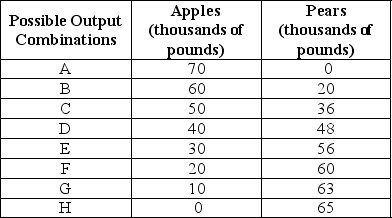 -Refer to Table 2-4.The Fruit Farm produces only apples and pears.The table above shows the maximum possible output combinations of the two fruits using all resources and currently available technology.
a.Graph the Fruit Farm's production possibilities frontier.Put apples on the horizontal axis and pears on the vertical axis.Be sure to identify the output combination points on your diagram.
b.Suppose the Fruit Farm is currently producing at point D.What is the opportunity cost of producing an additional 8,000 pounds of pears?
c.Suppose the Fruit Farm is currently producing at point D.What happens to the opportunity cost of producing more and more pears? Does it increase, decrease, or remain constant? Explain your answer.
d.Suppose the Fruit Farm is currently producing at point G.What happens to the opportunity cost of producing more and more apples? Does it increase, decrease, or remain constant? Explain your answer.
e.Suppose the Fruit Farm is plagued by the apple maggot infestation which destroys apple trees but not pear trees.Show in a graph what happens to its PPF.
-Refer to Table 2-4.The Fruit Farm produces only apples and pears.The table above shows the maximum possible output combinations of the two fruits using all resources and currently available technology.
a.Graph the Fruit Farm's production possibilities frontier.Put apples on the horizontal axis and pears on the vertical axis.Be sure to identify the output combination points on your diagram.
b.Suppose the Fruit Farm is currently producing at point D.What is the opportunity cost of producing an additional 8,000 pounds of pears?
c.Suppose the Fruit Farm is currently producing at point D.What happens to the opportunity cost of producing more and more pears? Does it increase, decrease, or remain constant? Explain your answer.
d.Suppose the Fruit Farm is currently producing at point G.What happens to the opportunity cost of producing more and more apples? Does it increase, decrease, or remain constant? Explain your answer.
e.Suppose the Fruit Farm is plagued by the apple maggot infestation which destroys apple trees but not pear trees.Show in a graph what happens to its PPF. (Essay)
4.9/5 (78)
(78) Table 2-7
 Table 2-7 shows the output per month of two people, Fred and Barney. They can either devote their time to making pogo sticks or making unicycles.
-Refer to Table 2-7.Which of the following statements is true?
Table 2-7 shows the output per month of two people, Fred and Barney. They can either devote their time to making pogo sticks or making unicycles.
-Refer to Table 2-7.Which of the following statements is true? (Multiple Choice)
4.9/5 (68)
(68) The points outside the production possibilities frontier are
(Multiple Choice)
4.9/5 (79)
(79) Figure 2-4
 Figure 2-4 shows various points on three different production possibilities frontiers for a nation.
-Refer to Figure 2-4.Consider the following events:
A.an increase in the patent protection period to 30 years
B.an increase of a nation's capital stock
C.an improved property rights system
Which of the events listed above could cause a movement from V to W?
Figure 2-4 shows various points on three different production possibilities frontiers for a nation.
-Refer to Figure 2-4.Consider the following events:
A.an increase in the patent protection period to 30 years
B.an increase of a nation's capital stock
C.an improved property rights system
Which of the events listed above could cause a movement from V to W? (Multiple Choice)
4.9/5 (66)
(66) Table 2-16
 -Refer to Table 2-12.This table shows the number of labor hours required to produce a digital camera and a bushel of wheat in China and South Korea.
a.Assume each country has a total of 9,000 labor hours to devote to the production of the two goods and draw the production possibilities frontier for each country.Put "Digital Camera" on the horizontal axis and "Wheat" on the vertical axis.Be sure to identify the intercept values on your graphs.
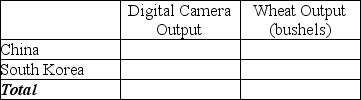
b.Suppose each country allocates 60% of its labor hours to wheat production and 40% to the production of digital cameras.Complete Table 2-13 below to show each country's output of the two products.
Table 2-13: Production and Consumption with no Trade
 c.If the two countries do not trade and consume whatever they produce, identify the current production and consumption point for each country on their respective production possibilities frontiers.Label China's consumption point "C" and South Korea's consumption point "K."
d.Suppose the two countries specialize and trade.Which country should produce digital cameras and which should produce wheat? Explain your answer.
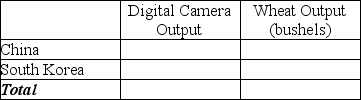
e.Complete Table 2-14 below to show each country's output with specialization.
Table 2-14: Output with Specialization
 f.Did specialization increase the combined output for the two countries without any increase in resources? If so, by how much?
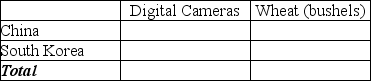
g.Suppose China and South Korea agree to trade so that in exchange for 1,200 bushels of wheat, the exporter of wheat receives 48 digital cameras.Complete Table 2-15 below to show each country's consumption bundle after trade.
Table 2-15: Consumption with Trade
 h.Show the consumption points after trade on each country's production possibilities frontier.Label these points "B" for China and "J" for South Korea.
i.Has trade made the two countries better off? Explain your answer.
-Refer to Table 2-12.This table shows the number of labor hours required to produce a digital camera and a bushel of wheat in China and South Korea.
a.Assume each country has a total of 9,000 labor hours to devote to the production of the two goods and draw the production possibilities frontier for each country.Put "Digital Camera" on the horizontal axis and "Wheat" on the vertical axis.Be sure to identify the intercept values on your graphs.
b.Suppose each country allocates 60% of its labor hours to wheat production and 40% to the production of digital cameras.Complete Table 2-13 below to show each country's output of the two products.
Table 2-13: Production and Consumption with no Trade
c.If the two countries do not trade and consume whatever they produce, identify the current production and consumption point for each country on their respective production possibilities frontiers.Label China's consumption point "C" and South Korea's consumption point "K."
d.Suppose the two countries specialize and trade.Which country should produce digital cameras and which should produce wheat? Explain your answer.
e.Complete Table 2-14 below to show each country's output with specialization.
Table 2-14: Output with Specialization
f.Did specialization increase the combined output for the two countries without any increase in resources? If so, by how much?
g.Suppose China and South Korea agree to trade so that in exchange for 1,200 bushels of wheat, the exporter of wheat receives 48 digital cameras.Complete Table 2-15 below to show each country's consumption bundle after trade.
Table 2-15: Consumption with Trade
h.Show the consumption points after trade on each country's production possibilities frontier.Label these points "B" for China and "J" for South Korea.
i.Has trade made the two countries better off? Explain your answer. (Essay)
4.9/5 (80)
(80) Table 2-7
Table 2-7 shows the output per month of two people, Fred and Barney. They can either devote their time to making pogo sticks or making unicycles.
-Refer to Table 2-7.What is Barney's opportunity cost of making a unicycle?
Table 2-7 shows the output per month of two people, Fred and Barney. They can either devote their time to making pogo sticks or making unicycles.
-Refer to Table 2-7.What is Barney's opportunity cost of making a unicycle? (Multiple Choice)
4.9/5 (88)
(88) Table 2-8
 Table 2-8 shows the number of labor hours required to produce a digital camera and a pound of wheat in China and South Korea.
-Refer to Table 2-8.If the two countries specialize and trade, who should export digital cameras?
Table 2-8 shows the number of labor hours required to produce a digital camera and a pound of wheat in China and South Korea.
-Refer to Table 2-8.If the two countries specialize and trade, who should export digital cameras? (Multiple Choice)
4.9/5 (80)
(80) Suppose your expenses for this term are as follows: tuition: $28,000, room and board: $9,000, books and other educational supplies: $2,500.Further, during the term, you can only work part-time and earn $16,000 instead of your full-time salary of $42,000.What is the opportunity cost of going to college this term, assuming that your room and board expenses would be the same even if you did not go to college?
(Multiple Choice)
5.0/5 (76)
(76) According to the production possibilities model, if more resources are allocated to the production of physical and human capital, then which of the following is likely to happen?
(Multiple Choice)
4.7/5 (80)
(80) Table 2-9
 Table 2-9 shows the number of labor hours required to produce a canoe and a sailboat in Guatemala and Honduras.
-Refer to Table 2-9.What is Guatemala's opportunity cost of producing one sailboat?
Table 2-9 shows the number of labor hours required to produce a canoe and a sailboat in Guatemala and Honduras.
-Refer to Table 2-9.What is Guatemala's opportunity cost of producing one sailboat? (Multiple Choice)
4.7/5 (70)
(70) Table 2-16
-Refer to Table 2-16.This table shows the number of labor hours required to produce a motorcycle and a guitar in Ireland and Scotland.
a.Which country has an absolute advantage in the production of motorcycles?
b.Which country has an absolute advantage in the production of guitars?
c.What is Ireland's opportunity cost of producing one motorcycle?
d.What is Scotland's opportunity cost of producing one motorcycle?
e.What is Ireland's opportunity cost of producing one guitar?
f.What is Scotland's opportunity cost of producing one guitar?
g.If each country specializes in the production of the product in which it has a comparative advantage, which country should produce motorcycles?
h.If each country specializes in the production of the product in which it has a comparative advantage, which country should produce guitars?
-Refer to Table 2-16.This table shows the number of labor hours required to produce a motorcycle and a guitar in Ireland and Scotland.
a.Which country has an absolute advantage in the production of motorcycles?
b.Which country has an absolute advantage in the production of guitars?
c.What is Ireland's opportunity cost of producing one motorcycle?
d.What is Scotland's opportunity cost of producing one motorcycle?
e.What is Ireland's opportunity cost of producing one guitar?
f.What is Scotland's opportunity cost of producing one guitar?
g.If each country specializes in the production of the product in which it has a comparative advantage, which country should produce motorcycles?
h.If each country specializes in the production of the product in which it has a comparative advantage, which country should produce guitars? (Essay)
4.9/5 (83)
(83) In a two-good, two country world, if one country has an absolute advantage in the production of both goods, it cannot benefit by trading with the other country.
(True/False)
4.9/5 (85)
(85) Figure 2-7
 Tesla opened its Gigafactory near Sparks, Nevada to produce lithium-ion batteries for both its automobiles and its Powerwall energy storage products. Figure 2-7 shows changes to its production possibilities frontier at the Gigafactory in response to new developments and different strategic production decisions.
-Refer to Figure 2-7.Assume that in 2024, Tesla temporarily shuts down part of the Gigafactory for an extensive renovation, and this reduces the amount of production capacity available for both types of batteries.This is best represented by the
Tesla opened its Gigafactory near Sparks, Nevada to produce lithium-ion batteries for both its automobiles and its Powerwall energy storage products. Figure 2-7 shows changes to its production possibilities frontier at the Gigafactory in response to new developments and different strategic production decisions.
-Refer to Figure 2-7.Assume that in 2024, Tesla temporarily shuts down part of the Gigafactory for an extensive renovation, and this reduces the amount of production capacity available for both types of batteries.This is best represented by the (Multiple Choice)
4.9/5 (77)
(77) For a person to have a comparative advantage in producing a product, she must be able to produce that product at a lower opportunity cost than her competitors.
(True/False)
4.9/5 (82)
(82) Figure 2-9
 Figure 2-9 shows the production possibilities frontiers for Pakistan and Indonesia. Each country produces two goods, cotton and cashews.
-Refer to Figure 2-9.Which country has a comparative advantage in the production of cashews?
Figure 2-9 shows the production possibilities frontiers for Pakistan and Indonesia. Each country produces two goods, cotton and cashews.
-Refer to Figure 2-9.Which country has a comparative advantage in the production of cashews? (Multiple Choice)
4.8/5 (79)
(79) Figure 2-5
 -Refer to Figure 2-5.If the economy is currently producing at point X, what is the gain in production if the economy moves to point Y?
 (Multiple Choice)
4.8/5 (95)
(95) Table 2-9
Table 2-9 shows the number of labor hours required to produce a canoe and a sailboat in Guatemala and Honduras.
-Refer to Table 2-9.Honduras has a comparative advantage in the production of
Table 2-9 shows the number of labor hours required to produce a canoe and a sailboat in Guatemala and Honduras.
-Refer to Table 2-9.Honduras has a comparative advantage in the production of (Multiple Choice)
4.9/5 (97)
(97) All of the following are critical functions of the government in facilitating the operation of a market economy except
(Multiple Choice)
4.8/5 (71)
(71) 
Filters
- Essay(0)
- Multiple Choice(0)
- Short Answer(0)
- True False(0)
- Matching(0)