



 Chat with AI
Exam 9: Aggregate Expenditure and Output in the Short Run

Exam 1: Economics: Foundations and Models160 Questions
Exam 2: Choices and Trade Offs in the Market192 Questions
Exam 3: Where Prices Come From: the Interaction of Demand and Supply201 Questions
Exam 4: Gdp: Measuring Total Production, Income and Economic Growth123 Questions
Exam 5: Economic Growth, the Financial System and Business Cycles132 Questions
Exam 6: Long-Run Economic Growth: Sources and Policies118 Questions
Exam 7: Unemployment120 Questions
Exam 8: Inflation110 Questions
Exam 9: Aggregate Expenditure and Output in the Short Run138 Questions
Exam 10: Aggregate Demand and Aggregate Supply Analysis134 Questions
Exam 11: Money, Banks and the Reserve Bank of Australia123 Questions
Exam 12: Monetary Policy116 Questions
Exam 13: Fiscal Policy163 Questions
Exam 14: Macroeconomics in an Open Economy141 Questions
Exam 15: The International Financial System145 Questions
Select questions type


Refer to Figure 9.4 for the following question.
Figure 9.4
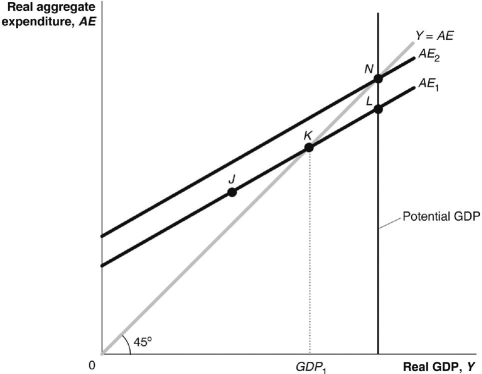 -In Figure 9.4, assume that potential GDP equals $100 billion. The economy is currently producing GDP₁ which is equal to $90 billion. If the MPC is 0.8, then how much must spending change for the economy to move to potential GDP?
 (Multiple Choice)
4.7/5  (81)
(81) Using the following table, compute aggregate expenditure and identify the macroeconomic equilibrium. The numbers in the table are in billions of dollars.
 _____________________________________________________________________________________________
_____________________________________________________________________________________________
_____________________________________________________________________________________________ (Essay)
4.8/5 (70)
(70) Why do economists care about aggregate expenditure?
_____________________________________________________________________________________________
_____________________________________________________________________________________________
(Essay)
4.8/5 (81)
(81) The larger the marginal propensity to save, the smaller the multiplier is.
(True/False)
4.7/5 (72)
(72) Given the following table, fill in the values of the marginal propensity to save (MPS)and the marginal propensity to consume (MPC). Show that the MPC + MPS = 1. The numbers in the table are in billions of dollars.
 _____________________________________________________________________________________________
_____________________________________________________________________________________________
_____________________________________________________________________________________________ (Essay)
4.8/5 (88)
(88) If aggregate expenditure is less than GDP, how will the economy reach macroeconomic equilibrium?
(Multiple Choice)
4.8/5 (79)
(79) If inflation in Australia is lower than inflation in other countries, what will be the effect on net exports for Australia, ceteris paribus?
(Multiple Choice)
4.8/5 (95)
(95) Which is the largest component of aggregate expenditure in Australia?
(Multiple Choice)
4.8/5 (88)
(88) A decrease in the price level ________ real wealth, which causes consumption to ________.
(Multiple Choice)
4.9/5 (80)
(80) On the 45° line diagram, the 45° line shows points such that:
(Multiple Choice)
4.8/5 (77)
(77) Improvements in inventory control help to reduce fluctuations in real GDP.
(True/False)
4.9/5 (94)
(94) What is the difference between 'aggregate expenditure' and 'aggregate demand'?
_____________________________________________________________________________________________
_____________________________________________________________________________________________
(Essay)
4.7/5 (71)
(71) Refer to Figure 9.3 for the following questions.
Figure 9.3
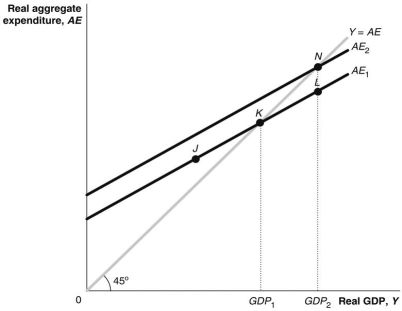 -Suppose that in Figure 9.3, government spending increases, shifting up the aggregate expenditure line. GDP increases from GDP₁ to GDP₂, and this amount is $400 billion. If the MPC is 0.75, then what is the distance between N and L or by how much did government spending change?
 (Multiple Choice)
4.8/5 (86)
(86) The resulting economic contractions and recessions in many countries during 2008 and 2009 following the global financial crisis affected the sales of personal computer manufacturers such as Dell, whose fiscal first-quarter profit fell 63% in 2009. Decreases in consumer purchases of computers would be counted as a decline in ________, and decreases in business purchases of computers would be counted as a decline in ________.
(Multiple Choice)
4.9/5 (84)
(84) Which of the following is not a component of aggregate expenditure?
(Multiple Choice)
4.8/5 (75)
(75) For all points above the 45° line, planned aggregate expenditure will be less than real GDP.
(True/False)
4.9/5 (92)
(92) What is the macroeconomic consequence if firms accumulate large amounts of unplanned inventory at the beginning of a recession?
_____________________________________________________________________________________________
_____________________________________________________________________________________________
(Essay)
4.8/5 (69)
(69) 
Filters
- Essay(0)
- Multiple Choice(0)
- Short Answer(0)
- True False(0)
- Matching(0)