



 Chat with AI
Exam 9: Aggregate Expenditure and Output in the Short Run

Exam 1: Economics: Foundations and Models160 Questions
Exam 2: Choices and Trade Offs in the Market192 Questions
Exam 3: Where Prices Come From: the Interaction of Demand and Supply201 Questions
Exam 4: Gdp: Measuring Total Production, Income and Economic Growth123 Questions
Exam 5: Economic Growth, the Financial System and Business Cycles132 Questions
Exam 6: Long-Run Economic Growth: Sources and Policies118 Questions
Exam 7: Unemployment120 Questions
Exam 8: Inflation110 Questions
Exam 9: Aggregate Expenditure and Output in the Short Run138 Questions
Exam 10: Aggregate Demand and Aggregate Supply Analysis134 Questions
Exam 11: Money, Banks and the Reserve Bank of Australia123 Questions
Exam 12: Monetary Policy116 Questions
Exam 13: Fiscal Policy163 Questions
Exam 14: Macroeconomics in an Open Economy141 Questions
Exam 15: The International Financial System145 Questions
Select questions type


Refer to Figure 9.1 for the following questions.
Figure 9.1
 -In Figure 9.1, if the economy is at point L, what will happen?
 (Multiple Choice)
4.8/5  (76)
(76) The slope of the consumption function is equal to the change in:
(Multiple Choice)
4.8/5 (70)
(70) A rising price level decreases consumption by decreasing the real value of household wealth.
(True/False)
4.8/5 (82)
(82) Refer to Figure 9.3 for the following questions.
Figure 9.3
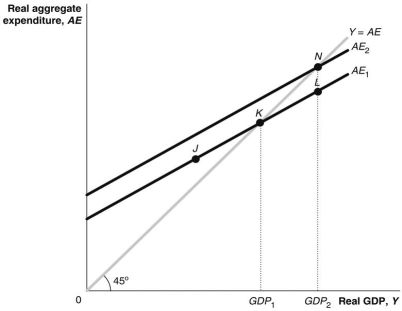 -Suppose that in Figure 9.3, investment spending increases by $10 million, shifting up the aggregate expenditure line and GDP increases from GDP₁ to GDP₂. If the MPC is 0.9, then what is the change in GDP?
 (Multiple Choice)
4.8/5 (91)
(91) Refer to Figure 9.1 for the following questions.
Figure 9.1
-In Figure 9.1, if the economy is at point J, what will happen?
-In Figure 9.1, if the economy is at point J, what will happen? (Multiple Choice)
4.9/5 (89)
(89) Refer to Figure 9.1 for the following questions.
Figure 9.1
-In Figure 9.1, if the economy is in equilibrium, it is at a level of aggregate expenditure given by point:
-In Figure 9.1, if the economy is in equilibrium, it is at a level of aggregate expenditure given by point: (Multiple Choice)
4.8/5 (89)
(89) Which is the smallest component of 'aggregate expenditure' in Australia?
(Multiple Choice)
4.9/5 (65)
(65) Which of the following is a true statement about the 'multiplier'?
(Multiple Choice)
4.9/5 (91)
(91) If national income increases by $80 million and consumption increases by $20 million, the marginal propensity to consume is:
(Multiple Choice)
4.8/5 (70)
(70) Using the following table, compute aggregate expenditure and identify the macroeconomic equilibrium. The numbers in the table are in billions of dollars.
 _____________________________________________________________________________________________
_____________________________________________________________________________________________
_____________________________________________________________________________________________ (Essay)
4.9/5 (72)
(72) During a(n)________ many firms experience reduced profits, which reduces ________ and investment spending.
(Multiple Choice)
5.0/5 (82)
(82) If an increase in autonomous consumption spending of $15 million results in a $60 million increase in equilibrium real GDP, then the MPC is:
(Multiple Choice)
4.7/5 (72)
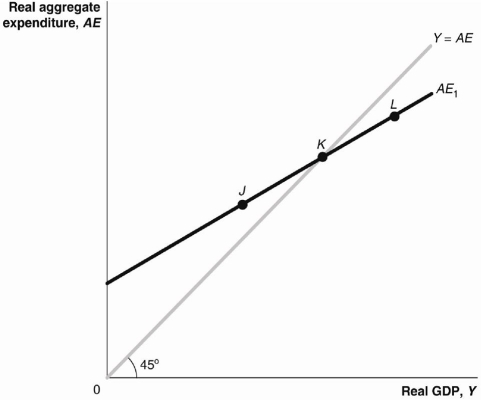
(72) At each of the three points in the following graph, indicate whether planned aggregate expenditure is greater than, equal to, or less than GDP.
 _____________________________________________________________________________________________
_____________________________________________________________________________________________
_____________________________________________________________________________________________ (Essay)
4.8/5 (98)
(98) If the marginal propensity to consume is 0.80, the marginal propensity to save is:
(Multiple Choice)
5.0/5 (90)
(90) What is the main reason for changes in GDP in the short run?
_____________________________________________________________________________________________
_____________________________________________________________________________________________
(Essay)
4.7/5 (73)
(73) If the multiplier is 10, the marginal propensity to consume must be 0.1.
(True/False)
5.0/5 (77)
(77) Consumption spending will ________ when disposable income ________ and increase when disposable income increases.
(Multiple Choice)
4.9/5 (77)
(77) Consumption is $6 million, planned investment spending is $7 million, government purchases are $10 million, and net exports are equal to $2 million. If GDP during that same time period is equal to $24 million, what unplanned changes in inventories occurred?
(Multiple Choice)
4.7/5 (65)
(65) 
Filters
- Essay(0)
- Multiple Choice(0)
- Short Answer(0)
- True False(0)
- Matching(0)