



 Chat with AI
Exam 5: Economic Growth, the Financial System and Business Cycles

Exam 1: Economics: Foundations and Models160 Questions
Exam 2: Choices and Trade Offs in the Market192 Questions
Exam 3: Where Prices Come From: the Interaction of Demand and Supply201 Questions
Exam 4: Gdp: Measuring Total Production, Income and Economic Growth123 Questions
Exam 5: Economic Growth, the Financial System and Business Cycles132 Questions
Exam 6: Long-Run Economic Growth: Sources and Policies118 Questions
Exam 7: Unemployment120 Questions
Exam 8: Inflation110 Questions
Exam 9: Aggregate Expenditure and Output in the Short Run138 Questions
Exam 10: Aggregate Demand and Aggregate Supply Analysis134 Questions
Exam 11: Money, Banks and the Reserve Bank of Australia123 Questions
Exam 12: Monetary Policy116 Questions
Exam 13: Fiscal Policy163 Questions
Exam 14: Macroeconomics in an Open Economy141 Questions
Exam 15: The International Financial System145 Questions
Select questions type


If you spend more of your income on consumption goods, which of the following will occur?
(Multiple Choice)
4.9/5  (93)
(93) The demand for loanable funds has a ________ slope because the lower the interest rate, the ________ number of investment projects are profitable, and the ________ the quantity of loanable funds demanded.
(Multiple Choice)
4.7/5 (86)
(86) The experience of recessions in Australia has shown that the unemployment rate:
(Multiple Choice)
4.8/5 (81)
(81) What is 'potential GDP'?
_____________________________________________________________________________________________
_____________________________________________________________________________________________
(Essay)
4.9/5 (78)
(78) Public saving is equal to taxation receipts, minus government purchases, minus transfer payments.
(True/False)
4.7/5 (66)
(66) The beginning of an economic contraction coincides with a/an ________ while during an economic expansion ________
(Multiple Choice)
4.9/5 (91)
(91) Explain and show graphically how a decrease in household saving affects the equilibrium interest rate and the equilibrium quantity of loanable funds.
_____________________________________________________________________________________________
_____________________________________________________________________________________________
(Essay)
4.8/5 (76)
(76) The rate of inflation does not necessarily increase during the expansion phase of the business cycle.
(True/False)
4.9/5 (82)
(82) If, between 2007 and 2017, the economy's real GDP grew from $20 billion to $40 billion, the average growth rate in the economy was
(Multiple Choice)
4.8/5 (81)
(81) Government budget surpluses and deficits affect the supply of loanable funds, and therefore affect interest rates.
(True/False)
4.8/5 (80)
(80) In the model of the market for loanable funds, which of the following will not shift the supply curve for loanable funds?
(Multiple Choice)
4.8/5 (72)
(72) Explain why the increase in GDP per capita understates the whole effect of economic growth on the standard of living.
_____________________________________________________________________________________________
_____________________________________________________________________________________________
(Essay)
4.8/5 (78)
(78) A financial intermediary's main function is to match ________ with excess funds to ________ who want to borrow funds.
(Multiple Choice)
4.7/5 (79)
(79) Refer to Figure 5.1 for the following questions.
Figure 5.1
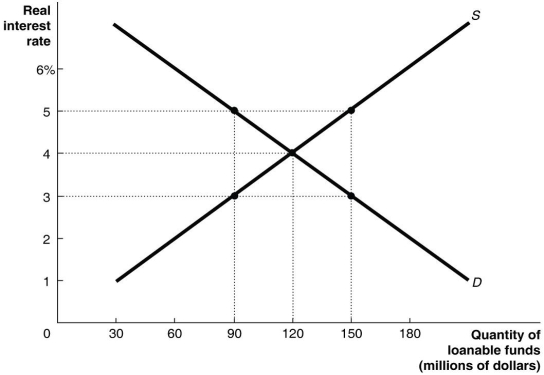 -Refer to Figure 5.1. As a result of an increase in the government budget deficit, the ________ for loanable funds will ________, thereby ________ the equilibrium real interest rate and ________ the equilibrium quantity of loanable funds.
 (Multiple Choice)
4.9/5 (69)
(69) Retained earnings are usually sufficient to finance a firm's rapid expansion in a high growth economy.
(True/False)
4.8/5 (81)
(81) During an expansion, how do inflation and unemployment typically change?
(Multiple Choice)
5.0/5 (87)
(87) When production in an economy grows more quickly than the population in that economy, which of the following must be occurring?
(Multiple Choice)
4.9/5 (81)
(81) Which of the following is a true statement about the length of recessions and expansions in the Australian economy?
(Multiple Choice)
4.8/5 (79)
(79) 
Filters
- Essay(0)
- Multiple Choice(0)
- Short Answer(0)
- True False(0)
- Matching(0)