



 Chat with AI
Exam 14: Raising Equity Capital

Exam 1: Corporate Finance and the Financial Manager91 Questions
Exam 2: Introduction to Financial Statement Analysis122 Questions
Exam 3: The Valuation Principle: the Foundation of Financial Decision Making120 Questions
Exam 4: The Time Value of Money101 Questions
Exam 5: Interest Rates118 Questions
Exam 6: Bonds122 Questions
Exam 7: Valuing Stocks122 Questions
Exam 8: Investment Decision Rules137 Questions
Exam 9: Fundamentals of Capital Budgeting107 Questions
Exam 10: Risk and Return in Capital Markets101 Questions
Exam 11: Systematic Risk and the Equity Risk Premium102 Questions
Exam 12: Determining the Cost of Capital106 Questions
Exam 13: Risk and the Pricing of Options112 Questions
Exam 14: Raising Equity Capital104 Questions
Exam 15: Debt Financing109 Questions
Exam 16: Capital Structure113 Questions
Exam 17: Payout Policy101 Questions
Exam 18: Financial Modelling and Pro Forma Analysis124 Questions
Exam 19: Working Capital Management122 Questions
Exam 20: Short Term Financial Planning105 Questions
Exam 21: Risk Management108 Questions
Exam 22: International Corporate Finance108 Questions
Exam 23: Leasing86 Questions
Exam 24: Mergers and Acquisitions81 Questions
Exam 25: Corporate Governance52 Questions
Select questions type


Melissa founded her company using $100,000 of her own money,issuing herself 50,000 shares of stock.An angel investor bought an additional 30,000 shares for $75,000.She now sells another 30,000 shares to a venture capitalist for $450,000.What is the post-money valuation for the company?
(Multiple Choice)
4.9/5  (83)
(83) Use the table for the question(s) below.
The founders and owners of a private company have funded it through the following rounds of investment:
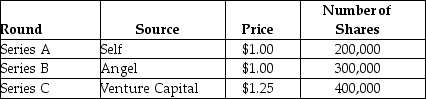 The owners decide to take the company public through an IPO, issuing 1 million new shares. Assuming that they successfully complete the IPO, the net income for the next year is estimated to be $5 million. The price of shares is set using average price-earnings ratios for similar businesses of 17.0.
-What will be closest to the IPO price per share?
The owners decide to take the company public through an IPO, issuing 1 million new shares. Assuming that they successfully complete the IPO, the net income for the next year is estimated to be $5 million. The price of shares is set using average price-earnings ratios for similar businesses of 17.0.
-What will be closest to the IPO price per share? (Multiple Choice)
4.9/5 (71)
(71) Saskatoon Smelting sells 25 million shares of stock in an SEO,with 20 million being primary shares issued by the company and 5 million being secondary shares sold by investors in the company.At the time of the sale,the firm's stock was selling at $4.75 per share.If the underwriter charges 7% of the gross proceeds as a fee,how much money was raised in the sale?
(Multiple Choice)
5.0/5 (75)
(75) Use the information for the question(s) below.
You founded your own firm three years ago. You initially contributed $200,000 of your own money and in return you received 2 million shares of stock. Since then, you have sold an additional 1 million shares of stock to angel investors. You are now considering raising capital from a venture capital firm. This venture capital firm would invest $5 million and would receive 2 million newly issued shares in return.
-Suppose you had sold the 1 million shares to the angel investor for $500,000.What would have been the post-money valuation of your shares immediately following the angel investor's investment?
(Multiple Choice)
4.8/5 (68)
(68) Chambers Industries has a market capitalization of $800 million and 250 million shares outstanding.The management of this firm plans to raise further capital through a rights issue.Which of the following rights schemes will raise the most money,if all shareholders exercise their rights?
(Multiple Choice)
4.9/5 (85)
(85) Use the information for the question(s) below.
You founded your own firm three years ago. You initially contributed $200,000 of your own money and in return you received 2 million shares of stock. Since then, you have sold an additional 1 million shares of stock to angel investors. You are now considering raising capital from a venture capital firm. This venture capital firm would invest $5 million and would receive 2 million newly issued shares in return.
-The post-money valuation of your firm is closest to:
(Multiple Choice)
4.9/5 (78)
(78) The offer price of shares in an IPO is generally less than the price those shares sell for at the end of the first trading day.Which of the following parties suffer most from this situation?
(Multiple Choice)
4.9/5 (94)
(94) Use the table for the question(s) below.
The founder of a company issues 100,000 shares of series A stock for his own $250,000 investment. He then goes through three further rounds of investment, as shown below:
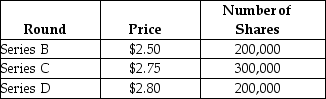 -Which of the following is closest to the percentage of the company owned by the founder of the company?
 (Multiple Choice)
4.9/5 (73)
(73) An IPO in which the underwriter purchases the entire issue at a discount and then resells it at the offer price is
(Multiple Choice)
4.9/5 (69)
(69) Underpricing of an IPO would most likely be greatest in which of the following markets?
(Multiple Choice)
4.8/5 (89)
(89) Use the table for the question(s) below.
David founds a company and goes through the investment rounds shown below:
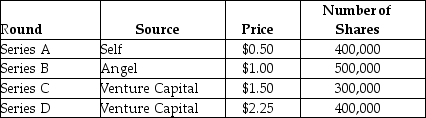 He decides to take the company public through an IPO, issuing 2 million new shares. Assuming that he successfully completes the IPO, the net income for the next year is estimated to be $8 million. His banker informs him that the price of shares should be set using average price-earnings ratios for similar businesses, which is 15.0.
-What share of the company will David own after the IPO?
He decides to take the company public through an IPO, issuing 2 million new shares. Assuming that he successfully completes the IPO, the net income for the next year is estimated to be $8 million. His banker informs him that the price of shares should be set using average price-earnings ratios for similar businesses, which is 15.0.
-What share of the company will David own after the IPO? (Multiple Choice)
4.7/5 (69)
(69) Luther Industries currently has 100 million shares of stock outstanding at a price of $25 per share.The company would like to raise money and has announced a rights issue.Every existing shareholder will be sent one right per share of stock that he or she owns.The company plans to require twenty rights to purchase one share at a price of $20 per share.The amount of money that Luther will raise through its rights offering is closest to?
(Multiple Choice)
4.8/5 (74)
(74)  Bejeweled,a chain of crafting shops,is selling 500,000 shares of stock in an auction IPO.At the end of the bidding period they have received the bids shown above.Which of the following is closest to the price at which the shares will be offered?
 (Multiple Choice)
4.8/5 (88)
(88) Melanie founded her company using $250,000 of her own money,issuing herself 100,000 shares of stock.An angel investor bought an additional 50,000 shares for $350,000.She now sells another 75,000 shares to a venture capitalist for $600,000.What is the post-money valuation for the company?
(Multiple Choice)
5.0/5 (80)
(80) Equity investors in a private company usually plan to realize a return on their investment by selling their stock when that company is acquired by another firm or sold to the public in a public offering.
(True/False)
4.8/5 (94)
(94) In a best-efforts IPO,the underwriter guarantees that all stock will be sold.
(True/False)
4.8/5 (69)
(69) Use the information for the question(s) below.
Luther Industries is in the process of selling shares of stock in an auction IPO. At the end of the bidding period, Luther's investment bank has received the following bids:
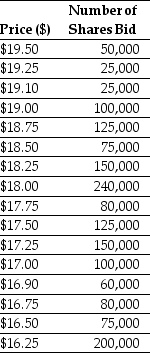 -What will the offer price of these shares be if Luther is selling 1 million shares?
 (Multiple Choice)
4.7/5 (89)
(89) Use the table for the question(s) below.
The founder of a company issues 100,000 shares of series A stock for his own $250,000 investment. He then goes through three further rounds of investment, as shown below:
-Which of the following statements regarding stock issues is most accurate?
-Which of the following statements regarding stock issues is most accurate? (Multiple Choice)
4.8/5 (77)
(77) 
Filters
- Essay(0)
- Multiple Choice(0)
- Short Answer(0)
- True False(0)
- Matching(0)