



 Chat with AI
Exam 14: Raising Equity Capital

Exam 1: Corporate Finance and the Financial Manager91 Questions
Exam 2: Introduction to Financial Statement Analysis122 Questions
Exam 3: The Valuation Principle: the Foundation of Financial Decision Making120 Questions
Exam 4: The Time Value of Money101 Questions
Exam 5: Interest Rates118 Questions
Exam 6: Bonds122 Questions
Exam 7: Valuing Stocks122 Questions
Exam 8: Investment Decision Rules137 Questions
Exam 9: Fundamentals of Capital Budgeting107 Questions
Exam 10: Risk and Return in Capital Markets101 Questions
Exam 11: Systematic Risk and the Equity Risk Premium102 Questions
Exam 12: Determining the Cost of Capital106 Questions
Exam 13: Risk and the Pricing of Options112 Questions
Exam 14: Raising Equity Capital104 Questions
Exam 15: Debt Financing109 Questions
Exam 16: Capital Structure113 Questions
Exam 17: Payout Policy101 Questions
Exam 18: Financial Modelling and Pro Forma Analysis124 Questions
Exam 19: Working Capital Management122 Questions
Exam 20: Short Term Financial Planning105 Questions
Exam 21: Risk Management108 Questions
Exam 22: International Corporate Finance108 Questions
Exam 23: Leasing86 Questions
Exam 24: Mergers and Acquisitions81 Questions
Exam 25: Corporate Governance52 Questions
Select questions type


Which of the following is a reason why an investor would choose to invest in new and growing firms as a limited partner in a venture capital firm rather than making those investments directly by themselves?
(Multiple Choice)
4.9/5  (91)
(91) What is the difference between preferred stocks issued by a private company and a mature company?
(Essay)
4.8/5 (81)
(81) Which of the following best describes a limited partnership that specializes in raising money to invest in the private equity of young firms?
(Multiple Choice)
4.8/5 (67)
(67) Use the table for the question(s) below.
The founders and owners of a private company have funded it through the following rounds of investment:
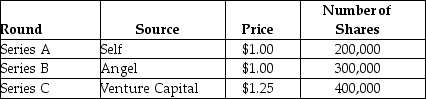 The owners decide to take the company public through an IPO, issuing 1 million new shares. Assuming that they successfully complete the IPO, the net income for the next year is estimated to be $5 million. The price of shares is set using average price-earnings ratios for similar businesses of 17.0.
-What portion of the company will be owned by the angel investor after the IPO?
The owners decide to take the company public through an IPO, issuing 1 million new shares. Assuming that they successfully complete the IPO, the net income for the next year is estimated to be $5 million. The price of shares is set using average price-earnings ratios for similar businesses of 17.0.
-What portion of the company will be owned by the angel investor after the IPO? (Multiple Choice)
4.8/5 (83)
(83) How does the total cost of issuing stock for the first time compare to the costs of other securities?
(Multiple Choice)
4.9/5 (93)
(93) Use the information for the question(s) below.
You founded your own firm three years ago. You initially contributed $200,000 of your own money and in return you received 2 million shares of stock. Since then, you have sold an additional 1 million shares of stock to angel investors. You are now considering raising capital from a venture capital firm. This venture capital firm would invest $5 million and would receive 2 million newly issued shares in return.
-After the venture capitalist's investment,the post-money valuation of the angel investor's shares are closest to:
(Multiple Choice)
4.9/5 (78)
(78)  Felicity Industries is selling 2 million shares of stock in an auction IPO.At the end of the bidding period they have received the bids shown above.Which of the following is closest to the price at which the shares will be offered?
 (Multiple Choice)
4.8/5 (86)
(86) A situation in which the underwriter does not guarantee the stock will be sold,but instead tries to sell the stock for the best possible price is
(Multiple Choice)
4.8/5 (80)
(80) A large publishing firm specializing in college textbooks wishes to expand into online delivery of its materials.In order to facilitate this,it invests in a number of small start-up companies that deliver college courses online and uses these companies to start diversifying the delivery of its content.Which of the following best describes the role of the publishing firm as described above?
(Multiple Choice)
4.9/5 (74)
(74) Which of the following statements regarding selling shares to the public is most accurate?
(Multiple Choice)
4.9/5 (64)
(64) Which of the following is a reason why an IPO is attractive to the managers of a private company?
(Multiple Choice)
4.7/5 (81)
(81) Melissa founded her company using $100,000 of her own money,issuing herself 50,000 shares of stock.An angel investor bought an additional 30,000 shares for $75,000.She now sells another 30,000 shares to a venture capitalist for $450,000.What percentage of the firm does Melissa now own?
(Multiple Choice)
4.8/5 (83)
(83) Which of the following statements regarding SEOs is most accurate?
(Multiple Choice)
4.7/5 (70)
(70) A cash offer differs from a rights offer in that in the latter shares are offered to both existing shareholders and investors at large.
(True/False)
4.9/5 (76)
(76) Use the table for the question(s) below.
Jeremy founded a company. He issues 200,000 shares of series A stock for his own $100,000 investment. He then goes through three further rounds of investment, as shown below:
 -What is the post-money valuation for the series D funding round?
 (Multiple Choice)
4.9/5 (95)
(95) An IPO is offered at $17 per share for 3 million shares.The IPO underwriters had a spread of 7%.What price did the underwriters pay per share of the IPO firm?
(Multiple Choice)
4.8/5 (71)
(71) Which of the following statements concerning the volume and number of IPOs issued over time is most accurate?
(Multiple Choice)
4.8/5 (73)
(73) Which of the following is an advantage of a cash offer over a rights offer?
(Multiple Choice)
4.9/5 (76)
(76) 
Filters
- Essay(0)
- Multiple Choice(0)
- Short Answer(0)
- True False(0)
- Matching(0)